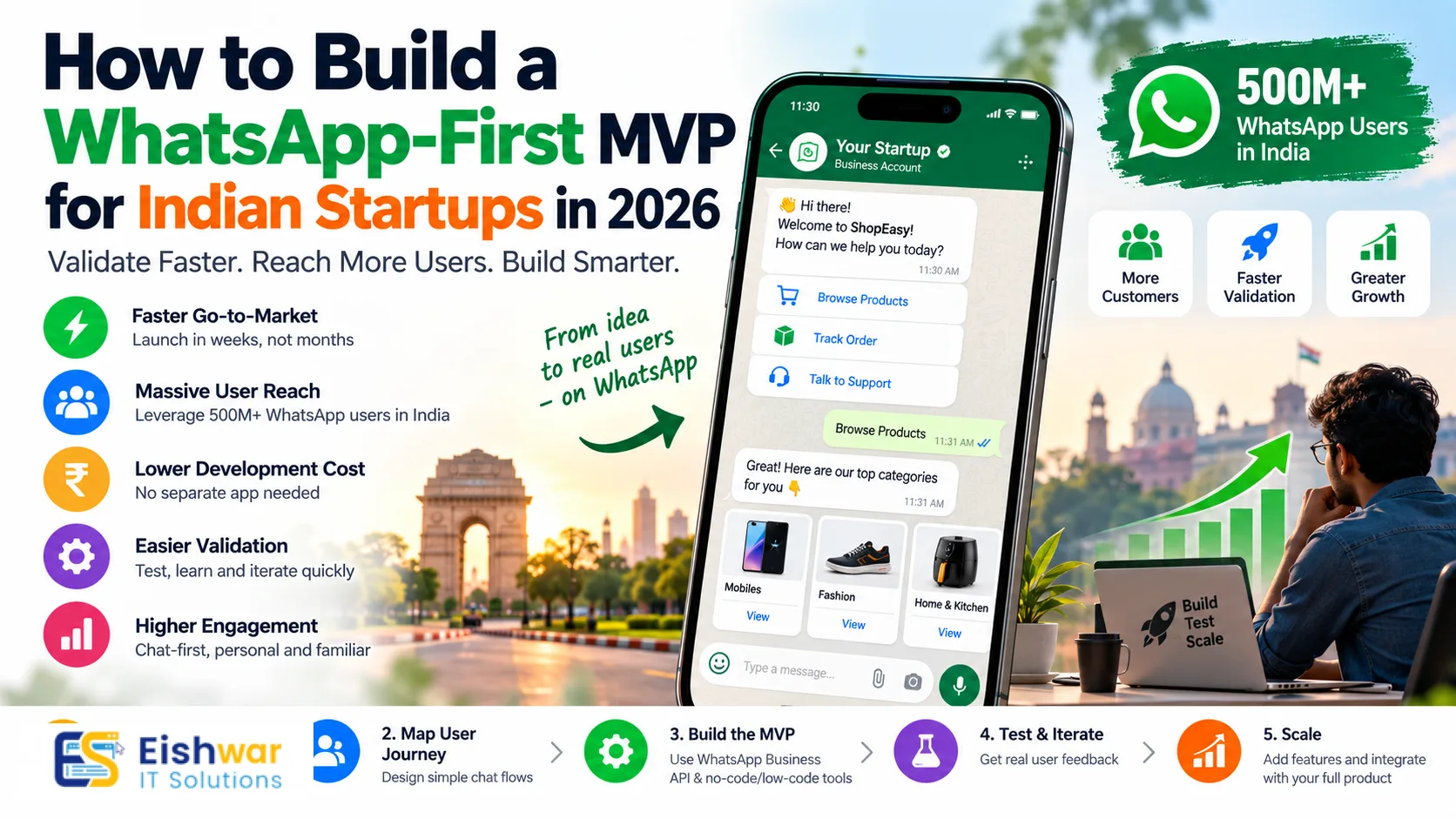
How to Build a WhatsApp-First MVP for Indian Startups in 2026
Introduction
In India, WhatsApp isn’t just a messaging app—it’s a way of life. With over 500 million users, it’s the go-to platform for everything from family chats to business transactions. For startups, this presents a massive opportunity: building a WhatsApp-first MVP. Instead of forcing users to download yet another app, you can meet them where they already are. In this guide, we’ll walk you through how to build a WhatsApp-first MVP for your Indian startup in 2026, from strategy to execution.
By 2026, the ecosystem has matured. WhatsApp Business API is more accessible, UPI payments are seamless, and users are comfortable with conversational commerce. According to Bain & Company, over 60% of Indian consumers have used messaging apps to make a purchase or booking. For startups, this means lower acquisition costs and faster time to market. Let’s dive in.
Why WhatsApp-First MVP Makes Sense for Indian Startups
Indian users are increasingly comfortable with conversational commerce. They order groceries, book appointments, and even apply for loans via WhatsApp. A WhatsApp-first MVP leverages this behavior, offering a seamless, low-friction experience. Here’s why it’s a smart move:
- Unmatched User Base: WhatsApp has deep penetration across urban and rural India. Your users are already there. For example, a startup in Jaipur can reach customers in Tier 3 cities without building an app.
- Low Friction: No app downloads, no updates. Just a chat. This reduces acquisition costs significantly. Click-to-chat ads cost ₹5-10 per conversation vs. ₹30-50 per app install.
- Cost-Effective: Building on WhatsApp Business API is faster and cheaper than native apps. A basic MVP costs ₹1-2 lakhs in 4-6 weeks, compared to ₹5-10 lakhs for a native app.
- High Engagement: WhatsApp messages have a 98% open rate, and 60% are read within 5 minutes. Your promotions and updates are almost guaranteed to be seen.
- Conversational Commerce: WhatsApp Pay and catalogs make transactions smooth. Users can browse, add to cart, and pay without leaving the chat.
In short, a WhatsApp-first MVP aligns perfectly with how Indian users communicate and transact. It’s a strategic move that can give your startup a competitive edge.
Key Components of a WhatsApp-First MVP
A WhatsApp-first MVP isn’t just a chatbot. It’s a complete system that integrates messaging with your backend. Here are the core components:
WhatsApp Business API (Cloud API)
The WhatsApp Business API allows you to send automated messages, use rich media, and handle high volumes. You can use Meta’s Cloud API or a Business Solution Provider (BSP) like Twilio, Gupshup, or Interakt. For Indian startups, Gupshup and Interakt offer local support and competitive pricing. Remember, outside the 24-hour window, you can only send pre-approved template messages for order updates and notifications.
Chatbot Framework and AI
You’ll need a chatbot framework to handle conversations. Options include Dialogflow, Rasa, or custom NLP. For a simple MVP, rule-based flows suffice, but AI enhances personalization. For example, an AI bot can understand “I need milk and eggs” and add items to cart. Tools like Dialogflow ES are easy to set up; Rasa offers more customization. For Indian languages, consider AI models trained on Hindi or Tamil.
Backend Integrations
Your MVP must connect to your CRM, inventory, payment gateways, and analytics. Integrate UPI and payment gateways like Razorpay or PayU. Use webhooks to connect WhatsApp to your backend. Popular stacks include Node.js, Python, and serverless functions. For CRM, Zoho CRM and Salesforce have WhatsApp integrations. For inventory, Shopify and WooCommerce have plugins.
User Experience Design
Design conversations that are intuitive. Use buttons, lists, and quick replies. Keep the flow simple: onboarding, browsing, ordering, payment, and support. For example, a salon booking MVP might start with: “Hi! Welcome to Glamour Salon. [Book Appointment] [View Services] [Talk to Us].” Avoid open-ended questions. Always include a fallback option like “Type ‘menu’ to see options.”
Payment Gateway Integration
Enable payments within WhatsApp. WhatsApp Pay is rolling out, but you can also share payment links or use UPI deep links. For Indian users, UPI is preferred. Generate a UPI deep link (e.g., upi://pay?pa=merchant@upi&pn=Merchant&am=100) and send it as a message. Alternatively, use Razorpay or PayU payment links. Ensure PCI compliance and data security.
Analytics and Monitoring
Track user interactions, drop-offs, and conversion rates. Key metrics: conversations started, messages per conversation, response time, conversion rate, and CSAT. Use your BSP’s analytics dashboard or integrate with Mixpanel or Clevertap. Set up alerts for high drop-off points. A/B test message templates to optimize.
Step-by-Step Guide to Building Your WhatsApp-First MVP
Step 1: Validate Your Idea with a Simple Prototype
Start with a basic WhatsApp Business account (not API) to manually test your concept. Talk to potential users, simulate the flow, and gather feedback. For example, if you’re building a tiffin service, share your WhatsApp Business profile with 20-30 people and take orders manually. Note questions, drop-off points, and willingness to pay. This costs nothing and gives invaluable insights.
Step 2: Choose the Right API Provider
Compare BSPs based on pricing, features, and support. Twilio and Gupshup are popular in India. Consider your budget and scalability needs. Twilio has a pay-as-you-go model; Gupshup offers competitive Indian pricing. Evaluate setup fees, monthly platform fees, per-message costs, template approval, and API documentation. For an MVP, start with a BSP that offers a free tier or low entry cost.
Step 3: Design Conversation Flows
Map out every possible user journey. Use flowcharts to visualize. Keep it simple: greet, present options, guide to action. For a grocery MVP: Greeting → Categories → Select Items → Add to Cart → Review → Payment → Confirm. Handle edge cases: out-of-stock items, unexpected inputs. Provide clear error messages and options to go back. Write exact messages and button labels. Get feedback from non-technical users.
Step 4: Build Core MVP Features
Focus on one core use case (e.g., ordering groceries). Implement catalog, cart, checkout, and order tracking. Use webhooks to connect to your backend. Use WhatsApp’s product message or list message for catalog. Maintain cart state in your backend. Integrate payment gateway. Send automated order updates via template messages. Start minimal: browse, add to cart, pay, track. Don’t add loyalty points yet. Tech stack: Node.js, MongoDB, and a BSP like Gupshup.
Step 5: Test with Real Users
Run a beta with a small group. Monitor conversations, fix bugs, and refine the flow. Pay attention to language and tone. If users are in Tamil Nadu, use Tamil greetings. Gather feedback via a short survey. Use Chatwoot to route to human agents if needed. During beta, manually review every conversation for the first week. Identify failure points and fix them. Aim for 90% success rate in completing the core action before scaling.
Step 6: Launch and Iterate
Once validated, launch to a wider audience. Use WhatsApp’s click-to-chat ads and social media. Create a WhatsApp link (wa.me/yournumber) and share on Instagram, Facebook, and your website. Run click-to-WhatsApp ads. Offer a first-order discount. Monitor analytics daily. Track conversion rates, response times, and user feedback. Iterate quickly: change low-engagement messages, add requested features if aligned. Set up weekly reviews.
Expert Tips for a Successful WhatsApp-First MVP
- Focus on One Use Case: Solve one problem exceptionally well. A medicine delivery startup can dominate that niche before expanding.
- Use Rich Media: Images, videos, and PDFs make conversations engaging. Optimize images to under 100KB.
- Ensure Compliance: Follow WhatsApp’s Business Policy and get user opt-in. Use double opt-in. Comply with India’s DPDP Act 2023.
- Optimize for Low Bandwidth: Keep media sizes small. Use text-based menus. Test on 2G/3G.
- Integrate Indian Payments: Offer UPI, Paytm, and cards. Use Razorpay or PayU. Always show payment confirmation.
- Leverage Analytics: Track response time, completion rate, and CSAT. Analyze drop-off points weekly.
- Localize and Personalize: Use regional languages and the user’s name. Personalization increases engagement by 30%.
- Provide Human Fallback: Always give an option to talk to a human. Route complex queries to agents.
Common Mistakes to Avoid
- Overcomplicating the Bot: Too many options confuse users. Limit menus to 3-4 options per level.
- Ignoring Opt-In: Sending unsolicited messages can get you banned. Get explicit consent.
- No Human Fallback: Users get frustrated if they can’t resolve an issue. Route to a human after two failed attempts.
- Slow Response Time: Users expect instant replies. Aim for under 5 seconds for automated responses.
- Not Testing on Different Devices: Test on Android and iOS. Check button visibility and media loading.
- Neglecting Data Privacy: Comply with India’s data protection laws. Store user data securely.
- Using the Wrong API Provider: Choosing a BSP that doesn’t support your scale can be costly. Do your research.
- Not Using Template Messages Effectively: Use them for order confirmations and reminders. Personalize them.
Future Trends in WhatsApp-First MVPs
- AI-Powered Conversational Agents: LLMs will enable natural, context-aware interactions. Integrate GPT-4 for nuanced requests.
- WhatsApp Pay Integration: Seamless in-chat payments with UPI will become standard, reducing checkout friction.
- ONDC Integration: Startups can tap into ONDC via WhatsApp for commerce, reaching a wider network without building a marketplace.
- Voice and Vernacular Support: Voice messages and regional languages will dominate. Use speech-to-text APIs for voice orders.
- B2B Use Cases: WhatsApp for supply chain, invoicing, and customer support. Integrate with ERP systems like Tally.
- Rich Media and Interactive Messages: Leverage carousels, limited-time offers, and interactive lists for engaging experiences.
FAQs
What is a WhatsApp-first MVP?
A WhatsApp-first MVP is a minimum viable product that primarily operates within WhatsApp, using the WhatsApp Business API to deliver core functionalities like ordering, booking, or support, without requiring a separate app.
How much does it cost to build a WhatsApp-first MVP in India?
Costs vary based on complexity. A basic MVP using a BSP can cost ₹50,000 to ₹2,00,000. For advanced features like AI and payment integration, expect ₹2,00,000 to ₹5,00,000.
Do I need WhatsApp Business API?
Yes, for automation and scalability. The regular WhatsApp Business app is for manual responses. The API allows programmatic access, multi-agent support, and integrations. If you handle over 100 conversations per day, you need the API.
Can I integrate payments in WhatsApp?
Yes, you can share payment links, use UPI deep links, or integrate WhatsApp Pay (where available). Many BSPs support payment gateway integrations. For Indian startups, UPI is the most seamless option.
How do I get users to opt-in?
Use click-to-chat links on your website, social media, and ads. Offer incentives like discounts. Ensure clear opt-in messaging. For example, “Get 10% off your first order. Chat with us on WhatsApp.”
Is a WhatsApp-first MVP scalable?
Absolutely. With the right architecture and BSP, you can handle thousands of concurrent conversations. Cloud API and serverless backends help scale. Use load balancers and auto-scaling groups.
How long does it take to build a WhatsApp-first MVP?
A basic MVP can be built in 4-6 weeks if you have a clear use case and a small team. Complex features like AI and multi-language support may take 8-12 weeks.
What are the key metrics to track?
Track conversation starts, messages per conversation, response time, conversion rate, drop-off points, and customer satisfaction (CSAT). Use these to iteratively improve your bot.
Conclusion
A WhatsApp-first MVP is a powerful way for Indian startups to launch quickly, engage users, and validate ideas without heavy investment. By leveraging India’s most popular messaging platform, you can meet users where they are and deliver value instantly. With the steps, tips, and trends outlined in this guide, you’re well-equipped to build your own WhatsApp-first MVP in 2026. Remember, start small, validate with real users, and iterate based on data. The conversational commerce wave is here—don’t miss it.
CTA
Ready to build your WhatsApp-first MVP? EishwarITSolution specializes in crafting conversational experiences for Indian startups. Contact us today to discuss your idea and get a free consultation.