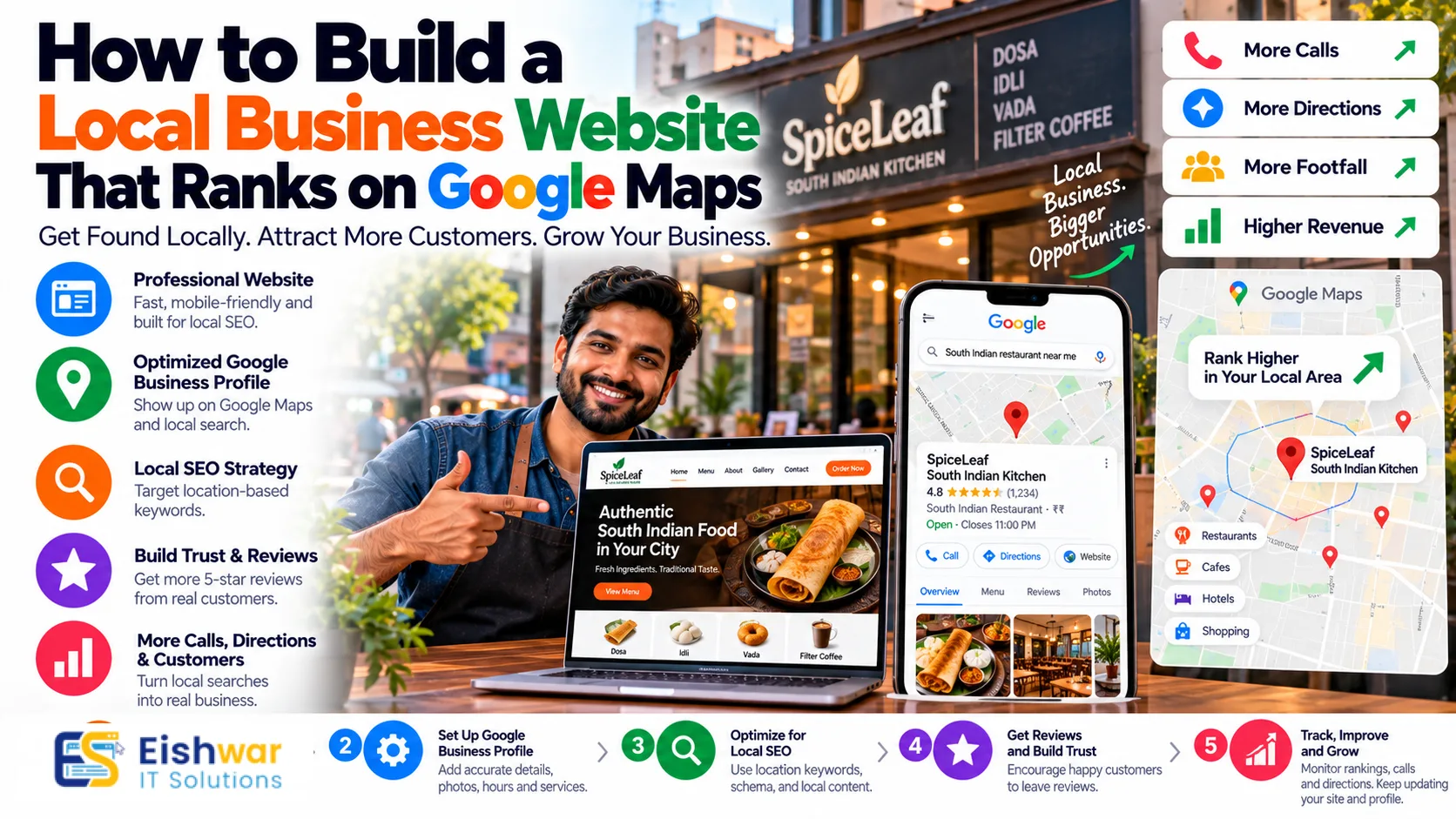
How to Build a Local Business Website That Ranks on Google Maps
Introduction
If you run a business in India, your next customer may be searching for you on Google Maps right now. They type something like 'best electrician near me' or 'digital marketing agency in Pune' and choose from the top local results. A well-built website can be the difference between appearing in that list and being invisible.
This beginner's guide explains how to build a local business website that ranks on Google Maps. You do not need to be a developer. You need a clear plan, the right pages, local SEO basics, and a website that loads fast on mobile. We will cover website structure, local signals, Google Business Profile integration, schema markup, tracking, and common mistakes to avoid.
At EishwarITSolution, we help Indian businesses turn simple websites into local lead-generation machines. Let's start with the foundation.
Main Section 1: Plan Your Website Around Local Search Intent
Understand how local customers search
Local search is different from national search. People search with urgency and location. They use phrases like 'plumber near me', 'CA in Chennai', 'best boutique in Jaipur', or 'website development company in Delhi'. Your website must answer three questions quickly: What do you offer? Where do you serve? How can someone contact you?
Start by listing your core services and the cities or areas you serve. Then create keyword variations: service + city, service + near me, service + locality. For example, if you run a salon in Bengaluru, target 'bridal makeup artist in Indiranagar' and 'salon near HSR Layout'. Use these naturally in page titles, headings, and content.
Choose the right pages for a local website
A local business website does not need hundreds of pages. It needs the right pages. Build these first:
- Home page: Clear value proposition, main services, service areas, phone number, and Google reviews.
- About page: Your story, team, certifications, and local presence.
- Services pages: One page per main service. Example: 'Residential Interior Design' and 'Office Interior Design'.
- Location pages: If you serve multiple cities or neighbourhoods, create a page for each important area.
- Contact page: Address, map embed, phone, WhatsApp, email, and working hours.
- Blog or resources: Local guides, tips, and answers to common customer questions.
Keep your URL structure simple. Use short, readable URLs like /services/plumber-in-pune/ or /locations/mumbai/. Avoid long dates and random numbers.
Design for mobile-first local users
Most local searches in India happen on mobile phones. If your website is slow or hard to use on a phone, people will leave. Google also uses mobile-first indexing. That means Google looks at your mobile version first when ranking your site.
Make sure your website has:
- Large, tappable phone and WhatsApp buttons.
- Fast loading pages, especially on 4G networks.
- Readable text without zooming.
- Simple navigation with a clear menu.
- Click-to-call and click-for-directions features.
Test your site on a budget Android phone. If it takes more than three seconds to load, you are losing local customers.
Main Section 2: Build the Pages and Signals Google Maps Trusts
Connect your website with Google Business Profile
Google Business Profile (GBP) is the engine behind Google Maps. Your website supports it, but it does not replace it. Claim and verify your GBP listing. Add your exact business name, address, phone number, category, hours, photos, and services.
Link your GBP to your website. Use a tracking link with UTM parameters so you know how many people click from Maps to your site. For example: eishwar.com/?utm_source=google&utm_medium=gbp&utm_campaign=local. This simple step helps you measure local traffic.
Make sure your website footer and contact page show the same name, address, and phone number (NAP) as your GBP. Consistency builds trust with Google.
Add local business schema markup
Schema markup is code that helps Google understand your business. For local SEO, use LocalBusiness schema. It tells Google your business name, address, geo coordinates, phone number, opening hours, and service areas.
You can add JSON-LD code to your website header or footer. If you use WordPress, plugins like Rank Math or Yoast can generate it. But always validate with Google's Rich Results Test. Do not add fake ratings or services. Only mark up what is true.
For multi-location businesses, use separate LocalBusiness schema for each location page, with that location's exact NAP details.
Create unique location pages
If you serve multiple areas, do not copy the same page and change the city name. Google calls that doorway content. It can hurt your rankings. Instead, write genuinely useful content for each location.
Here is a simple formula for a location page:
- H1: Service + Location. Example: 'Emergency Plumber in Andheri, Mumbai'.
- Introduction: How you serve that area, response time, and coverage.
- Services offered in that location.
- Local landmarks and neighbourhoods you cover.
- Testimonials from customers in that area.
- Embedded Google Map and directions.
- Clear call-to-action with phone number and form.
This approach helps Google Maps understand your relevance to each area and gives customers confidence.
Optimize on-page SEO for local searches
Each important page should target one primary local keyword. Use it in the title tag, meta description, H1, first 100 words, and naturally in the body. Do not stuff keywords. Write for humans first.
Internal linking matters. Link from your home page to your main service pages and location pages. Link from blog posts to relevant service pages. This helps Google crawl your site and understand which pages are most important.
Also include your city or region in image alt text when it makes sense. Example: 'interior designer in Bandra Mumbai project'.
Build trust with reviews and local content
Reviews are a major local ranking factor. Ask happy customers to review your Google Business Profile. Respond to every review, positive or negative. On your website, show a selection of Google reviews with a link to your profile.
Publish local content regularly. Write about local events, area guides, or common problems your customers face. For example, a pest control company in Delhi could write 'Monsoon pest control tips for Delhi homeowners'. This builds authority and gives you more chances to appear in local searches.
Add real photos of your team, office, projects, and service area. Stock photos do not build trust the way real images do.
Handle technical SEO basics
Technical SEO is not optional. Make sure your website has:
- HTTPS security with a valid SSL certificate.
- A mobile-friendly responsive design.
- Fast Core Web Vitals scores.
- An XML sitemap submitted to Google Search Console.
- A clean robots.txt file.
- Proper canonical tags to avoid duplicate content.
- Structured data for LocalBusiness and FAQs.
These basics help Google trust your website and show it in local results.
Main Section 3: Optimize, Track, and Improve Local Visibility
Set up tracking that actually matters
You cannot improve what you do not measure. Install Google Analytics 4 and Google Search Console. Track these actions:
- Phone calls from your website.
- Form submissions.
- WhatsApp clicks.
- Direction requests.
- Website clicks from Google Business Profile.
- Local keyword rankings.
Use UTM tags on your GBP website link, social media, and email signatures. This helps you see which channels bring real local leads.
Monitor and improve your local rankings
Check your Google Maps ranking for your main keywords every month. Search from different locations if you serve a wide area. Tools like Local Falcon or BrightLocal can show grid-based ranking data, but you can start with manual searches.
If you are not ranking, check these areas:
- Is your GBP complete and accurate?
- Are you using the right primary category?
- Do you have enough genuine reviews?
- Does your website have dedicated location pages?
- Are local citations consistent?
- Is your website fast and mobile-friendly?
Fix the weakest link first. Local SEO is often about removing friction, not doing everything at once.
Build local citations and links
Citations are mentions of your NAP on other websites. List your business on relevant Indian directories: Justdial, IndiaMART, Sulekha, Yellow Pages India, and local chamber of commerce sites. Make sure the details match your website and GBP exactly.
Local links are even more powerful. Sponsor a local event, join a business association, or contribute to a local news site. A link from a respected local organization can boost your Maps ranking and send direct traffic.
Do not buy spammy links or use fake listings. Google is good at detecting them, and penalties can be costly.
Convert visitors into customers
Ranking on Google Maps is only half the battle. Your website must turn visitors into enquiries. Use clear calls-to-action on every page. Add a sticky call button on mobile. Use WhatsApp chat for quick questions. Keep forms short: name, phone, service needed.
Show trust signals: reviews, certifications, years in business, photos of completed work, and service guarantees. Remove distractions that do not help the visitor contact you.
Test different headlines and CTAs. Small changes can significantly increase local leads.
Expert Tips
- Keep NAP consistent everywhere. Even small differences in your address or phone number can confuse Google.
- Use real photos. Google and customers trust businesses that show their actual team, office, and work.
- Write for your customer, not for Google. Answer real questions in plain language.
- Focus on one city at a time. Build authority in your main service area before expanding.
- Update your Google Business Profile weekly. Post offers, events, and updates to stay active.
- Speed matters. Compress images, use caching, and choose a good hosting provider.
- Use schema, but do not lie. Only mark up information that is visible on your page.
- Ask for reviews consistently. A steady flow of new reviews is better than a one-time burst.
Common Mistakes
- Not showing your address or service area. If customers cannot tell where you operate, they will leave.
- Creating duplicate location pages. Same content with different city names can trigger doorway page penalties.
- Ignoring mobile users. Most local searches happen on phones. A desktop-only experience kills conversions.
- Keyword stuffing. Repeating 'best plumber in Mumbai' ten times on a page looks spammy.
- Neglecting Google Business Profile. Your website alone will not rank in Maps without a complete GBP.
- Using fake reviews. Google can detect them and suspend your listing.
- No tracking. If you do not measure calls, forms, and direction requests, you cannot improve.
- Building a slow website. Large images and cheap hosting hurt rankings and user experience.
- Forgetting about maintenance. Broken links, outdated plugins, and security issues can damage trust.
Future Trends
Local search is changing quickly. Here are trends Indian businesses should watch:
- AI-powered local search. Google is using AI to summarize local options. Clear, structured content will help you get mentioned.
- Voice search. More people ask 'Ok Google, find a dentist near me'. Conversational content and FAQs will matter more.
- Zero-click local results. Users may call or get directions directly from Maps without visiting your site. Keep your GBP complete.
- Visual search. Google Lens and image search are becoming more common. Use high-quality, geotagged images.
- Vernacular content. In India, Hindi, Marathi, Tamil, and other regional language content can expand your local reach.
- WhatsApp integration. Customers expect instant chat. Make WhatsApp a primary contact option.
- Core Web Vitals and page experience. Google continues to reward fast, stable, mobile-friendly websites.
- E-E-A-T for local businesses. Experience, expertise, authoritativeness, and trust are increasingly important for local rankings.
FAQs
Do I need a website to rank on Google Maps?
No, you can rank on Google Maps with a complete Google Business Profile alone. However, a website improves trust, supports local SEO, and gives you more control over conversions. Most competitive local businesses need both.
How long does it take to rank on Google Maps in India?
It depends on competition, your location, and your starting point. Some businesses see improvements in 4 to 8 weeks. Competitive cities like Mumbai, Delhi, and Bengaluru may take 3 to 6 months of consistent effort.
What is NAP consistency and why does it matter?
NAP stands for Name, Address, and Phone number. Consistency means your business details are exactly the same on your website, Google Business Profile, and local directories. It helps Google trust your business information.
Can I use the same content for multiple city pages?
No. Duplicate location pages can hurt your rankings. Write unique content for each city or area, including local landmarks, testimonials, and service details.
How often should I update my local business website?
Update core pages when your services, hours, or contact details change. Add new blog posts or local guides every month. Refresh reviews and photos on your Google Business Profile weekly.
Is local SEO different from regular SEO?
Yes. Local SEO focuses on location-based searches, Google Maps, Google Business Profile, local citations, and reviews. Regular SEO focuses more on broad keywords and national or global rankings.
Conclusion
Building a local business website that ranks on Google Maps is not about tricks. It is about giving Google clear, consistent, and trustworthy information while giving customers a fast, helpful experience. Start with a mobile-friendly website, complete your Google Business Profile, add location pages, use LocalBusiness schema, and collect genuine reviews.
Track your calls, forms, and direction requests. Fix what is not working. Keep improving month after month. In India's competitive local market, consistency beats complexity.
Whether you are a plumber in Pune, a boutique in Jaipur, or a consultant in Gurgaon, a strong local website can bring a steady flow of nearby customers.
CTA
Ready to build a local business website that ranks on Google Maps? EishwarITSolution can help you plan, design, and develop a fast, mobile-friendly website with local SEO built in. Visit eishwar.com or contact us today to discuss your project. Let's make your business easier to find, trust, and choose.