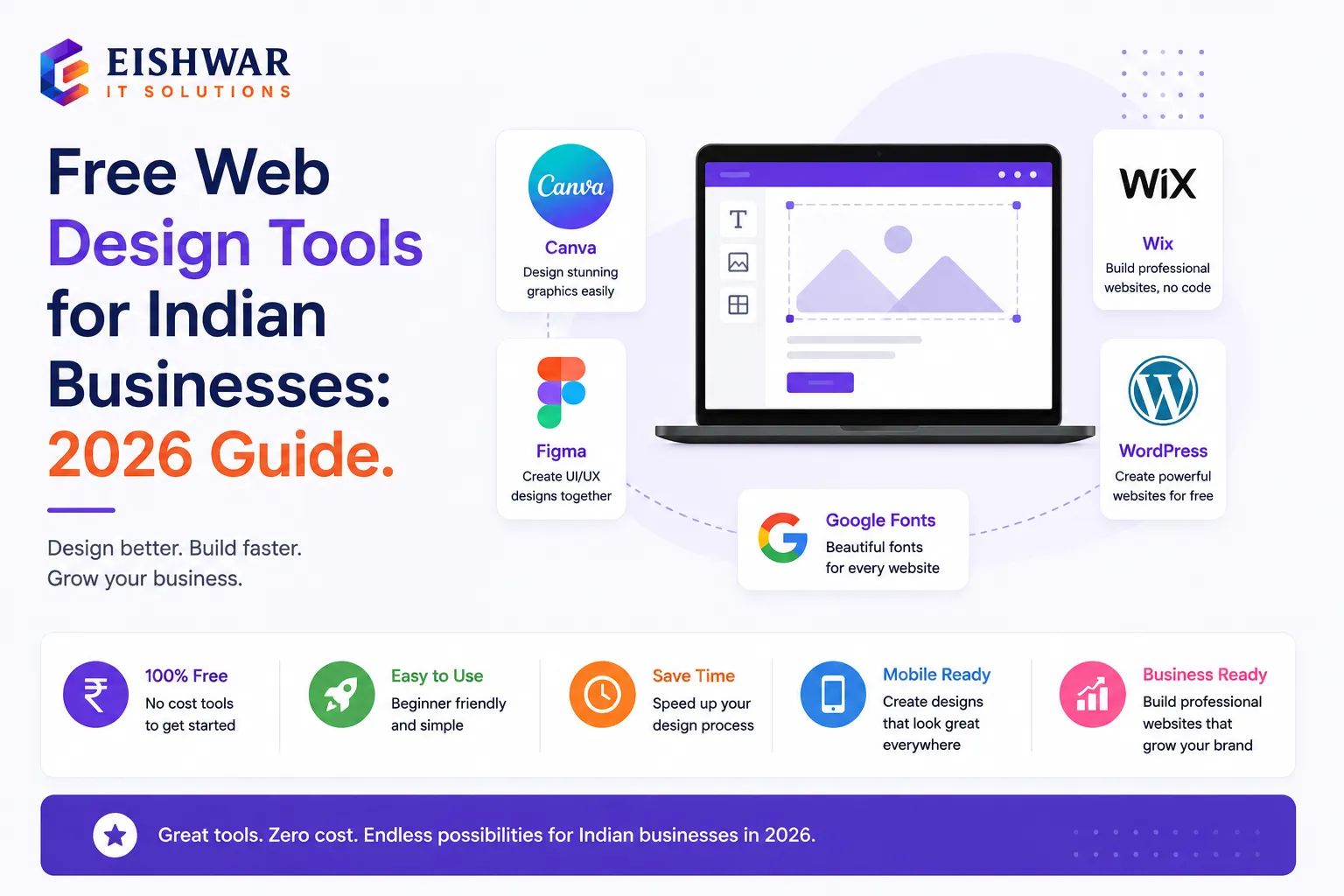
Free Web Design Tools for Indian Businesses: 2026 Guide
Introduction
In 2026, Indian businesses—from startups in Bengaluru to family-run shops in Bilaspur—need a strong online presence. But hiring a professional web designer can be expensive, often costing ₹50,000 or more for a basic site. The good news? A wealth of free and open-source tools now make it possible to design a stunning, functional website on a shoestring budget. This guide walks you through the best options available, tailored for the Indian market. Whether you're a business owner, marketer, or freelancer, these tools will help you create a website that attracts customers and drives growth—without draining your wallet. With over 70% of Indian consumers researching businesses online before purchasing, a well-designed website is no longer a luxury—it's a necessity. Let's dive into the tools that can make it happen for free.
Main Section 1: Why Free and Open-Source Tools Matter for Indian Businesses
India's digital economy is booming, with projections showing over 900 million internet users by 2026. Yet, many small and medium enterprises (SMEs) still struggle with limited budgets. Paid tools like Adobe XD (₹3,000+/year) or Figma (Pro at ₹4,500+/year) can cost thousands of rupees annually, which is a significant expense for a local kirana store or a freelance graphic designer in Tier-2 cities. Free and open-source alternatives level the playing field. They offer flexibility, community support, and no licensing fees. Plus, they often have active Indian user groups and local language support—for example, WordPress has full Hindi and Tamil translations, and GIMP offers a Hindi interface. By using these tools, you can reinvest savings into marketing, inventory, or customer service. Consider a small textile business in Surat: by using free tools, they saved ₹30,000 in design costs in the first year, which they used to run a Facebook ad campaign that boosted sales by 20%.
Main Section 2: Top Free Web Design Tools for 2026
1. WordPress (Open-Source CMS)
WordPress powers over 40% of websites globally, including many Indian businesses. It's free, open-source, and has thousands of themes and plugins. For Indian businesses, plugins like WooCommerce (e-commerce) and Yoast SEO (local SEO) are invaluable. Many Indian hosting providers like Hostinger and Bluehost offer one-click WordPress installation, often with free domain names for the first year. Example: A textile shop in Surat can set up an online store in hours using a free theme like Astra and WooCommerce. They can add payment gateways like Razorpay (free to integrate) and ship across India. Practical tip: Start with a lightweight theme like GeneratePress to ensure fast loading times on slower internet connections common in rural areas.
2. GIMP (Graphic Design)
GIMP is a free alternative to Photoshop. It supports layers, masks, and advanced image editing. Perfect for creating logos, banners, and product images. Indian businesses can use it to resize images for mobile users or design social media posts. It's available in multiple languages, including Hindi and Bengali. For example, a restaurant in Jaipur can use GIMP to create a menu PDF with custom food photography. Practical tip: Use the 'Resynthesizer' plugin to remove backgrounds from product images—ideal for e-commerce listings. GIMP also supports CMYK color mode for print materials like flyers.
3. Figma (Free Plan)
Figma's free plan is generous: unlimited files, 3 projects, and real-time collaboration. It's ideal for UI/UX design and prototyping. Indian web teams can use it to wireframe a restaurant menu or an e-commerce checkout flow. The community has ready-made components like Indian payment gateways (e.g., Paytm, Razorpay icons). For instance, a startup in Pune can collaborate with a remote designer in Delhi on a single Figma file, reducing iteration time by 50%. Practical tip: Use Figma's 'Auto Layout' feature to create responsive designs that adapt to mobile screens—critical since 70% of Indian web traffic comes from phones.
4. Canva (Free Plan)
Canva is a user-friendly design tool with thousands of templates. The free version includes drag-and-drop editing, stock photos, and social media templates. Indian businesses can create professional-looking flyers, Instagram posts, and website mockups. For example, a local salon in Raipur can design a promotional banner in minutes using a Diwali-themed template. Practical tip: Use Canva's 'Brand Kit' feature (even in the free plan) to save your logo, colors, and fonts for consistent branding across all materials. Canva also offers templates specifically for Indian festivals like Holi and Dussehra.
5. Bootstrap (Front-End Framework)
Bootstrap is a free CSS framework for building responsive websites. It ensures your site looks great on phones and desktops. Indian developers love it because it's lightweight and fast. Many free templates are designed for Indian businesses, such as a Bootstrap-based portfolio for a freelance photographer in Kochi. Practical tip: Use Bootstrap's grid system to create mobile-first layouts. For example, a restaurant website can display menu items in a single column on phones and three columns on desktops. Bootstrap also includes pre-built components like navigation bars and carousels that save hours of coding.
6. Inkscape (Vector Graphics)
Inkscape is a free vector editor similar to Adobe Illustrator. It's great for creating logos, icons, and illustrations. Indian businesses can design a unique brand identity without paying for expensive software. The tool supports SVG format, which is perfect for web use—SVG files are small and scale without losing quality. For example, a chai stall in Varanasi can design a logo with a traditional 'kulhad' (clay cup) icon using Inkscape's drawing tools. Practical tip: Use Inkscape's 'Trace Bitmap' feature to convert raster images (like scanned sketches) into scalable vectors.
7. Visual Studio Code (Code Editor)
VS Code is a free, open-source code editor with extensions for HTML, CSS, JavaScript, and more. It has built-in Git support and a huge library of extensions. Indian web developers use it to debug code, format documents, and collaborate. It's lightweight and runs smoothly on low-end laptops, even those with 4GB RAM. Practical tip: Install the 'Live Server' extension to see real-time changes to your website as you code. For Indian developers, the 'Hindi Language Pack' extension can make the interface more accessible.
Main Section 3: How to Choose the Right Tools for Your Business
Start by assessing your needs. Do you need a simple brochure site or an e-commerce platform? For a basic site, WordPress with a free theme like 'Twenty Twenty-Four' might suffice. For custom design, combine GIMP for graphics and Bootstrap for layout. If you're a marketer, Canva and Figma can help you create landing pages and email templates. Always test tools with a small project before committing. For example, if you're a freelance photographer, try building a portfolio with WordPress and a free photography theme. If you're a restaurant owner, use Canva to design a menu page and Figma to prototype a reservation form. Join Indian web design communities on Telegram (e.g., 'Indian Web Developers') or Reddit (r/developersIndia) for support and tips. Practical tip: Create a checklist of features you need (e.g., contact form, image gallery, payment gateway) and match them to tool capabilities.
Expert Tips
- Start with one tool: Master WordPress or Figma before exploring others. Trying to learn everything at once can be overwhelming.
- Use local resources: Many Indian developers offer free tutorials in Hindi and English on YouTube channels like 'Technical Suneja' or 'CodeWithHarry'.
- Optimize for mobile: Over 70% of Indian web traffic comes from phones. Test your designs on real devices using tools like BrowserStack (free tier) or simply resize your browser window.
- Leverage free stock photos: Sites like Unsplash and Pexels offer high-quality images for Indian themes (e.g., local markets, festivals). Search for 'Indian street food' or 'Diwali' to find relevant visuals.
- Backup regularly: Free tools like UpdraftPlus (WordPress plugin) can automate backups to Google Drive or Dropbox. Schedule weekly backups to avoid data loss.
- Use local fonts: Incorporate Indian language fonts like 'Noto Sans Devanagari' for Hindi content. Google Fonts offers many free options.
Common Mistakes
- Overcomplicating designs: Keep it simple. Too many colors or fonts can confuse visitors. Stick to 2-3 primary colors and 1-2 fonts.
- Ignoring SEO: Even free tools need SEO plugins or meta tags. Use Yoast or Rank Math for WordPress, or manually add meta descriptions in HTML.
- Skipping mobile optimization: A desktop-only design will lose customers. Use Bootstrap or responsive WordPress themes to ensure mobile-friendliness.
- Using too many plugins: This slows down your site. Stick to essentials like SEO, caching, and security. Aim for no more than 10-15 plugins.
- Not updating software: Regular updates fix security flaws and improve performance. Set automatic updates for WordPress core and plugins.
- Neglecting page speed: Large images and unoptimized code can slow down your site. Use tools like TinyPNG to compress images and enable caching.
Future Trends
By 2027, AI-driven design tools like Wix ADI (free version) will become more popular, allowing users to generate entire websites by answering a few questions. Expect more open-source tools with built-in AI features, such as automatic image cropping or color palette suggestions. Indian businesses should also watch for regional language support in design tools—already, WordPress offers Hindi and Tamil translations, and Canva has templates in Marathi and Gujarati. Voice search optimization will also gain traction, so design for voice-friendly interfaces with clear headings and structured data. Additionally, low-code platforms like AppGyver (free) will enable non-developers to build web apps without coding. For Indian businesses, this means faster time-to-market and lower costs. Keep an eye on tools like 'Bubble' (free tier) for creating custom web applications.
FAQs
1. Are free web design tools safe to use?
Yes, as long as you download from official websites. Avoid pirated versions. Open-source tools are regularly audited by the community. For example, WordPress has a dedicated security team that releases patches quickly. Always use strong passwords and enable two-factor authentication.
2. Can I build an e-commerce site with free tools?
Absolutely. WordPress with WooCommerce (free) lets you sell products, manage inventory, and accept payments via Razorpay or Paytm. You can also use free themes like 'Storefront' and plugins for shipping (e.g., 'Indian Shipping Zones'). For a simpler option, try Canva to design product pages and link to a payment gateway.
3. Do I need coding skills to use these tools?
Not necessarily. Tools like Canva and Figma require no code. For WordPress, basic technical knowledge helps, but many hosting providers offer managed support. If you want to customize a Bootstrap template, basic HTML/CSS knowledge is useful but not mandatory—many free templates are drag-and-drop.
4. Which tool is best for beginners?
Start with Canva for design and WordPress for website building. Both have gentle learning curves and extensive tutorials. Canva's drag-and-drop interface is intuitive, while WordPress has a vast library of video guides in Hindi and English. For coding beginners, try 'Thimble' by Mozilla (free) to learn HTML/CSS interactively.
5. How can I get support for open-source tools in India?
Join Indian web developer groups on Facebook (e.g., 'Indian Web Developers'), LinkedIn, or GitHub. Many cities like Pune and Hyderabad have local meetups (online and offline) through platforms like Meetup.com. Also, check forums like 'WordPress.org/support' for Hindi-language threads.
6. Can I use these tools for a multilingual website?
Yes. WordPress has plugins like 'Polylang' (free) or 'WPML' (paid) to create sites in multiple Indian languages. Canva allows you to create designs in different scripts. For example, a travel agency in Goa can have a site in English, Hindi, and Konkani.
7. What if I need advanced features like custom animations?
Free tools like 'Animate.css' (CSS library) or 'Greensock' (free tier) can add animations to your site. For WordPress, plugins like 'Elementor' (free version) offer animation effects. Figma's free plan also allows prototyping with micro-interactions.
Conclusion
Free and open-source web design tools have democratized website creation for Indian businesses. From WordPress to GIMP, these resources empower you to build a professional online presence without a huge budget. Start small, experiment, and watch your business grow. Remember, your website is your digital storefront—make it inviting, fast, and mobile-friendly. With the right tools and a bit of creativity, you can compete with larger players and attract customers from across India. The key is to take the first step: choose one tool, build a simple page, and iterate from there. Your online journey starts today.
CTA
Ready to build your website with free tools? Contact EishwarITSolution for expert guidance. We help Indian businesses choose the right tools and design stunning websites. Get a free consultation today! Our team specializes in WordPress, Figma, and Bootstrap solutions tailored for the Indian market. Whether you're in Mumbai or Moradabad, we're here to help you succeed online.