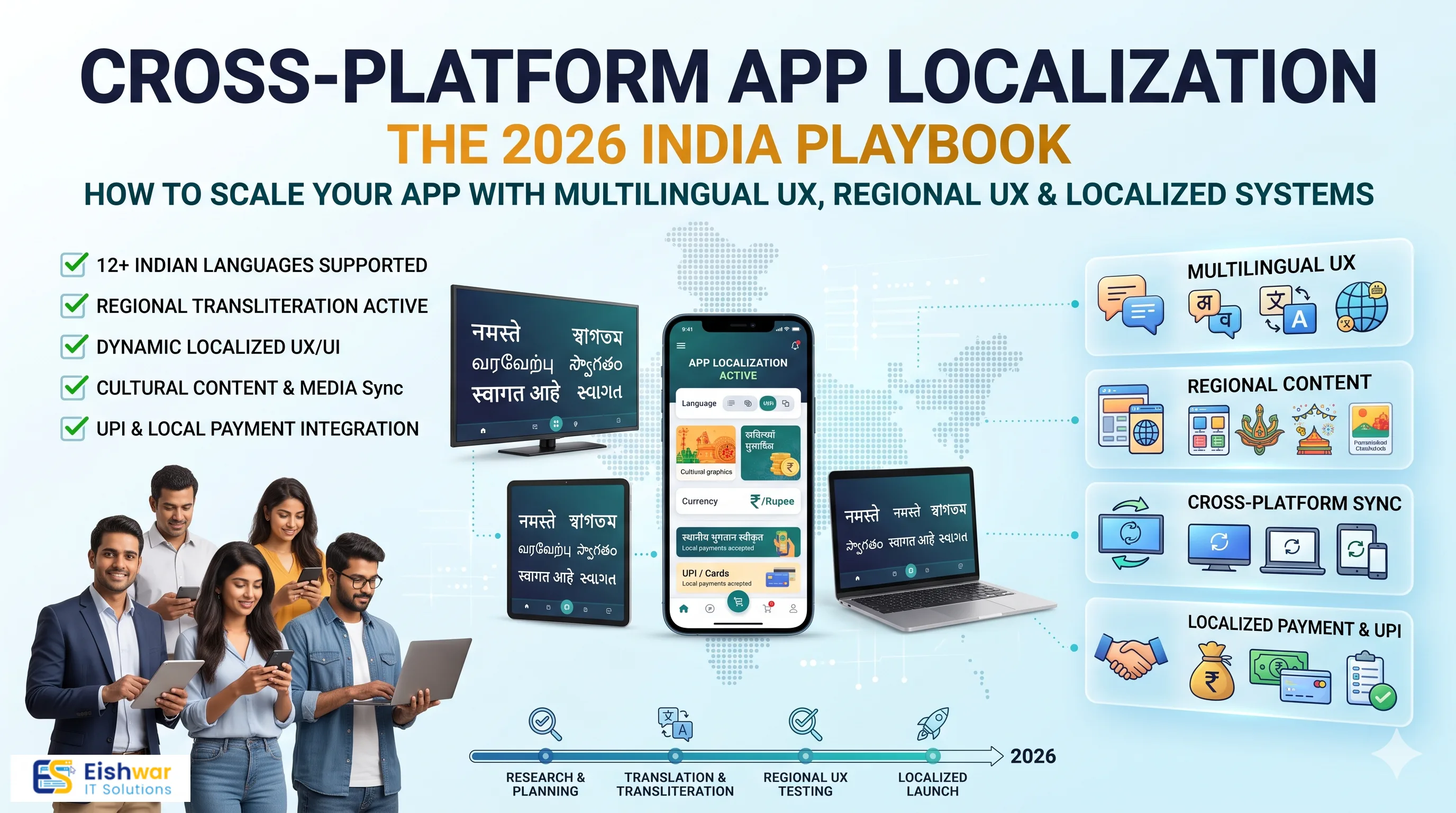
Cross-Platform App Localization: The 2026 India Playbook
Introduction
India is a land of extraordinary linguistic and cultural diversity. With 22 officially recognized languages, over 19,500 dialects spoken across its 28 states and 8 union territories, and a population exceeding 1.4 billion, the country presents both a monumental opportunity and a formidable challenge for app developers. In 2026, cross-platform app localization is no longer a luxury reserved for global enterprises—it is a fundamental necessity for any business aspiring to thrive in the world's second-largest smartphone market.
For business owners, marketers, and product professionals, understanding how to effectively localize your app can be the difference between a successful launch and a costly flop. This comprehensive guide will walk you through the importance of localization, the unique advantages of cross-platform frameworks, and a step-by-step strategy to make your app resonate deeply with Indian users. We'll also explore future trends, expert tips, and common pitfalls to avoid, ensuring you are fully equipped to navigate the Indian market with confidence.
Why Localization Matters for Indian Audiences
India's digital landscape is undergoing a seismic shift. As of 2025, the country has over 1.2 billion mobile users, with projections indicating that the Indian language internet user base will reach 536 million by 2026—surpassing English users by a significant margin. This is not just a statistic; it represents a fundamental change in how businesses must approach the Indian market. English proficiency is limited to roughly 10-12% of the population, meaning that an app available only in English is effectively invisible to nearly 90% of potential users.
Localization goes far beyond mere translation. It involves adapting your app's content, design, functionality, and even business logic to meet the cultural and linguistic needs of your target audience. For India, this means supporting multiple scripts (Devanagari, Tamil, Telugu, Bengali, Gurmukhi, etc.), regional number formats (Lakh/Crore), date and time conventions, and crucially, local payment methods like UPI, Paytm, and PhonePe. A well-localized app builds trust, fosters user engagement, and significantly boosts conversion rates. According to a Google-KPMG report, 71% of Indian users are more likely to make a purchase if the app is in their local language, and 56% trust ads in their language more. Ignoring localization is not just a missed opportunity—it's a strategic error that can doom your app to obscurity.
The Cross-Platform Advantage for Localization
Cross-platform development frameworks like Flutter, React Native, and Xamarin have revolutionized the way mobile apps are built. They allow developers to write a single codebase and deploy it on both iOS and Android, dramatically reducing development time, cost, and maintenance overhead. But what many businesses fail to realize is that these frameworks also offer robust, built-in localization support that simplifies the entire process.
Flutter, for instance, has first-class localization support through the flutter_localizations package, which provides widgets and APIs for handling translations, text direction, and locale-specific formatting. It automatically adapts to the device's locale, and you can easily manage multiple language files using ARB (Application Resource Bundle) format. React Native, on the other hand, leverages libraries like i18next and react-native-localize to implement multi-language support with ease. These tools allow you to define translation keys, manage pluralization, and handle date/number formatting without writing platform-specific code.
Moreover, cross-platform apps are ideally suited for India's fragmented device ecosystem. Budget Android devices dominate the market, with a significant portion of users on entry-level smartphones with limited memory and processing power. Cross-platform frameworks are optimized to run efficiently on such devices, ensuring that your app reaches the widest possible audience without compromising on performance. This is a critical advantage in a market where 3G and 4G networks are still prevalent in rural areas, and users expect apps to load quickly and run smoothly even on modest hardware.
Key Strategies for Localizing Your App for India
Localization is not a one-size-fits-all process. It requires a deep understanding of your target audience and a strategic approach. Here are some key strategies to ensure your app truly resonates with Indian users:
1. Support Major Indian Languages
While Hindi is the most widely spoken language, it is not the only one—and it's not even the primary language in many southern states. Consider supporting Tamil, Telugu, Bengali, Marathi, Kannada, Malayalam, Gujarati, Punjabi, and others based on your target market. A study by Google found that 71% of Indian users prefer content in their local language, and 56% trust ads in their language more. Start with Hindi and one or two regional languages, then expand based on user data and analytics. For example, if your app is an e-commerce platform, you might prioritize Tamil and Telugu because of the high smartphone penetration in Tamil Nadu and Telangana.
2. Adapt to Local Formats
Indians use the Lakh/Crore numbering system (1,00,000 is one Lakh, 1,00,00,000 is one Crore), and date formats differ from Western standards (DD/MM/YYYY is common). Ensure your app displays numbers, dates, and times in formats familiar to Indian users. For instance, showing a price as ₹1,50,000 instead of ₹150,000 can significantly improve user experience. Similarly, use the 12-hour clock with AM/PM, and format dates as "15 August, 2026" rather than "08/15/2026." These small details demonstrate attention to local preferences and build trust.
3. Incorporate Local Payment Options
UPI (Unified Payments Interface) is the most popular payment method in India, with over 300 million monthly active users. Integrate UPI, along with wallets like Paytm, PhonePe, and Google Pay, to provide a seamless transaction experience. This is crucial for e-commerce, fintech, and any app that involves monetary transactions. Additionally, consider supporting cash on delivery (COD) for users who are not comfortable with digital payments, especially in smaller towns and rural areas. A localized payment experience is a major trust signal and can significantly reduce cart abandonment rates.
4. Use Culturally Relevant Visuals
Images and icons should reflect Indian culture and diversity. Avoid using visuals that are culturally insensitive or irrelevant. For example, using a cow as a symbol of food might be offensive to some, and showing people in Western clothing may not resonate with all users. Research your target audience and test your visuals with local users. Use images that depict Indian people, clothing, landmarks, and everyday scenarios. For example, an e-commerce app could show models wearing traditional Indian attire, and a travel app could feature iconic Indian destinations like the Taj Mahal or the backwaters of Kerala.
5. Optimize for Low Bandwidth
Many Indian users have limited internet connectivity, especially in rural areas. Optimize your app to load quickly even on 3G networks. Use lightweight images, lazy loading, and efficient caching strategies to improve performance. Consider offering a "lite" version of your app for users with low-end devices or poor connectivity. For example, you can compress images, use vector graphics instead of raster images, and minimize the use of heavy animations. This is especially important in a market where data costs are a concern for many users.
Expert Tips for Seamless Cross-Platform Localization
To make your localization process smooth and effective, follow these expert tips from industry veterans:
- Start with a Localization-Ready Architecture: Design your app with localization in mind from day one. Avoid hardcoding strings; use resource files or localization libraries. This means using string resources in Flutter (via ARB files) or React Native (via i18next JSON files). This approach makes it easy to add new languages later without refactoring your code.
- Use Professional Translation Services: While machine translation has improved significantly, it still lacks the nuance and cultural sensitivity required for a market as diverse as India. Invest in professional translators who are native speakers of the target language. They can capture idioms, colloquialisms, and cultural references that machine translation might miss. For example, the phrase "break a leg" has no direct equivalent in Hindi; a professional translator would use a culturally appropriate expression like "शुभकामनाएं" (shubhkaamnayein) or "अच्छा करो" (achha karo).
- Test with Real Users: Conduct usability testing with Indian users from different regions to identify any cultural or linguistic issues. This will help you refine your localization strategy. Use A/B testing to compare different translations and visual elements. For example, you might test whether a Hindi translation is more effective in Devanagari script or in Romanized Hindi (Hinglish), which is increasingly popular among urban youth.
- Keep Translations Contextual: Words can have multiple meanings. Provide translators with context to ensure accurate translations. For example, the word 'bank' could mean a financial institution or a riverbank. In Hindi, 'bank' as a financial institution is 'बैंक' (baink), while a riverbank is 'किनारा' (kinaara). Providing context helps translators choose the correct term.
- Automate the Workflow: Use continuous localization tools like Lokalise, Crowdin, or Phrase that integrate with your CI/CD pipeline. This allows you to update translations in real-time without manual intervention. For example, when a developer adds a new string to the codebase, the tool automatically creates a task for translators, and once translated, the updated file is automatically pushed to your app. This ensures that your app is always up-to-date with the latest translations.
Common Mistakes to Avoid in App Localization
Avoid these pitfalls to ensure your localization efforts are successful:
- Ignoring Right-to-Left Languages: While India mainly uses left-to-right scripts, some languages like Urdu are right-to-left (RTL). If you plan to include Urdu (which is spoken by a significant minority), ensure your app supports RTL layouts. This includes mirroring the UI, adjusting text alignment, and handling bidirectional text correctly. Flutter and React Native both have built-in RTL support, but you need to enable it and test thoroughly.
- Translating Idioms and Slang Literally: Phrases like 'break a leg' don't make sense in other languages. Use culturally equivalent expressions instead. For example, in Hindi, 'break a leg' could be translated as 'शुभकामनाएं' (shubhkaamnayein) or 'अच्छा करो' (achha karo). Similarly, 'hit the nail on the head' in Tamil would be 'சரியாகச் சொன்னீர்கள்' (sariyākaс் conṉīrkaḷ), which means 'you said it correctly'. Always work with native speakers to find appropriate equivalents.
- Overlooking Text Expansion: Translated text can be longer or shorter than the original. For example, English text often expands by 20-30% when translated to Hindi or Tamil. Ensure your UI can accommodate varying text lengths to avoid layout issues. Use flexible layouts, dynamic text sizing, and test with the longest possible translations. For instance, a button that says "Submit" in English might become "सबमिट करें" in Hindi, which is longer and may not fit in a fixed-width button.
- Not Localizing Images and Graphics: Text embedded in images must be localized too. Use tools that allow you to manage localized images, or avoid embedding text in images altogether. For example, if your app has a promotional banner with English text, you'll need to create separate banners for each language. Use image editing tools or design systems that support text overlays, so you can easily swap out the text without redesigning the entire image.
- Skipping Local Legal and Compliance Requirements: India has specific data privacy laws (DPDP Act, 2023) and other regulations. Ensure your app complies with local regulations, including data localization requirements, consent mechanisms, and user rights. For example, the DPDP Act requires apps to obtain explicit consent from users before collecting personal data, and to provide users with the ability to access, correct, and delete their data. Failure to comply can result in hefty fines and loss of user trust.
Future Trends in App Localization for India
The landscape of app localization is constantly evolving. Here are some trends to watch for in 2026 and beyond:
AI-Powered Localization
Artificial intelligence is making localization faster and more accurate. Neural machine translation (NMT) can now handle context and nuance better, reducing the need for human intervention. For example, Google Translate and DeepL use NMT to produce more natural translations. However, human oversight is still essential for quality, especially for marketing content and user-facing messages. AI can also be used to automate the detection of untranslated strings, identify cultural faux pas, and even suggest localized content based on user behavior.
Voice and Vernacular Search
With the rise of voice assistants like Google Assistant, Alexa, and Siri, more Indians are using voice search in their local languages. Optimizing your app for voice search in Hindi, Tamil, Telugu, etc., can give you a competitive edge. This involves not only translating your content but also ensuring that your app's search functionality understands and responds to voice queries in multiple languages. For example, a user might say "मुझे साड़ी दिखाओ" (show me sarees) in Hindi, and your app should be able to understand and return relevant results.
Hyperlocal Content
Beyond language, users expect content that is relevant to their specific region. This includes local offers, events, and even dialect variations. Hyperlocalization will become a key differentiator. For example, an e-commerce app could show different products or promotions based on the user's city or even neighborhood. A food delivery app could highlight local cuisines and restaurants. Hyperlocalization requires integrating geolocation data and tailoring content accordingly, which can significantly increase user engagement and conversion rates.
Augmented Reality (AR) and Localization
AR features can be localized to provide culturally relevant experiences. For example, an educational app could use AR to teach history with local landmarks, or a shopping app could allow users to virtually try on traditional Indian attire. AR can also be used for language learning, where users can point their camera at an object and see its name in their local language. As AR technology becomes more accessible, expect to see more apps leveraging it for localized experiences.
FAQs
1. What is app localization and why is it important for India?
App localization is the process of adapting your app to a specific language, culture, and region. In India, it's crucial because a majority of users prefer content in their local language. It helps in building trust, increasing engagement, and expanding your user base. With over 1.2 billion mobile users and a rapidly growing internet user base, localization is the key to unlocking the full potential of the Indian market.
2. How does cross-platform development help with localization?
Cross-platform frameworks like Flutter and React Native allow you to manage multiple languages in one codebase. This reduces development time and cost, and makes it easier to maintain consistent localization across platforms. With built-in localization support and a wide range of libraries, you can efficiently handle translations, formatting, and even RTL layouts without writing platform-specific code.
3. Which Indian languages should I prioritize?
It depends on your target audience. Hindi is a good start, but you should also consider Tamil, Telugu, Bengali, Marathi, and others based on the regions you're targeting. Analyze your user data to make informed decisions. For example, if your app is popular in southern India, prioritize Tamil and Telugu. If you're targeting the eastern region, Bengali and Odia might be more important. Conduct market research and use analytics to understand your user demographics.
4. What are the costs involved in localizing a cross-platform app?
Costs vary based on the number of languages, the complexity of your app, and whether you use professional translation services. On average, localization can cost 10-20% of the original development cost. However, the return on investment is significant. For example, if your app generates $100,000 in revenue, a 10% increase in conversion due to localization could yield an additional $10,000, far exceeding the cost of localization. Additionally, using cross-platform frameworks can reduce the cost of maintaining multiple language versions.
5. Can I use machine translation for app localization?
Machine translation is fast and cheap, but it may not be accurate for all languages. It's best to use a combination of machine translation for initial drafts and human review for quality assurance. For example, you can use Google Translate to generate a rough translation, then have a native speaker review and refine it. This hybrid approach balances cost and quality, ensuring your app is both accurate and culturally appropriate.
6. How do I handle localization for Hinglish (Hindi+English)?
Hinglish is a popular blend of Hindi and English used in urban India. To support Hinglish, you can create a separate locale that uses Romanized Hindi with English words. This requires careful attention to transliteration and cultural context. For example, "The offer is valid till Sunday" might be "ऑफर रविवार तक वैध है" in Hindi, but in Hinglish it could be "Offer Sunday tak valid hai." Test with users to see which version resonates better with your audience.
7. What are the best tools for cross-platform localization?
Some popular tools include Lokalise, Crowdin, Phrase, and Transifex. These tools integrate with your CI/CD pipeline and support multiple platforms, making it easy to manage translations. For Flutter, you can use the flutter_localizations package and ARB files. For React Native, i18next and react-native-localize are excellent choices. Choose a tool that fits your team's workflow and budget.
Conclusion
As India's digital landscape becomes more diverse, cross-platform app localization is a strategic imperative for businesses. By embracing localization, you not only expand your reach but also build deeper connections with your users. The time to act is now—start planning your localization strategy today to stay ahead in 2026. Remember, localization is not a one-time task but an ongoing process that requires continuous adaptation and improvement. With the right approach, tools, and partners, you can successfully tap into the immense potential of the Indian market.
Ready to Localize Your App?
At EishwarITSolution, we specialize in cross-platform app development and localization. Our team can help you create an app that speaks your customers' language. Contact us today for a free consultation. Let's work together to make your app a success in India and beyond.
CTA
At EishwarITSolution, we specialize in cross-platform app development and localization. Our team can help you create an app that speaks your customers' language. <a href="http://eishwar.com" target="_blank">Contact us today</a> for a free consultation. Let's work together to make your app a success in India and beyond.