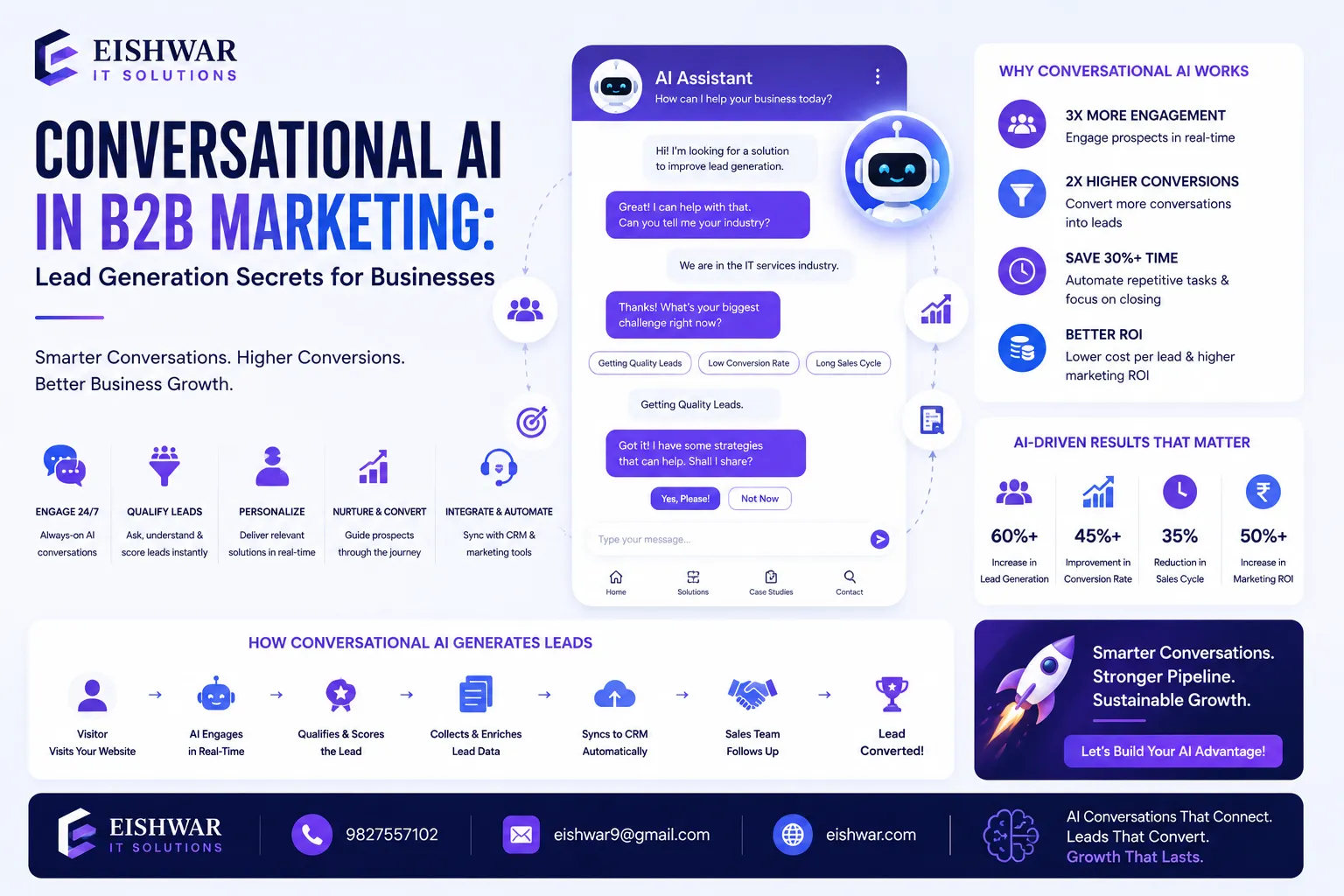
Conversational AI in B2B Marketing: Lead Generation Secrets for Indian Enterprises in 2026
Introduction
Imagine a potential client visits your website at 2 AM, asks a detailed question about your product, and gets an instant, accurate response—without any human intervention. That's the power of conversational AI. In 2026, Indian enterprises are increasingly turning to chatbots and voice assistants to transform their B2B lead generation efforts. This isn't just about automating replies; it's about creating intelligent, personalized conversations that nurture prospects from first touch to qualified lead.
For business owners, marketers, and professionals in India, embracing conversational AI is no longer optional—it's a competitive necessity. With the country's rapid digital adoption and a growing preference for instant, always-on communication, AI-driven conversations are becoming the new front door for B2B sales. This article explores how you can leverage this technology to generate high-quality leads, reduce costs, and stay ahead of the curve.
Main Section 1: Why Conversational AI is a Game-Changer for Indian B2B Lead Generation
Traditional B2B lead generation relies heavily on forms, email campaigns, and cold calling. While these methods still work, they often suffer from low engagement and high friction. Conversational AI flips the script by offering immediate, two-way interactions that feel natural and helpful.
The Shift in Buyer Expectations
Indian B2B buyers now expect instant responses. According to a recent study, 82% of buyers expect an immediate answer to their sales questions. Chatbots and voice assistants meet this demand 24/7, capturing leads even when your sales team is offline. Moreover, conversational AI can qualify leads in real-time by asking relevant questions, scoring responses, and routing high-intent prospects to the right salesperson. For example, a chatbot for a manufacturing software company can ask about factory size, production volume, and current pain points to determine if the lead is worth pursuing.
Cost Efficiency and Scalability
For Indian enterprises, cost is a critical factor. Conversational AI reduces the need for large customer support teams while handling thousands of interactions simultaneously. A single chatbot can manage multiple conversations at once, ensuring no lead slips through the cracks. This scalability is especially valuable for growing businesses that want to expand without proportionally increasing headcount. Consider a mid-sized IT services firm in Bangalore: deploying a chatbot for initial lead qualification saved them ₹12 lakhs annually in support staff costs while increasing lead capture by 35%.
Main Section 2: Implementing Conversational AI for B2B Lead Generation – A Step-by-Step Guide
Ready to deploy conversational AI? Here's a practical roadmap tailored for Indian enterprises.
Step 1: Define Your Lead Qualification Criteria
Before building a chatbot, map out what constitutes a qualified lead for your business. Common B2B criteria include company size, industry, budget, and decision-making authority. Program your AI to ask these qualifying questions naturally during the conversation. For example: "What industry does your company operate in?" or "Are you looking for solutions for your entire organization or a specific department?" A practical tip: use a scoring system (e.g., 0-100) based on responses, and automatically flag leads above 70 for immediate sales follow-up.
Step 2: Choose the Right Platform and Integrations
Select a conversational AI platform that integrates seamlessly with your existing CRM and marketing tools. Popular options for Indian businesses include Zendesk, Intercom, and custom solutions built on Dialogflow or Rasa. Ensure the platform supports Indian languages like Hindi, Tamil, or Bengali if your audience is multilingual. Integration with WhatsApp Business API is also crucial, as WhatsApp is the most widely used messaging app in India. For instance, a chatbot that captures leads via WhatsApp can send automated follow-ups with case studies or demo links, boosting conversion rates.
Step 3: Design a Human-Like Conversation Flow
The key to successful conversational AI is making interactions feel natural. Avoid robotic scripts. Use a friendly, professional tone that reflects your brand voice. Map out common user journeys—from initial greeting to lead capture. Include fallback options for when the AI doesn't understand a query, such as transferring to a human agent. Test the flow with real users from your target audience. For example, a chatbot for a logistics company might start with: "Hi! I'm here to help you optimize your supply chain. Can I ask a few quick questions to see how we can assist?"
Step 4: Monitor, Analyze, and Optimize
Deploying a chatbot is not a one-time task. Continuously monitor conversation logs to identify bottlenecks, frequently asked questions, and drop-off points. Use analytics to refine the AI's responses and improve lead capture rates. A/B test different greeting messages or qualification questions to see what works best. For instance, try two versions: one that asks "What's your biggest challenge?" and another that asks "Are you looking for cost savings or efficiency gains?" Track which yields higher engagement.
Main Section 3: Voice Assistants – The Next Frontier for B2B in India
While chatbots dominate text-based interactions, voice assistants are rapidly gaining traction in B2B environments. In India, where voice search is growing at 270% annually, voice-enabled lead generation offers a unique opportunity.
Voice Assistants for Trade Shows and Events
Imagine a voice assistant at your exhibition booth that answers visitor questions, collects contact details, and schedules demos—all hands-free. This not only enhances visitor experience but also captures leads without manual effort. Several Indian enterprises are already experimenting with voice-powered kiosks at industry events. For example, a SaaS company at a Mumbai tech expo used a voice assistant to engage 200+ visitors in a single day, capturing 45 qualified leads with minimal staff involvement.
Voice-Enabled Website Navigation
Integrating voice search on your B2B website allows prospects to ask questions like "Show me case studies for the manufacturing sector" or "What is the pricing for your enterprise plan?" Voice assistants can then guide users to relevant pages and capture their information for follow-up. This reduces friction and improves user engagement. A practical tip: ensure your voice assistant can handle common Indian accents and dialects by training it on diverse speech samples.
Expert Tips
- Start Small, Scale Fast: Begin with a simple chatbot that handles FAQs and lead capture. Once you see results, expand to more complex scenarios like product recommendations or demo scheduling. For instance, a startup in Pune started with a basic WhatsApp chatbot and scaled to a full-fledged voice assistant within six months.
- Personalize at Scale: Use AI to remember past interactions and tailor responses. For instance, if a prospect previously asked about cybersecurity solutions, your chatbot can reference that in future conversations, saying, "I recall you were interested in cybersecurity. Would you like to see our latest case study on that?"
- Combine with Human Touch: Always provide an option to speak with a human. B2B buyers often need personalized attention for high-stakes decisions. Hybrid models work best. For example, a chatbot can qualify leads and then schedule a call with a sales rep, ensuring a seamless transition.
- Leverage Indian Language Support: Don't ignore regional languages. A chatbot that speaks Hindi or Tamil can significantly increase engagement among non-English speaking decision-makers. A Chennai-based manufacturing firm saw a 40% boost in lead conversions after adding Tamil support.
- Use Data Ethically: Be transparent about data collection and comply with India's upcoming Digital Personal Data Protection Act. Trust is crucial in B2B relationships. Always include a privacy notice in your chatbot's welcome message.
Common Mistakes
- Overcomplicating the Conversation Flow: Trying to handle every possible query upfront leads to a confusing user experience. Start with core scenarios and iterate. For example, focus on lead qualification and FAQs first, then add features like appointment scheduling.
- Ignoring Mobile Optimization: Many B2B professionals in India access websites via smartphones. Ensure your chatbot is fully responsive and works well on mobile browsers. Test on devices like a OnePlus or Samsung Galaxy to avoid layout issues.
- Neglecting Training and Updates: A chatbot that gives outdated or incorrect information damages credibility. Regularly update your AI's knowledge base with new products, pricing, and policies. Set a monthly review cycle to keep content fresh.
- Failing to Test with Real Users: Internal testing is not enough. Get feedback from actual prospects to uncover usability issues and improve the conversation flow. Use tools like UserTesting or conduct beta trials with a small group of clients.
- No Clear Handoff to Sales: If the chatbot cannot close a lead, ensure a smooth transition to a human sales rep. A poor handoff can kill a promising opportunity. For instance, automatically send a summary of the conversation to the sales team via CRM integration.
Future Trends
Conversational AI in B2B marketing is evolving rapidly. Here are trends to watch for 2026 and beyond:
- AI-Powered Predictive Lead Scoring: Future chatbots will use machine learning to predict which leads are most likely to convert, based on conversation patterns and historical data. For example, a chatbot might prioritize leads who ask about pricing over those asking general questions.
- Omnichannel Conversational AI: Seamless integration across websites, WhatsApp, email, and even LinkedIn. Prospects can start a conversation on one channel and continue on another without losing context. This ensures a unified experience, crucial for B2B buyers who research across multiple touchpoints.
- Voice-to-Text Lead Capture: Voice assistants will automatically transcribe and log conversations into CRM systems, making follow-up easier than ever. This reduces manual data entry and ensures no lead details are missed.
- Emotion AI: Advanced systems will detect customer sentiment (frustration, interest, confusion) and adjust responses accordingly, improving lead nurturing. For instance, if a prospect sounds frustrated, the chatbot might offer to connect them with a human agent immediately.
- Hyper-Personalization via LLMs: Large language models will enable chatbots to generate highly personalized content, such as custom case studies or product descriptions, in real-time. Imagine a chatbot that creates a tailored ROI calculator based on a prospect's industry and company size.
FAQs
- What is conversational AI in B2B marketing? Conversational AI uses chatbots and voice assistants to engage with prospects in natural language, automating lead qualification, nurturing, and support. It mimics human conversation to build rapport and capture data efficiently.
- How can Indian enterprises benefit from conversational AI? It provides 24/7 availability, reduces costs, scales easily, and captures leads even during off-hours, giving Indian businesses a competitive edge. For example, a Delhi-based tech firm saw a 50% increase in lead capture after implementing a chatbot.
- What are the best platforms for building a B2B chatbot in India? Popular platforms include Dialogflow, Rasa, Intercom, and Zendesk. For WhatsApp integration, consider Twilio or WATI. Choose based on your technical expertise and budget—Dialogflow is great for beginners, while Rasa offers more customization.
- Is conversational AI expensive for small businesses? Costs vary, but many platforms offer tiered pricing. Starting with a basic chatbot can cost as little as ₹10,000–₹25,000 per month, making it accessible for SMEs. Some open-source options like Rasa can be even cheaper if you have in-house development skills.
- How do I ensure my chatbot doesn't annoy prospects? Keep conversations brief, offer value first, and always provide an option to speak with a human. Avoid aggressive sales pitches. For instance, start with helpful information like a free guide before asking for contact details.
- Can conversational AI handle Indian languages? Yes, many platforms support Hindi, Tamil, Telugu, and other regional languages. Ensure you choose a provider with strong NLP for Indian dialects. Test with native speakers to refine accuracy.
- What metrics should I track for chatbot lead generation? Key metrics include conversation completion rate, lead capture rate, average response time, and conversion rate from chatbot to sales. Also track user satisfaction scores to gauge experience quality.
- How does voice assistant differ from chatbot for B2B? Voice assistants enable hands-free, voice-based interactions, ideal for trade shows or mobile users. Chatbots are text-based and better for detailed queries. Both can be integrated for a comprehensive strategy.
- What are the privacy concerns with conversational AI? Data security is paramount. Ensure your chatbot complies with India's data protection laws and encrypts all conversations. Avoid storing sensitive information like credit card details unless necessary.
- How soon can I see results after implementing conversational AI? Many enterprises see a 20–30% increase in lead generation within the first 3 months, with continuous improvement over time. Quick wins include reduced response times and higher engagement rates.
Conclusion
Conversational AI is not just a trend—it's a fundamental shift in how Indian enterprises approach B2B lead generation. By offering instant, personalized, and scalable interactions, chatbots and voice assistants can dramatically improve your marketing ROI. The key is to start with a clear strategy, choose the right technology, and continuously optimize based on real data.
As we move through 2026, the businesses that embrace conversational AI will be the ones that capture the most qualified leads, build stronger relationships, and outpace their competition. The future of B2B marketing is conversational—are you ready to talk?
CTA
Ready to transform your B2B lead generation with conversational AI? Contact EishwarITSolution today for a free consultation. Our experts will help you design a custom chatbot or voice assistant strategy tailored to your industry and audience. Get in touch now and start converting more leads with smarter conversations.