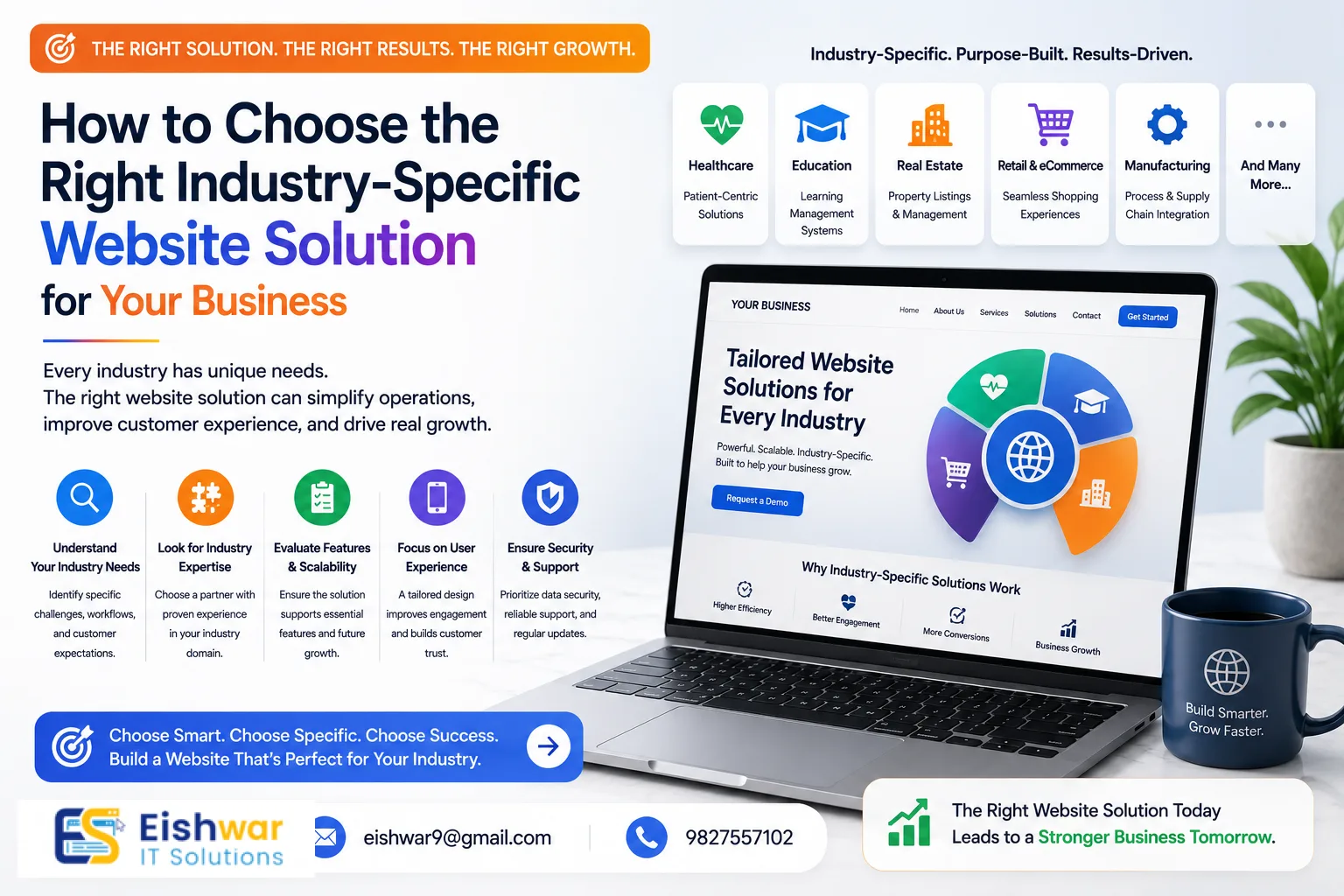
How to Choose the Right Industry-Specific Website Solution for Your Business in India
Introduction
In today's digital-first economy, having a generic website is like showing up to a board meeting in casual wear—it just doesn't fit. For businesses in India, where industries range from manufacturing to healthcare, education to real estate, an industry-specific website solution isn't a luxury; it's a necessity. At EishwarITSolution, we specialize in crafting custom websites that speak directly to your target audience, streamline operations, and boost conversions.
But with so many options available, how do you choose the right one? Whether you're a business owner in Mumbai, a marketer in Bangalore, or a professional in Delhi, this guide will walk you through the process step by step. We'll cover practical tips, common pitfalls, and emerging trends—all tailored to the Indian market. By the end, you'll know exactly what to look for in an industry-specific website solution and how EishwarITSolution can help you achieve your goals.
Main Section 1: Understanding Industry-Specific Website Solutions
An industry-specific website solution is more than just a template with your logo slapped on. It's a strategically designed platform that incorporates features, workflows, and content unique to your sector. For example, a real estate website needs property listing tools, mortgage calculators, and virtual tour integration. A healthcare site requires appointment booking, patient portals, and HIPAA-compliant data handling (or its Indian equivalent under IT Act).
Why does this matter? Because your customers expect a seamless experience. If you run a restaurant in Pune, your website should display menus, accept online orders, and show real-time table availability—not just a contact page. Industry-specific solutions ensure your site does exactly what your business needs, without unnecessary bloat.
In India, industries are diverse. A textile manufacturer in Surat needs a B2B portal with bulk order forms, while a coaching institute in Kota needs a learning management system. The right solution adapts to your industry's language, regulations, and customer behavior.
Consider the example of a logistics company in Delhi. A generic website might list services, but an industry-specific solution includes real-time shipment tracking, route optimization tools, and integration with GST invoicing. This not only improves customer satisfaction but also reduces operational overhead by automating manual processes. Similarly, a dental clinic in Chennai benefits from online appointment scheduling, patient history management, and automated reminders—features that a standard brochure site cannot provide.
To further illustrate, think about a wedding planning business in Jaipur. An industry-specific website would offer vendor directories, budget calculators, guest list management, and photo galleries—all tailored to the wedding industry. This level of specificity builds trust and positions your business as an expert in your field.
Main Section 2: Step-by-Step Guide to Choosing the Right Solution
Selecting an industry-specific website solution requires a structured approach. Here's a practical framework you can use today:
Step 1: Define Your Business Goals
Start by asking: What do you want your website to achieve? Is it lead generation, e-commerce, brand awareness, or client management? For instance, a law firm in Chennai might prioritize a secure client portal, while a fashion boutique in Jaipur needs a visually rich online store. Write down your top three goals and rank them by priority. This will guide every decision you make.
Example: A real estate developer in Mumbai might have goals like generating 50 qualified leads per month, showcasing 100+ properties with virtual tours, and enabling online booking for site visits. These goals directly influence the features you need.
Step 2: Research Industry-Specific Features
List must-have features for your sector. For example, a travel agency needs a booking engine, currency converter, and itinerary builder. A manufacturer needs a product catalog with technical specs and RFQ forms. Compare these with what different providers offer. Create a checklist and score each solution against it.
Practical tip: Look at top competitors in your industry and note the features they offer. For instance, if you run an online pharmacy, features like prescription upload, medicine reminders, and doorstep delivery tracking are essential. A generic e-commerce platform might not support these out of the box.
Step 3: Evaluate Platform Flexibility
Not all solutions are created equal. Some are rigid templates, while others (like those from EishwarITSolution) are fully customizable. Check if the platform allows you to add custom modules, integrate third-party tools (like payment gateways or CRM), and scale as your business grows. Ask about API access and whether you can modify the codebase.
Example: A growing edtech startup in Bangalore might start with a simple course listing but later need live class integration, student analytics, and certification management. A flexible platform can evolve with you, avoiding costly migrations.
Step 4: Check Localization and Language Support
India is multilingual. Your solution should support Hindi, regional languages, and English to reach wider audiences. Also, consider local payment methods like UPI, NetBanking, and Paytm. For example, a food delivery service in Hyderabad should offer Telugu language options and accept payments via Google Pay and PhonePe.
Beyond language, think about cultural nuances. A website for a wedding planner in Punjab might use vibrant colors and include community-specific features like a 'Ladies Sangeet' photo gallery. Localization goes beyond translation—it's about resonance.
Step 5: Review Security and Compliance
Different industries have different compliance needs. For example, healthcare websites must follow data privacy laws, while e-commerce sites need PCI-DSS compliance. Ensure your solution meets these standards. In India, also consider the IT Act and upcoming data protection regulations.
Practical example: A fintech company in Mumbai handling transactions must implement SSL encryption, two-factor authentication, and regular security audits. A generic solution might lack these, putting your business at risk.
Step 6: Test User Experience (UX)
A good industry-specific website is intuitive. Test the demo version with real users from your target audience. Does the navigation make sense? Is the checkout process smooth? Feedback at this stage can save you costly redesigns later. Use tools like heatmaps and session recordings to identify pain points.
Example: For a hospital website, test if patients can easily find doctor profiles, book appointments, and access lab reports. A confusing interface can lead to lost patients and negative reviews.
Step 7: Compare Costs and ROI
Look beyond the upfront price. Consider maintenance, hosting, and future upgrades. A slightly more expensive solution that boosts conversions by 20% is a better investment than a cheap one that frustrates users. Calculate the expected ROI based on your goals. For instance, if a ₹2,00,000 solution generates 100 extra leads per month, and each lead is worth ₹5,000, the payback period is just 4 months.
Main Section 3: Why EishwarITSolution Stands Out for Indian Businesses
At EishwarITSolution, we understand the Indian market inside out. Our team has built websites for dozens of industries—from education to real estate, healthcare to logistics. Here's what sets us apart:
- Deep Industry Expertise: We don't just code; we research your sector. Our solutions come pre-loaded with industry-specific modules, saving you time and money. For example, our real estate solution includes property comparison tools and EMI calculators, while our healthcare solution offers telemedicine integration.
- Customization Without Complexity: You get a bespoke design without the headache of starting from scratch. We tailor every element to your brand and audience. Our clients often say it feels like a custom build, but at a fraction of the cost.
- Localized Approach: Multi-language support, local payment gateways, and region-specific SEO are built into every project. We also optimize for local search terms like 'best hospital in Pune' or 'real estate agent in Delhi'.
- End-to-End Support: From strategy to launch and beyond, our team is with you every step. We even offer training for your staff, ensuring they can manage content and updates independently.
- Proven Results: Our clients see an average 35% increase in leads and 25% improvement in user engagement within three months of launch. For instance, a logistics client in Mumbai reported a 40% reduction in customer support calls after implementing our tracking portal.
We also provide transparent pricing with no hidden fees. Our team works in agile sprints, so you see progress weekly and can provide feedback in real time. This collaborative approach ensures the final product aligns perfectly with your vision.
Expert Tips
Here are actionable tips from our senior strategists at EishwarITSolution:
- Prioritize Mobile-First Design: Over 70% of Indian users browse on mobile. Ensure your industry-specific solution is fully responsive and fast on 4G/5G networks. Test on multiple devices, including budget smartphones common in India.
- Use Schema Markup: Implement structured data for your industry (e.g., LocalBusiness, Product, Event) to improve search visibility. For example, a restaurant can use schema to display menu items and reviews directly in search results.
- Integrate Analytics Early: Set up Google Analytics and heatmaps from day one to track user behavior and iterate quickly. Monitor metrics like bounce rate, conversion rate, and average session duration to identify areas for improvement.
- Leverage Social Proof: Include client testimonials, case studies, and industry certifications to build trust—especially important in B2B sectors. For example, a manufacturing company can showcase ISO certifications and client logos.
- Plan for Scalability: Choose a solution that can handle increased traffic and additional features as your business grows. Cloud-based options are ideal. For instance, an e-commerce site should be able to handle flash sales without crashing.
Bonus tip: Consider integrating chatbots for instant customer support. In industries like healthcare and real estate, chatbots can answer common queries 24/7, freeing up your team for complex tasks.
Common Mistakes
Avoid these pitfalls when selecting your industry-specific website solution:
- Ignoring User Research: Building based on assumptions rather than actual customer needs leads to poor engagement. Always validate with surveys or interviews. For example, a salon might assume clients want online booking, but research might reveal they prefer calling.
- Overcomplicating Features: Too many options can overwhelm users. Focus on core functionalities that directly impact your goals. A travel website doesn't need a blog if the primary goal is bookings.
- Neglecting SEO: A beautiful site that doesn't rank is invisible. Ensure your solution includes SEO-friendly URLs, meta tags, and fast loading times. Use tools like Google PageSpeed Insights to optimize performance.
- Choosing Based on Price Alone: Cheap solutions often lack support, security, and scalability. Invest wisely for long-term success. A ₹20,000 template might cost more in lost revenue than a ₹1,00,000 custom solution.
- Forgetting Content Strategy: A website is only as good as its content. Plan for regular updates, blogs, and multimedia that resonate with your audience. For instance, a healthcare site should publish health tips and patient stories to build authority.
Future Trends
The world of industry-specific website solutions is evolving rapidly. Here's what to watch for in India:
- AI-Powered Personalization: Websites that adapt content and offers based on user behavior will become standard. Expect chatbots, recommendation engines, and dynamic pricing. For example, an e-learning site can recommend courses based on a user's browsing history.
- Voice Search Optimization: With the rise of voice assistants in regional languages, optimizing for voice queries will be crucial for local SEO. Think about phrases like 'best dentist near me' or 'order biryani online'.
- Progressive Web Apps (PWAs): PWAs offer app-like experiences without downloads, ideal for industries like e-commerce and news. They work offline and load instantly, improving user engagement.
- Blockchain for Trust: In sectors like real estate and finance, blockchain can verify transactions and documents, enhancing credibility. For instance, property titles can be stored on a blockchain to prevent fraud.
- Sustainability Metrics: Eco-conscious consumers expect websites to show carbon footprint data, especially for manufacturing and logistics. A green certification badge can differentiate your brand.
Staying ahead of these trends ensures your website remains competitive and relevant in the fast-changing Indian market.
FAQs
What is an industry-specific website solution?
An industry-specific website solution is a tailored website designed to meet the unique needs of a particular sector, such as healthcare, real estate, education, or manufacturing. It includes specialized features, workflows, and content that generic templates lack. For example, a hospital website includes patient portals and appointment scheduling, while a real estate site has property listings and virtual tours.
How do I know which features my industry needs?
Start by analyzing your customer journey and business processes. Research competitor websites, consult with industry peers, and work with experts like EishwarITSolution who have built solutions for similar sectors. Create a list of must-have features based on pain points and goals. For instance, a restaurant might need online ordering, table reservation, and menu management.
Can I customize a pre-built industry solution?
Yes, most reputable providers offer customizable templates. At EishwarITSolution, we modify every aspect—from layout to functionality—to match your brand and requirements. You can add custom modules, change color schemes, and integrate third-party tools. The level of customization depends on the provider, so always ask for examples of past customizations.
How much does an industry-specific website cost in India?
Costs vary based on complexity, features, and customization. Basic solutions start around ₹50,000, while advanced ones with integrations can go up to ₹5,00,000 or more. Factors include the number of pages, custom development, third-party integrations, and ongoing maintenance. Contact EishwarITSolution for a tailored quote based on your specific needs.
How long does it take to build an industry-specific website?
Typically 4 to 12 weeks, depending on the scope. A simple site with pre-built modules can be ready in a month, while a complex solution with custom development may take three months or more. The timeline includes design, development, testing, and deployment. We provide a detailed project plan upfront so you know what to expect.
Will my industry-specific website be SEO-friendly?
Absolutely. At EishwarITSolution, we bake SEO into every project—clean code, fast loading, schema markup, and keyword-optimized content. This ensures your site ranks well on Google and other search engines. We also conduct keyword research specific to your industry and location, such as 'best real estate agent in Bangalore' or 'affordable dental clinic in Pune'.
What ongoing support do you provide after launch?
We offer comprehensive post-launch support, including hosting management, security updates, content updates, and performance monitoring. Our team is available for troubleshooting and feature enhancements. We also provide training for your staff so they can manage the website independently. Support plans are flexible and can be customized to your needs.
Conclusion
Choosing the right industry-specific website solution is a strategic decision that can transform your business. By understanding your industry's unique needs, following a structured selection process, and partnering with an experienced provider like EishwarITSolution, you can build a website that not only looks great but also drives real results.
Remember, your website is often the first impression customers have of your brand. Make it count with a solution tailored to your industry, your audience, and your goals. The future of your business online starts here. With the right approach, your website becomes a powerful tool for growth, efficiency, and customer satisfaction.
CTA
Ready to take your business to the next level with a custom industry-specific website? Contact EishwarITSolution today for a free consultation and personalized demo. Let's build something extraordinary together.