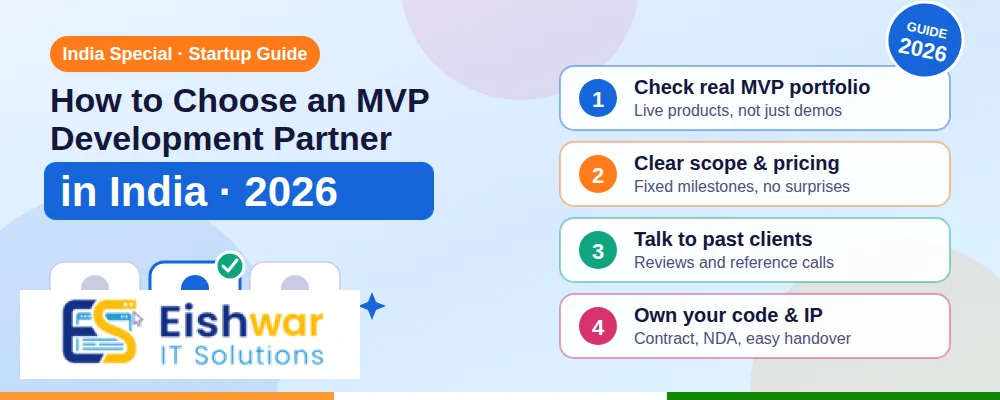
How to Choose an MVP Development Partner in India (2026 Guide)
Introduction
You have an idea, a rough wireframe, and a burning desire to launch. Now you need someone to turn that into a working MVP. The partner you choose will shape your product, your budget, your timeline, and even your investor conversations.
In India, the options are endless. Freelancers, boutique agencies, large IT firms, product studios, and low-code specialists all promise the moon. But the right MVP development partner in India is not just a coder. They are a product thinker, a problem solver, and a temporary co-founder for your tech journey.
This guide is for business owners, marketers, and professionals who want to hire an MVP development partner in India without wasting months or lakhs. We will cover what to look for, how to evaluate, what to avoid, and how to manage the relationship after the contract is signed.
Main Section 1: Understand What an MVP Development Partner Really Does
An MVP, or minimum viable product, is the smallest version of your product that delivers real value to early users. It is not a half-baked demo. It is a learning tool. A good MVP development partner helps you build, measure, and learn fast.
The difference between a coder and a product partner
A coder writes code. A product partner asks why you are building a feature, who will use it, and how you will measure success. They challenge assumptions, suggest alternatives, and protect your budget from scope creep. If your only criterion is the lowest hourly rate, you will likely get code that works but a product that does not sell.
Types of MVP development partners in India
- Freelancers: Good for small, well-defined tasks. Risk: limited capacity, no backup, and you manage everything.
- Boutique agencies: Usually 5 to 30 people. Strong product focus, flexible, and cost-effective. Best for most Indian startups.
- Large IT firms: Process-heavy and expensive. Great for enterprise, overkill for an MVP.
- Product studios: They act like co-founders, often take equity or higher fees. Great if you need deep strategy.
- Low-code specialists: Fast and cheap for validation, but may need a rebuild later. Good for testing demand.
Core services a good partner must offer
- Product discovery and scoping
- UX and UI design for Indian users
- Full-stack web development
- API and third-party integrations (UPI, GST, WhatsApp, payment gateways)
- Quality assurance and testing
- Deployment, DevOps, and monitoring
- Analytics and feedback loops
- Post-launch support and iteration
If a partner only talks about code and not about users, metrics, or go-to-market, that is a red flag.
Main Section 2: The 10-Point Evaluation Framework
Use this framework to compare partners objectively. Score each partner from 1 to 5 on every point. Do not rely on gut feeling alone.
1. Product thinking and discovery
Ask how they run discovery. Do they conduct user interviews? Do they create user stories and acceptance criteria? A partner who jumps straight to quoting hours without understanding the problem will build the wrong thing.
2. Relevant portfolio and live references
Look for live products, not just screenshots. Ask for references from clients whose startups resemble yours. Check if those products are still running. A portfolio of 20 dead links means nothing.
3. Technical depth and stack fit
Your MVP stack should match your long-term goals. Common choices in India include React or Next.js for frontend, Node.js or Django for backend, and PostgreSQL or MongoDB for data. Ask about security, scalability, and how they handle payments. Avoid partners who insist on an obscure stack you cannot hire for later.
4. Communication and project management
Who is your single point of contact? What tools do they use? How often will you get demos? Daily standups and weekly demos are standard. If they disappear for days, your MVP will slip.
5. Legal, IP, and data protection
Insist on an NDA before sharing your idea. The contract must state that all intellectual property belongs to you. With India's Digital Personal Data Protection Act, your partner must handle user data responsibly. Ask about data storage, encryption, and breach protocols.
6. Pricing model and total cost of ownership
Fixed price is easy to budget but risky for changing scope. Time and materials is flexible but can balloon. Retainers work for ongoing work. Ask for a detailed breakup: discovery, design, development, testing, deployment, and support. Do not forget GST, TDS, and payment gateway fees.
7. India-specific compliance and integrations
Your MVP may need UPI autopay, GST invoicing, WhatsApp Business API, or regional language support. A partner with India-specific experience will save you weeks of trial and error.
8. Team stability and key-person risk
Who will actually work on your project? Is the senior developer you met going to be replaced by an intern? Ask about team tenure and backup plans. Key-person risk is real in small agencies.
9. Post-launch support and SLAs
What happens after launch? Do they offer a warranty period? What is the response time for critical bugs? A service-level agreement (SLA) protects you. Without it, you may be stranded.
10. Cultural fit and founder mindset
You will work closely with this team for months. Do they respect your time? Do they push back when needed? Do they celebrate your wins? Choose a partner who feels like an extension of your team.
Main Section 3: How to Run the Selection Process Step by Step
Now that you know what to evaluate, here is a practical process to choose the right MVP development partner in India.
Step 1: Define your MVP scope and success metrics
Write a one-page document. State the problem, target user, core features, and what success looks like in 90 days. For example: 500 signups, 50 paying users, 20% weekly retention. This document becomes your RFP and your scorecard.
Step 2: Create a shortlist of 3 to 5 partners
Sources include referrals, LinkedIn, startup communities, and platforms like Clutch. Avoid choosing only on price. Look for partners who have built similar products or served similar customers.
Step 3: Send a focused RFP
Include your scope, timeline, budget range, and must-have integrations. Ask for a proposed approach, team structure, timeline, and cost. A good partner will ask questions before quoting.
Step 4: Run discovery calls and ask hard questions
Use the 10-point framework. Ask for examples of failures and how they handled them. Ask what they would not do. Ask how they handle scope changes. The answers reveal more than polished presentations.
Step 5: Use a paid discovery or trial project
Before signing a large contract, pay for a small discovery sprint or a two-week trial. This reduces risk for both sides. You see how they work, and they understand your product.
Step 6: Score and negotiate
Score each partner. Negotiate on scope, timeline, and payment milestones, not just price. A lower price with vague deliverables is a trap. Tie payments to milestones: 20% kickoff, 30% design approval, 30% development completion, 20% launch.
Step 7: Onboard with clear governance
Set up a shared Slack or Teams channel. Agree on sprint length, demo schedule, and reporting format. Define who approves changes. Keep a decision log. This prevents confusion later.
Step 8: Plan for handover from day one
Ask for documentation, code comments, and access to repositories. A good partner wants you to be independent. A bad partner holds your code hostage. Make handover a contract requirement.
Expert Tips
- Tip 1: Hire for product thinking, not just coding speed. The fastest code is useless if it solves the wrong problem.
- Tip 2: Always talk to at least two past clients. Ask if they would hire the partner again.
- Tip 3: Keep your MVP scope brutally small. Every extra feature delays learning and increases cost.
- Tip 4: Insist on a written change request process. Verbal changes are how budgets die.
- Tip 5: Own your domain, hosting, and third-party accounts from day one. Do not let the agency register them in their name.
- Tip 6: Budget 20% of your MVP cost for post-launch iteration. The first version is never the final version.
- Tip 7: Choose a partner who understands Indian users: UPI habits, low-bandwidth conditions, and regional language needs.
Common Mistakes
- Mistake 1: Choosing the cheapest quote. You will pay twice when you rebuild.
- Mistake 2: Skipping the contract. A handshake is not a legal agreement.
- Mistake 3: Not checking IP ownership. Some contracts give the agency rights to your code.
- Mistake 4: Over-scoping the MVP. If it takes six months, it is not an MVP.
- Mistake 5: Ignoring post-launch support. Launch is the start, not the finish.
- Mistake 6: Hiring a partner who cannot communicate in your language. Miscommunication kills projects.
- Mistake 7: Forgetting data privacy. With DPDP Act, non-compliance can cost you crores.
Future Trends
The way Indian startups hire MVP development partners is changing. Here is what to expect in 2026 and beyond.
- AI-assisted development: Partners will use AI to write boilerplate code, generate tests, and speed up prototyping. This reduces cost but increases the need for human product judgment.
- Composable and headless architectures: More MVPs will use headless CMS, serverless functions, and API-first design. This makes it easier to swap components later.
- DPDP Act compliance by design: Data protection will be built into MVPs from day one, not added later.
- Fractional CTO and product leadership: Startups will hire part-time technical leaders to manage agencies, reducing risk.
- Outcome-based pricing: Some partners will tie fees to milestones like user acquisition or retention, not just hours.
- Vertical SaaS and micro-SaaS: Niche MVPs for specific industries will grow, requiring partners with domain knowledge.
- Remote-first collaboration: Time zone and tool proficiency will matter more than physical location.
FAQs
1. How much does it cost to hire an MVP development partner in India?
For a simple web MVP, expect ₹1.5 lakh to ₹5 lakh. A mid-complexity MVP with integrations can cost ₹5 lakh to ₹15 lakh. Enterprise-grade MVPs may exceed ₹20 lakh. Always ask for a detailed breakup and include GST and support costs.
2. Should I hire a freelancer or an agency for my MVP?
If your scope is small, well-defined, and you can manage the project, a freelancer can work. For anything complex, an agency offers reliability, diverse skills, and backup. Most startups benefit from a boutique agency that provides product thinking and full-stack delivery.
3. How long does it take to build an MVP in India?
A focused web MVP typically takes 6 to 12 weeks. Simple low-code MVPs can launch in 3 to 4 weeks. Complex MVPs with multiple integrations may take 4 to 6 months. Timelines depend on scope clarity and feedback speed.
4. What legal documents should I sign with my MVP partner?
You need a non-disclosure agreement (NDA), a master services agreement (MSA), and a statement of work (SOW). Ensure the contract covers IP assignment, confidentiality, payment terms, termination, and data protection. Get a lawyer to review it.
5. How do I protect my idea when sharing it with agencies?
Share only what is necessary during initial conversations. Sign an NDA before revealing sensitive details. Focus on the problem and target user first. A professional agency will respect your IP and not steal your idea.
6. What if the MVP partner delivers poor quality?
Have clear acceptance criteria and milestone-based payments. If quality is poor, stop payments and invoke the contract's remedy clause. Regular demos and code reviews help catch issues early. Prevention is better than legal battles.
7. Can I hire an MVP development partner outside India?
Yes, but consider time zones, communication, and legal jurisdiction. Indian partners understand the local market, payment systems, and compliance better. For India-focused startups, a local partner often has an edge.
Conclusion
Choosing an MVP development partner in India is one of the most important decisions you will make as a founder. The right partner will challenge you, build fast, and help you learn from real users. The wrong partner will burn your budget and delay your launch.
Use the 10-point framework, run a structured selection process, and never skip the legal and post-launch details. Focus on product thinking, communication, and cultural fit. Remember, an MVP is not about perfection. It is about learning quickly and iterating toward product-market fit.
Take your time to choose well. Your future self will thank you.
CTA
Ready to build your MVP with a partner who understands Indian startups? EishwarITSolution helps founders turn ideas into working web solutions. Visit eishwar.com or contact us for a free consultation. Let us build something your users will love.