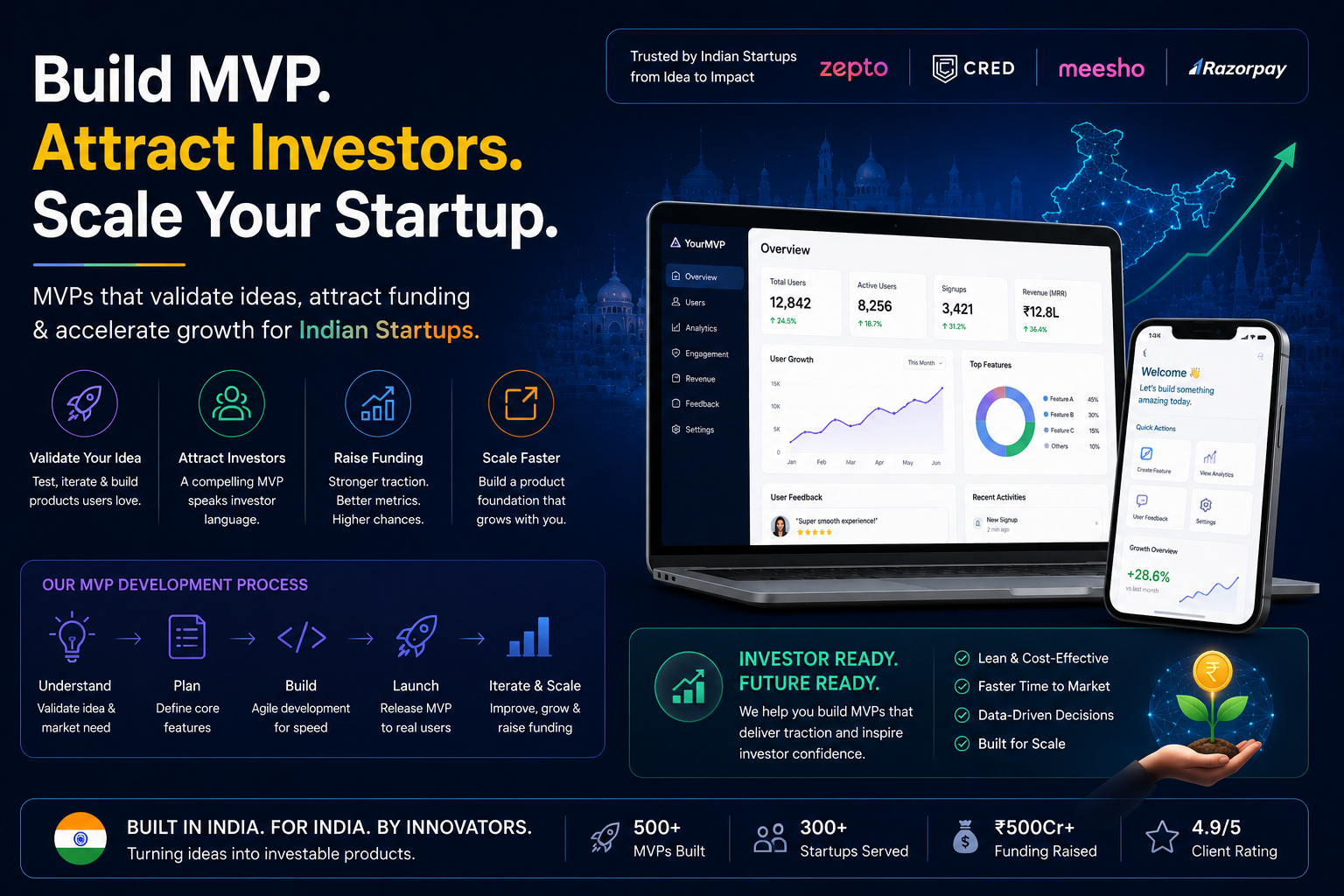
How to Build an MVP That Attracts Investors: A Blueprint for Indian Startups
Introduction
Building a Minimum Viable Product (MVP) is a critical step for any startup. But for Indian entrepreneurs, the challenge is bigger: you need an MVP that does more than test your idea—it must attract investors. In a competitive funding landscape, having a polished, data-backed MVP can be your ticket to seed funding or Series A. This guide walks you through exactly how to build an investor-ready MVP, with practical examples and insider tips from the Indian startup ecosystem. We'll cover everything from why investors care about MVPs to the specific components that make them irresistible, step-by-step building instructions, expert advice, common pitfalls, and future trends. Whether you're in Bangalore, Mumbai, or a smaller city, this blueprint is designed to help you stand out and secure the capital you need.
Main Section 1: Why Investors Care About Your MVP
Investors don't just fund ideas—they fund execution. An MVP is your proof of concept. It shows you can ship, iterate, and listen to users. For Indian startups, where investor scrutiny is high, your MVP must demonstrate traction, market fit, and scalability. A well-built MVP reduces risk and builds confidence. Take the example of Ola: their MVP was a simple booking system for a few cars in Bangalore. That tiny test proved demand and helped them raise early funding. Your MVP should tell a similar story—small but powerful. Investors want to see that you've validated the problem, have a clear solution, and can execute efficiently. They also look for evidence of product-market fit, which an MVP can provide through user engagement and feedback. In India, where the startup ecosystem is rapidly maturing, investors are particularly keen on MVPs that show an understanding of local nuances, such as regional languages, payment preferences, and cultural behaviors. A well-executed MVP can be the difference between a polite 'no' and a term sheet.
Main Section 2: Key Components of an Investor-Ready MVP
To attract investors, your MVP needs these elements:
- Core Value Proposition: Solve one problem exceptionally well. Don't build features—build a solution. For example, if you're creating a food delivery app, focus on fast and reliable delivery for a specific cuisine or locality, rather than trying to offer every restaurant in the city.
- User Feedback Loop: Include analytics and feedback mechanisms. Investors want to see you learn from users. Tools like Google Analytics, Hotjar, or in-app surveys can capture valuable insights. For instance, a health-tech startup we advised integrated a simple feedback form after each consultation, which helped them refine their doctor matching algorithm.
- Scalable Architecture: Use tech that can grow. Avoid custom hacks that limit future expansion. Cloud services like AWS, Google Cloud, or Azure provide scalable infrastructure. For example, a SaaS startup used serverless functions on AWS Lambda to handle variable loads without upfront costs.
- Clear Metrics: Track user acquisition, retention, and engagement. Numbers speak louder than ideas. Key metrics include daily active users (DAU), monthly active users (MAU), churn rate, customer acquisition cost (CAC), and lifetime value (LTV). A fintech startup we worked with tracked these metrics from day one and presented them in a clean dashboard to investors.
- Professional Design: Even a simple MVP should look clean and functional. First impressions matter. Use design frameworks like Material Design or Bootstrap to ensure a consistent and appealing UI. A cluttered or ugly interface can undermine your credibility.
For example, a fintech startup we worked with built an MVP that only handled UPI payments for small merchants. They tracked daily active users and churn rate. Within three months, they had data to show investors and secured a seed round. The key was their laser focus on a single pain point—quick and reliable UPI transactions—and their ability to demonstrate real user adoption.
Main Section 3: Steps to Build an MVP That Attracts Investors
Follow this blueprint:
- Identify the Problem: Talk to 20-30 potential users. Validate the pain point. Use interviews, surveys, and observation to understand their struggles. For example, an edtech startup discovered that students in tier-2 cities struggled with English pronunciation, so they built an MVP focused on voice-based learning.
- Define Success Metrics: What does success look like? 100 signups? 50% retention? Set targets. Be specific: 'We aim to achieve 500 signups in the first month with a 60% retention rate after 30 days.' This gives investors a clear benchmark.
- Build with Speed: Use no-code tools or lean development. Aim for 4-6 weeks. Platforms like Bubble, Webflow, or Adalo allow rapid prototyping. For backend, consider Firebase or AWS Amplify. Keep costs low but functionality high. A logistics startup built their MVP in 5 weeks using Bubble, integrating a simple map interface for tracking deliveries.
- Test with Real Users: Launch to a small group. Collect feedback aggressively. Use beta testing platforms like BetaList or Product Hunt, or reach out to your network. Encourage users to report bugs and suggest improvements. A social commerce startup launched to 100 users on WhatsApp and iterated based on their feedback.
- Iterate Quickly: Fix bugs, improve UX, and add one or two key features based on feedback. Use agile methodologies to release updates every week. For instance, a travel-tech startup added a 'book later' feature after users requested it, which increased engagement by 20%.
- Show Traction: Document growth, user stories, and metrics. Create a one-pager for investors. Include a timeline of your progress, key milestones, and testimonials. A health-tech startup created a simple PDF with graphs showing user growth and retention, which they used in investor meetings.
Actionable tip: Use tools like Bubble or Webflow for rapid prototyping. For backend, consider Firebase or AWS Amplify. Keep costs low but functionality high. Also, consider using A/B testing tools like Optimizely to refine your MVP based on user behavior.
Expert Tips
- Focus on One Metric: Choose one key performance indicator (KPI) that matters most to your business. Investors love clarity. For a subscription service, that might be monthly recurring revenue (MRR). For a marketplace, it could be the number of transactions.
- Tell a Story: Your MVP is a narrative. Frame it as a journey from problem to solution. Use data to back up your story. For example, 'We discovered that 80% of small businesses in India struggle with inventory management. Our MVP reduced their stockouts by 30% in just two months.'
- Network Before Launch: Connect with angel investors and accelerators early. They can provide guidance and warm introductions. Attend events like Startup India or NASSCOM product conclaves. A fintech startup we know got their first investor introduction through a mentor at an accelerator.
- Prepare a Pitch Deck: Your MVP data should feed directly into your pitch deck. Highlight user feedback and growth. Include screenshots, user testimonials, and a demo video. Keep it concise—10-12 slides max.
- Leverage Local Insights: Indian investors appreciate startups that understand local challenges. For example, if your MVP addresses a problem specific to Indian farmers or small retailers, emphasize that in your pitch.
Common Mistakes
- Overbuilding: Adding too many features dilutes your core value. Keep it minimal. Remember, an MVP is about learning, not perfection.
- Ignoring User Feedback: If you don't listen, investors won't trust your ability to iterate. Set up a system to collect and analyze feedback regularly.
- Poor Design: A clunky MVP screams amateur. Invest in a decent UI. Even a simple design should be intuitive and visually appealing.
- No Data Collection: Without metrics, you have no proof. Track everything. Use analytics tools from day one.
- Wrong Target Audience: Test with your ideal customer, not friends and family. Friends and family may give biased feedback. Instead, target early adopters who fit your customer persona.
- Neglecting Legal and Compliance: In India, regulatory compliance is crucial, especially for fintech, healthtech, or edtech. Ensure your MVP adheres to relevant laws to avoid investor concerns.
Future Trends
The Indian startup ecosystem is evolving. In 2026, investors are looking for MVPs that leverage AI for personalization, use blockchain for transparency, or focus on sustainability. No-code platforms will make MVP development even faster. We also see a rise in micro-MVPs—ultra-lean versions that test a single feature. For example, a startup might launch a simple chatbot to validate demand before building a full app. Additionally, there's a growing emphasis on data privacy and security, so MVPs that incorporate these features will stand out. Stay ahead by adopting these trends early. Consider integrating AI tools like OpenAI's API for personalized recommendations, or using blockchain for supply chain transparency. Also, keep an eye on government initiatives like Digital India and Startup India, which can provide support and resources.
FAQs
What is an MVP and why do investors care?
An MVP (Minimum Viable Product) is the simplest version of your product that solves a core problem. Investors care because it proves you can execute and validate market demand. It reduces their risk and shows you have a data-driven approach to building a business.
How long does it take to build an MVP for investors?
Typically 4-8 weeks, depending on complexity. Use no-code tools to speed up the process. For a simple MVP, you can even launch in 2-3 weeks with platforms like Bubble or Webflow.
What metrics should I track in my MVP?
Focus on user acquisition, retention rate, engagement, and conversion. Investors want to see growth and stickiness. Specific metrics include DAU, MAU, churn rate, CAC, and LTV. For a marketplace, track number of transactions and average order value.
Can I build an MVP without coding?
Yes! Platforms like Bubble, Webflow, and Adalo allow you to build functional MVPs without coding. Great for testing ideas quickly. However, for complex features like real-time data processing, you may need some custom development.
How do I present my MVP to investors?
Create a demo video, a one-page summary with key metrics, and a pitch deck that highlights user feedback and traction. Practice your story. Use tools like Loom for quick demos, and include a link to your live MVP if possible.
What is the ideal budget for building an MVP in India?
The cost can range from ₹50,000 to ₹5,00,000, depending on complexity and whether you use no-code tools or hire developers. For a simple MVP, using no-code platforms can keep costs under ₹1,00,000. Always prioritize essential features to stay within budget.
How do I validate my MVP idea before building?
Conduct customer interviews, create a landing page with a sign-up form, or run a small survey. Tools like Typeform or Google Forms can help. If you get 50-100 sign-ups or positive responses, it's a good sign to proceed with building your MVP.
Conclusion
Building an MVP that attracts investors is about more than just code—it's about strategy. Focus on solving a real problem, collect data, and iterate based on feedback. Indian startups have immense potential, and with the right MVP, you can unlock funding and scale. Start today, stay lean, and let your MVP do the talking. Remember, every successful startup began with a simple MVP that proved its worth. Your journey starts now.
CTA
Ready to build an investor-ready MVP? Contact EishwarITSolution today for a free consultation. Let's turn your idea into a fundable reality. Our team of experts specializes in building MVPs for Indian startups, with a focus on scalability and investor appeal. Don't wait—your next round of funding is just an MVP away.