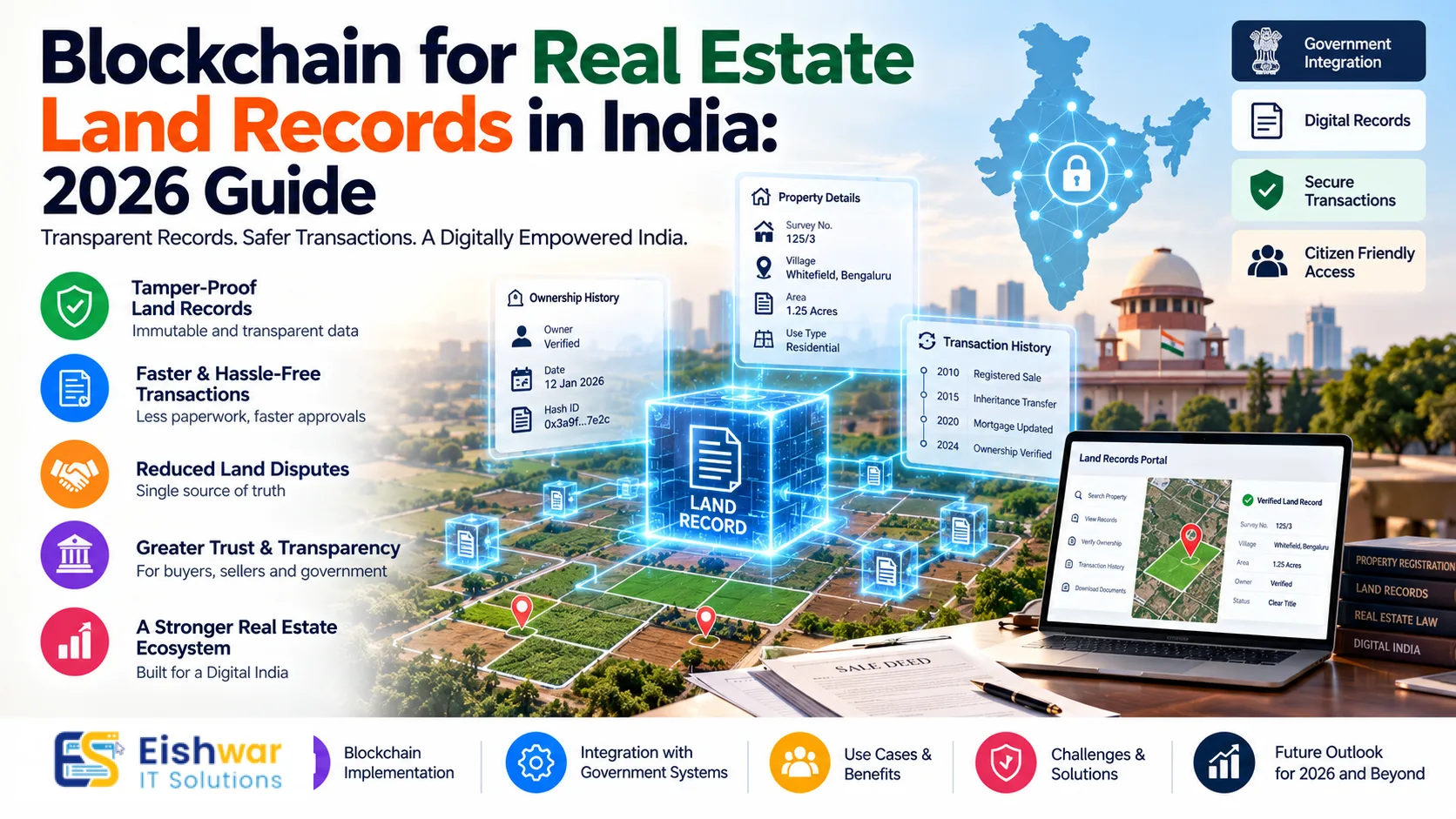
Blockchain for Real Estate Land Records in India: 2026 Guide to Transparent Property Transactions
Introduction
Land disputes in India are a costly affair. They clog courts, delay infrastructure projects, and scare off investors. According to a 2024 NITI Aayog report, over 66% of civil cases in India relate to land or property disputes. That's a staggering number. But what if there was a way to make land records tamper-proof, transparent, and instantly verifiable? Enter blockchain.
Blockchain technology, the same innovation behind Bitcoin and Ethereum, is now being applied to real estate land records. In India, several states have already piloted blockchain-based land registries. By 2026, this technology is set to move from pilot projects to mainstream adoption. For business owners, marketers, and professionals, understanding this shift is not just about technology—it's about opportunity.
This guide will walk you through how blockchain for real estate land records in India works, the web solutions driving it, and what you need to know to stay ahead. We will also cover practical examples, implementation tips, and common mistakes so you can move from curiosity to action.
Why does this matter to web solution providers? Because land records are not just government databases. They are the foundation for property marketplaces, loan origination systems, legal-tech tools, and smart city dashboards. When the record layer becomes programmable, every web application built on top of it can become faster, safer, and more valuable.
Main Section 1: The State of Land Records in India & Why Blockchain Matters
India's land records system is a complex web of paper documents, fragmented databases, and manual processes. Each state has its own registration department, and records are often stored in local offices. Even within a state, revenue, registration, and municipal departments may maintain separate versions of the truth. This creates several problems:
- Fraud and Forgery: Fake title deeds, double selling, and unauthorized mutations are common. A single forged signature can transfer a property that belongs to someone else.
- Disputes and Litigation: Ambiguous ownership leads to lengthy court battles. Families, businesses, and developers can spend years proving a basic fact.
- Inefficiency: Buying or selling property involves multiple visits, bribes, and delays. A simple title search can take weeks and requires coordination across offices.
- Lack of Trust: Buyers cannot easily verify if a property is free from encumbrances. Banks face similar risk when accepting land as collateral.
Blockchain offers a solution by creating a single, immutable ledger of land ownership. Once a transaction is recorded, it cannot be altered or deleted. Every change is time-stamped and traceable. This brings unprecedented transparency and trust. Instead of trusting a single clerk or local server, participants trust a shared record that everyone can audit according to permissions.
It is important to understand what blockchain does and does not do. It does not magically correct bad data at the source. It does create a tamper-evident history from the point of entry. That means the first mile—survey, verification, and data entry—still matters enormously. But once data is on-chain, manipulation becomes far harder.
Why Now?
The Indian government's push for Digital India and the success of Aadhaar and DigiLocker have created a digital infrastructure. States like Telangana, Andhra Pradesh, Maharashtra, and Karnataka have already launched blockchain land record pilots. The technology is mature, and the legal framework is catching up.
Consider Telangana's Dharani portal, which integrates land records with blockchain for secure mutations. Andhra Pradesh has piloted a blockchain-based land registry to reduce fraud. These initiatives prove that the concept works. The missing piece is widespread adoption and integration with web solutions that businesses can use.
For a web solutions company, this is a classic platform shift. When Aadhaar APIs became available, entire businesses were built around e-KYC. When UPI arrived, payment gateways were rebuilt. Blockchain land records will create similar opportunities for property-tech portals, legal-tech platforms, and fintech integrations.
Main Section 2: How Blockchain-Powered Web Solutions Work for Property Transactions
Blockchain isn't just a backend database. It powers a new generation of web solutions that make property transactions seamless. Here's how it works:
1. Digital Identity and Verification
Using blockchain-based digital identities (DIDs), buyers, sellers, and officials can verify each other without paperwork. Integration with Aadhaar and PAN can ensure KYC compliance while preserving privacy. For businesses, this means faster onboarding and reduced fraud risk. A property marketplace can verify a seller in seconds, check that the PAN matches the title deed, and confirm that the Aadhaar-linked identity has not been flagged—all without storing raw identity documents on a central server.
2. Smart Contracts for Property Transfer
Smart contracts are self-executing agreements coded on the blockchain. When a buyer pays, the ownership automatically transfers. Escrow services, stamp duty, and registration fees can be handled automatically. This reduces human error and corruption. Imagine a scenario where a builder sells a flat, and the ownership token is transferred to the buyer's digital wallet instantly upon payment confirmation. No middlemen, no delays.
In practice, a smart contract might hold funds in escrow until the registrar's digital signature is added. If the seller fails to deliver clear title, the contract can refund the buyer automatically. This is not about removing lawyers or registrars; it is about giving them better tools.
3. Immutable Land Registry
All land records are stored on a distributed ledger. Any change—sale, inheritance, mortgage—is recorded as a new block. The entire history is visible to authorized parties. This eliminates duplicate records and fraudulent mutations. Banks can verify collateral in seconds, not weeks. If a property has been mortgaged three times, the ledger shows it. If a mutation was reversed by a court order, that too is recorded.
4. Tokenization of Real Estate
Properties can be tokenized into digital assets. This allows fractional ownership, making real estate investment accessible to smaller investors. It also enables faster liquidity and easier transfer of shares. In India, platforms like RealX are already exploring this model. A commercial building could be divided into 10,000 tokens, each representing a share of rental income and appreciation. Blockchain land records make the underlying ownership verifiable, which is essential for trust.
5. Web Portals and Mobile Apps
State governments and private players are building web portals where citizens can view land records, initiate transfers, and pay taxes. These portals are powered by blockchain on the backend, ensuring data integrity. For businesses, this means APIs to integrate with existing ERP and CRM systems. You can automate property due diligence, title searches, and compliance checks.
6. APIs and Backend Integration
The real value for web solution providers is in integration. A fintech app can call a blockchain land record API to check title status before approving a loan. A legal-tech platform can pull mutation history into a due diligence report. A property listing site can display a 'blockchain verified' badge that links to an on-chain proof. These integrations require secure APIs, role-based access, and careful data privacy design.
Main Section 3: Real-World Applications & Business Benefits for Indian Stakeholders
Blockchain for land records is not just a government project. It has massive implications for businesses across sectors.
For Real Estate Developers
Developers can prove clear title, speed up approvals, and reduce litigation. They can also tokenize projects to raise funds from a broader investor base. A developer in Mumbai can showcase a blockchain-verified title certificate to potential buyers, building instant trust. For large townships, a blockchain record can track plot allotments, construction milestones, and environmental clearances in one place.
For Banks and Financial Institutions
Banks can use blockchain land records to verify collateral before issuing loans. Smart contracts can automate mortgage repayments and release liens instantly. This reduces NPAs and speeds up lending. Imagine a home loan that automatically adjusts the interest rate based on on-chain credit scores—that's the future. Even a simple change like automatic lien release after full repayment can remove weeks of paperwork.
For Legal Professionals
Lawyers can perform due diligence faster. Title searches that took weeks can be done in minutes. This reduces costs and improves client service. Law firms can offer new advisory services around smart contract auditing and blockchain compliance. Instead of hunting for missing pages in a sub-registrar office, a lawyer can focus on interpretation, risk, and negotiation.
For Property Buyers and Sellers
Individuals benefit from transparent pricing, fewer intermediaries, and faster closings. They can verify ownership history with a few clicks. No more paying bribes to get a copy of a document. A seller with a clean blockchain record can command a premium because buyers trust the history.
For Government
Governments can increase revenue through accurate property taxes, reduce disputes, and improve ease of doing business. It also helps in land acquisition for infrastructure projects. A 2025 report by the World Economic Forum estimates that blockchain-based land registries could save India up to $5 billion annually in dispute resolution and administrative costs.
For Web Solution Providers and Marketers
This is a new vertical for agencies and SaaS companies. You can build blockchain-verified property portals, white-label due diligence tools, and API marketplaces. Marketers can position brands around trust, transparency, and speed. A real estate portal that offers verifiable title history will differentiate itself in a crowded market.
Challenges to Overcome
Despite the promise, challenges remain. Scalability is a concern—public blockchains can be slow. Privacy is another issue; land records contain sensitive data. The digital divide means not everyone has internet access. Finally, legal recognition of blockchain records is still evolving. Businesses must navigate these hurdles carefully. A permissioned blockchain with off-chain storage for sensitive documents is often the pragmatic choice.
Expert Tips
- Start with a Pilot: If you're a business looking to integrate blockchain, begin with a small pilot project. Test the technology with a single property or a small portfolio. Measure time saved, cost reduced, and user satisfaction.
- Collaborate with Government: Align your solutions with state government initiatives. Many states have sandbox programs for blockchain startups. A pilot with a registrar office can give you credibility and real data.
- Ensure Legal Compliance: Work with legal experts to ensure your blockchain solution complies with the Registration Act, Transfer of Property Act, and data protection laws. Digital signatures must be legally valid.
- Choose the Right Blockchain: For land records, permissioned blockchains like Hyperledger Fabric or Quorum are often more suitable than public ones due to privacy and scalability. You can also use a hybrid model.
- Focus on User Experience: The best blockchain solution is useless if it's hard to use. Invest in intuitive web and mobile interfaces. Users should not need to understand hashes or wallets.
- Integrate with Existing Systems: Use APIs to connect with Aadhaar, DigiLocker, and state land record databases. Avoid creating another silo.
- Build a Consortium: Partner with banks, lawyers, and government officials to create a shared blockchain network. This increases trust and adoption. Governance rules matter as much as code.
Common Mistakes
- Ignoring Legal Framework: Blockchain doesn't replace the law. You still need legally recognized digital signatures and registration processes. A smart contract is not a substitute for a registered deed.
- Overcomplicating the Solution: Not every property transaction needs a custom blockchain. Sometimes a simple distributed ledger suffices. Start simple and add complexity only when needed.
- Neglecting Data Privacy: Land records contain sensitive personal data. Ensure compliance with India's Digital Personal Data Protection Act, 2023. Store personal data off-chain and only hashes on-chain.
- Lack of Stakeholder Buy-In: Involve registrars, lawyers, banks, and citizens early. Adoption is as much about people as technology. Training and change management are essential.
- Assuming Immutability Solves Everything: Garbage in, garbage out. The initial data entry must be accurate. Oracles and verification mechanisms are crucial. A wrong entry becomes permanently wrong unless a controlled correction process exists.
- Forgetting Scalability: Plan for growth. A blockchain that works for 100 properties may fail for 100,000. Test throughput and storage costs before going live.
Future Trends
- Integration with AI and IoT: AI can analyze land records for patterns, while IoT sensors can track property usage and environmental compliance. This can help with smart city planning and property tax assessment.
- Tokenized Real Estate and DeFi: Expect to see more fractional ownership platforms and DeFi mortgages built on blockchain land records. This could unlock liquidity for otherwise illiquid assets.
- National Blockchain Land Registry: A unified national portal could emerge, linking state registries for seamless inter-state transactions. This would be a massive boost for infrastructure and investment.
- Digital Twins: Virtual replicas of properties on the blockchain will enable remote due diligence and smart city planning. A buyer could take a virtual tour and verify ownership in the same session.
- Green Land Records: Blockchain can track carbon credits and environmental compliance tied to land use. This creates new markets for sustainable development.
- Interoperability: Cross-chain solutions will allow different state blockchains to communicate, making property transactions across states effortless. Standards will be critical.
FAQs
Is blockchain land records legally valid in India?
Currently, blockchain land records are not a replacement for traditional registration. However, states like Telangana and Andhra Pradesh have issued government orders recognizing blockchain-based records for specific purposes. The legal framework is evolving, and by 2026, we expect more clarity on digital signatures, evidentiary value, and integration with the Registration Act.
How can small businesses benefit from blockchain land records?
Small businesses can benefit by using blockchain-powered platforms for property verification, faster loan approvals, and transparent lease agreements. It reduces risk and saves time and money. For example, a small logistics company can verify a warehouse title in minutes before signing a long-term lease.
What are the costs involved in implementing blockchain for land records?
Costs vary based on scale. A basic pilot can start from ₹5-10 lakhs, while enterprise solutions may cost more. However, the long-term savings from reduced fraud and litigation far outweigh the initial investment. Cloud-based permissioned blockchains can reduce infrastructure costs significantly.
Will blockchain eliminate the need for lawyers and registrars?
No. Blockchain automates processes but still requires legal oversight, especially for dispute resolution and complex transactions. Lawyers will shift from paperwork to advisory roles, and registrars will focus on verification and exception handling.
How does blockchain ensure data privacy?
Permissioned blockchains allow only authorized parties to view sensitive data. Zero-knowledge proofs can verify ownership without revealing personal details. Compliance with data protection laws is essential, so personal data is often stored off-chain while only cryptographic proofs go on-chain.
Can I tokenize my property in India?
Tokenization is still in a grey area legally. Some platforms offer it for investment purposes, but regulatory approval is needed. Consult a legal expert before proceeding. The Securities and Exchange Board of India and other regulators are still studying the model.
What is the role of Web3 in land records?
Web3 enables decentralized applications and user-owned data. In land records, Web3 can give property owners control over their digital identity and records, while enabling peer-to-peer transactions without intermediaries. It also supports wallet-based access to land documents.
Conclusion
Blockchain for real estate land records in India is not a futuristic fantasy—it's happening now. From Telangana's pilot to Maharashtra's blockchain sandbox, the momentum is building. For business owners, marketers, and professionals, this presents a unique opportunity to be part of a transparent, efficient, and trustworthy property ecosystem. The technology is ready. The need is urgent. By 2026, blockchain-powered land records will be a competitive advantage for those who adopt early. Whether you're a developer, banker, lawyer, or entrepreneur, now is the time to understand and embrace this shift. Start by auditing your current property workflows, identifying trust gaps, and exploring how blockchain APIs can plug into your existing web platforms.
CTA
Ready to explore blockchain solutions for your real estate business? <a href='http://eishwar.com/contact'>Contact EishwarITSolution</a> today for a free consultation. Our experts can help you integrate blockchain into your web platforms, ensuring transparency and security. Don't get left behind—let's build the future of property transactions together.