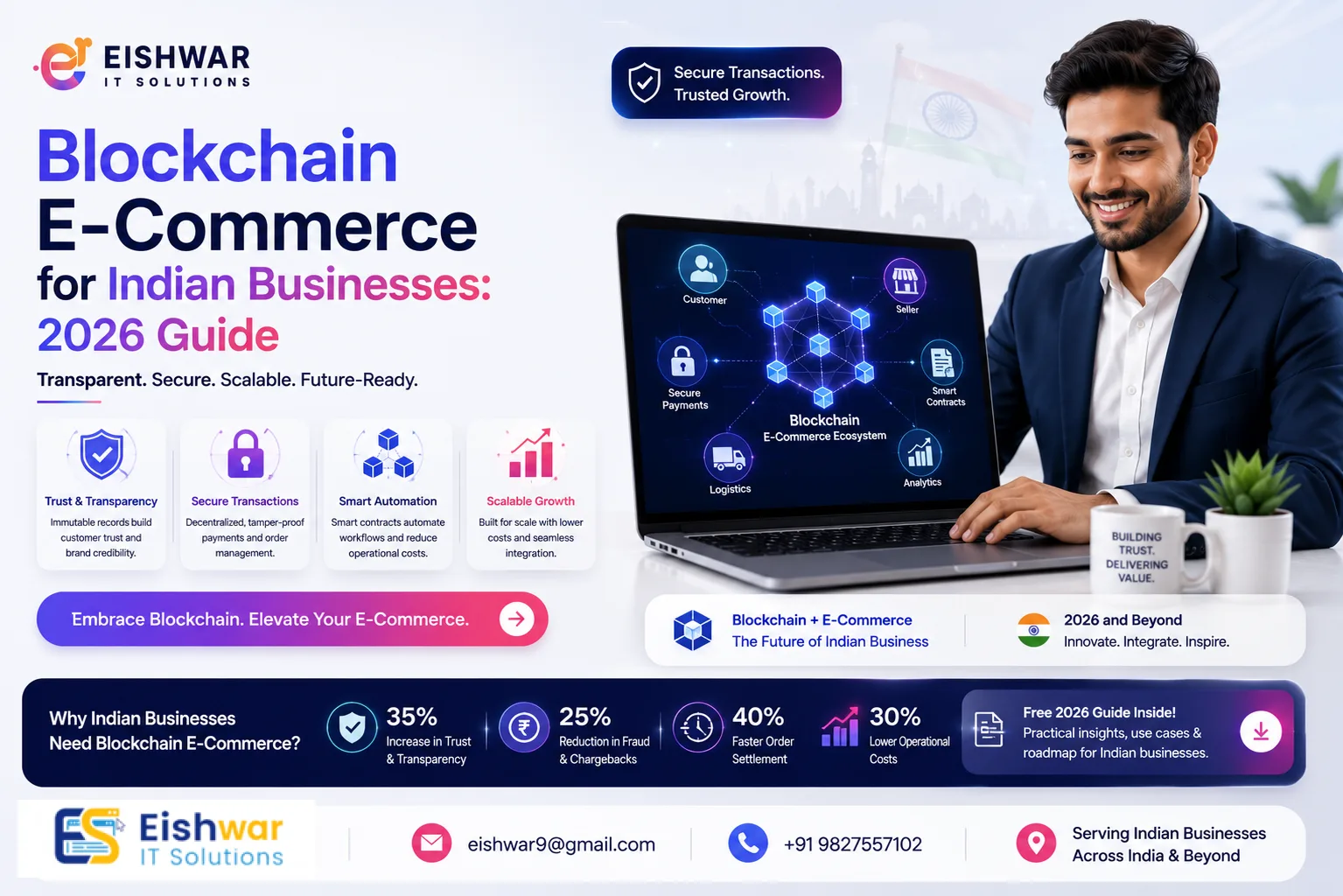
Blockchain E-Commerce for Indian Businesses: 2026 Guide
Introduction
India's e-commerce market is booming, with over 300 million online shoppers and projections to exceed $200 billion by 2026. Yet, traditional platforms still grapple with high transaction fees, counterfeit goods, data breaches, and opaque supply chains. Enter blockchain-based e-commerce platforms—a decentralized alternative that promises transparency, security, and cost savings. For Indian business owners, marketers, and professionals, this isn't just a tech upgrade; it's a strategic advantage in a hyper-competitive market.
In this guide, we'll explore how blockchain e-commerce works, why it matters for India, and how you can leverage it to future-proof your online business. From accepting crypto payments to tokenizing loyalty programs, we cover actionable insights without the jargon overload. We'll also dive into practical examples from Indian small and medium enterprises (SMEs) that have already started this journey, providing a roadmap you can follow step by step.
Main Section 1: Why Blockchain E-Commerce Matters for Indian Businesses in 2026
Blockchain technology, at its core, is a decentralized ledger that records transactions transparently and immutably. When applied to e-commerce, it eliminates intermediaries, reduces fraud, and gives buyers and sellers direct control. For Indian businesses, this translates to several key benefits:
- Lower Transaction Costs: Credit card and payment gateway fees in India typically range from 2-5%. Blockchain-based payments, especially using stablecoins or central bank digital currencies (CBDCs), can slash those fees to near zero. For a business processing ₹10 lakh per month, this could save ₹20,000-50,000 annually—money that can be reinvested into growth.
- Enhanced Trust: With product provenance recorded on-chain, customers can verify authenticity—crucial for industries like luxury goods, electronics, and organic food. For example, a Bengaluru-based organic spice brand can provide a QR code on each package that links to a blockchain record showing the farm, harvest date, and certification details, reducing counterfeiting risks.
- Global Reach: Accept payments from anywhere without currency conversion hassles or cross-border fees. A Jaipur artisan selling to a buyer in London can receive USDC (a stablecoin) and convert to INR instantly via a crypto-to-fiat ramp, bypassing the 3-5% forex markup charged by banks.
- Data Security: Decentralized storage reduces the risk of massive data breaches that plague centralized platforms. With blockchain, customer data is not stored in a single honeypot; instead, it's encrypted and distributed across nodes, making it nearly impossible for hackers to compromise.
- Supply Chain Transparency: Blockchain enables end-to-end traceability, which is increasingly demanded by conscious consumers. A study by IBM found that 73% of consumers are willing to pay a premium for transparent supply chains—a trend that Indian businesses can capitalize on.
For example, a small artisan business in Jaipur can sell handmade jewelry to a buyer in London, with the transaction recorded on a public blockchain. The buyer pays in USDC (a stablecoin), and the seller receives the equivalent in INR via a crypto-to-fiat ramp—all within minutes and at a fraction of traditional costs. This eliminates the need for intermediaries like PayPal or international wire transfers, which often take days and incur hefty fees.
Main Section 2: Practical Steps to Launch a Blockchain E-Commerce Store
Ready to dive in? Here's a step-by-step roadmap tailored for Indian businesses:
Step 1: Choose Your Blockchain Platform
Popular options include Ethereum (for smart contracts), Binance Smart Chain (low fees), or Polygon (fast and scalable). For Indian businesses, consider platforms with strong local developer communities and regulatory clarity. Polygon, for instance, offers low transaction costs (often under ₹1) and is widely used in Indian Web3 projects. Ethereum, while more expensive, provides robust security and a vast ecosystem of tools. Evaluate your needs: if you're selling high-value items, Ethereum's security might justify the cost; for high-volume, low-margin products, Polygon or Binance Smart Chain are better fits.
Step 2: Set Up a Crypto Wallet
Integrate wallets like MetaMask, Coinbase Wallet, or Indian-friendly options like WazirX Wallet. Ensure your checkout flow supports both crypto and fiat payments for maximum reach. For example, you can use a plugin that allows customers to pay with UPI or credit card on the frontend, while the backend settles in crypto. This hybrid approach caters to both crypto-savvy and traditional shoppers.
Step 3: Use a Decentralized E-Commerce Plugin
Platforms like WooCommerce have plugins for crypto payments (e.g., NowPayments or Coinbase Commerce). For a fully decentralized store, explore NFT-based marketplaces like OpenSea or Rarible for digital goods, or build on top of protocols like Boson Protocol for physical products. Boson Protocol, for instance, allows you to tokenize physical items as NFTs, enabling peer-to-peer trade with built-in dispute resolution—a game-changer for second-hand goods or luxury items.
Step 4: Implement Smart Contracts for Automation
Smart contracts can automate order fulfillment, escrow services, and dispute resolution. For instance, a smart contract can release payment to the seller only when the buyer confirms delivery, building trust without a middleman. You can also use smart contracts for recurring subscriptions or dynamic pricing based on demand. For example, a Mumbai-based fashion brand could use a smart contract that automatically adjusts prices during flash sales, ensuring fairness and transparency.
Step 5: Market Your Blockchain Advantage
Highlight the transparent supply chain, lower fees, and crypto payment options in your marketing. Use terms like "blockchain-verified authenticity" or "zero-fee payments" to attract tech-savvy customers. Create content that educates your audience about the benefits—blog posts, social media snippets, or even short videos showing how the blockchain works behind the scenes. For instance, a Delhi-based electronics reseller could run a campaign titled "Know Your Gadget's Journey" with QR codes on product pages linking to blockchain records.
Pro Tip: Start with a pilot program for a single product category to test the waters. Monitor customer feedback and transaction volumes before scaling up. This minimizes risk and allows you to refine your approach.
Main Section 3: Real-World Use Cases and Indian Examples
Blockchain e-commerce isn't just theoretical. Here are some examples relevant to India:
- Farm-to-Table Traceability: A Kerala spice exporter uses blockchain to track cardamom from farm to export, allowing buyers to scan a QR code and see every step—harvest date, processing facility, quality checks, and shipping details. This builds trust and premium pricing, with some buyers paying up to 20% more for verified organic products.
- Digital Art and NFTs: Indian artists sell digital artwork as NFTs on platforms like Rarible, bypassing galleries and reaching global collectors. For example, a Mumbai-based digital artist sold a series of NFTs themed on Indian mythology for ₹15 lakh, with royalties automatically paid via smart contracts on secondary sales.
- Loyalty Programs on Chain: A Mumbai-based fashion brand issues tokenized loyalty points that customers can trade or redeem across partner stores, increasing engagement. These tokens are stored on a blockchain, making them transparent and transferable—unlike traditional points that expire or are locked to one brand.
- Second-Hand Goods Marketplace: A Delhi startup uses blockchain to verify the history of pre-owned smartphones, reducing fraud in the resale market. Each phone has a digital twin on the blockchain, recording repairs, ownership changes, and warranty status. Buyers can check this history before purchasing, reducing scams by 40% according to the startup's data.
- Cross-Border Remittances for E-Commerce: A Chennai-based handicraft exporter uses blockchain to receive payments from international buyers, cutting transfer times from 5 days to 10 minutes and fees from 7% to under 1%.
These examples show that blockchain e-commerce isn't limited to tech giants—any business can adopt it with the right partner and a clear strategy.
Expert Tips
- Start Small: Pilot blockchain payments for a specific product line before full rollout. For instance, test with a single high-value item like a luxury watch or a limited-edition collectible to gauge customer interest and iron out technical issues.
- Educate Your Team: Train staff on blockchain basics to avoid confusion and build confidence. Conduct workshops or provide access to online courses (e.g., Coursera's Blockchain Specialization). A knowledgeable team can better support customers and identify opportunities.
- Comply with Indian Regulations: Stay updated on RBI and SEBI guidelines regarding crypto and digital assets. Consider consulting a legal expert who specializes in fintech. As of 2026, the regulatory environment is more favorable, but compliance with KYC/AML norms and tax reporting (30% tax on crypto gains) is mandatory.
- Focus on User Experience: The blockchain backend should be invisible to customers. Simplify the checkout process as much as possible—avoid forcing users to install wallets or understand gas fees. Use fiat on-ramps that convert crypto to INR automatically at the point of sale.
- Leverage Hybrid Solutions: Combine blockchain for critical transactions (payments, provenance) with traditional databases for speed and cost efficiency. For example, store product images and descriptions on a centralized server, but keep ownership records and payment history on the blockchain.
- Monitor Gas Fees: On Ethereum, gas fees can spike during network congestion. Use layer-2 solutions like Polygon or Arbitrum to keep costs predictable. For a small business, even a ₹50 gas fee can eat into margins on low-ticket items.
Common Mistakes
- Overcomplicating the Checkout: Forcing users to install wallets or understand gas fees will kill conversions. Use fiat on-ramps and abstract the blockchain complexity. A 2025 study showed that 60% of users abandon a crypto checkout if they need to install a wallet.
- Ignoring Scalability: Public blockchains can get congested. Choose platforms with high throughput or layer-2 solutions. For example, during a flash sale, Ethereum might process only 15 transactions per second, causing delays. Polygon handles up to 7,000 TPS, making it more suitable for high-volume sales.
- Neglecting Security Audits: Smart contracts are vulnerable to bugs. Always audit your code by a reputable firm like CertiK or OpenZeppelin. A single vulnerability could lead to loss of funds or customer data. Budget for audits—typically ₹1-5 lakhs for a custom contract.
- Assuming All Customers Are Crypto-Savvy: Offer multiple payment options to avoid alienating traditional shoppers. A 2026 survey by PwC India found that only 15% of Indian online shoppers have used crypto for purchases. Cater to the 85% with UPI, credit cards, and net banking options.
- Underestimating Tax Complexity: In India, crypto transactions are subject to 30% tax on gains and 1% TDS. Ensure your accounting system tracks these for compliance. Use tools like CoinTracker or Koinly to automate tax reporting.
Future Trends
By 2026-2027, expect to see:
- Wider Adoption of CBDCs: India's Digital Rupee (eRupee) could become a standard payment method in blockchain e-commerce, bridging crypto and fiat seamlessly. The RBI's pilot program has already shown success in wholesale and retail transactions, and by 2026, it may be integrated into major e-commerce platforms.
- AI-Driven Smart Contracts: AI will optimize contract terms in real-time based on market conditions, inventory, and customer behavior. For example, a smart contract could automatically offer a discount to a repeat customer or adjust shipping costs based on fuel prices.
- Decentralized Marketplaces for Physical Goods: Boson Protocol and similar projects will make it easy to tokenize physical products as NFTs, enabling peer-to-peer trade with dispute resolution. This could revolutionize the second-hand market, which is expected to grow to $50 billion in India by 2027.
- Metaverse Integration: Virtual storefronts in metaverse platforms like Decentraland will accept blockchain payments, creating immersive shopping experiences. Indian brands like Tata and Reliance are already experimenting with virtual stores, and by 2026, this could become a mainstream channel for luxury goods.
- Green Blockchain Solutions: With growing environmental concerns, energy-efficient blockchains like Tezos or Algorand will gain traction. Indian businesses can market their eco-friendly practices by choosing proof-of-stake networks that consume 99% less energy than proof-of-work systems like Bitcoin.
FAQs
1. Is blockchain e-commerce legal in India?
Yes, blockchain technology itself is legal. However, the regulatory landscape for cryptocurrencies is evolving. As of 2026, using blockchain for payments and smart contracts is permitted, but businesses must comply with KYC/AML norms and tax reporting (30% tax on crypto gains and 1% TDS). Always consult a local legal expert to ensure compliance with RBI and SEBI guidelines.
2. How much does it cost to integrate blockchain into an e-commerce site?
Costs vary widely. Using a plugin like Coinbase Commerce is free (only transaction fees of about 1% per transaction). Building a custom smart contract solution can range from ₹2-10 lakhs depending on complexity, plus ongoing maintenance costs. For small businesses, starting with a plugin is cost-effective—you can integrate it in a day with minimal technical skills.
3. Will blockchain slow down my website?
Not necessarily. The frontend remains fast—blockchain interactions happen in the background. Using layer-2 solutions or sidechains can ensure near-instant transactions (under 2 seconds on Polygon). The user experience should be comparable to traditional e-commerce, with the added benefit of enhanced security and transparency.
4. Can I accept both crypto and fiat payments?
Absolutely. Many blockchain payment gateways automatically convert crypto to fiat (like INR) at the time of transaction, so you don't have to hold volatile assets. This hybrid approach is recommended for Indian businesses—it gives customers choice while protecting you from crypto price fluctuations. For example, NowPayments offers auto-conversion to INR at current market rates.
5. How do I handle returns and refunds with blockchain payments?
Smart contracts can include escrow logic that holds funds until the buyer confirms satisfaction. For returns, the contract can release funds back to the buyer automatically when the seller confirms receipt of the returned item. This automates trust and reduces disputes. For example, a smart contract could require the buyer to return the item within 30 days, and upon scanning a QR code on the return package, the funds are released.
6. What are the tax implications of accepting crypto payments in India?
As of 2026, any income from crypto transactions is taxed at 30% under the Income Tax Act, plus applicable surcharge and cess. Additionally, a 1% TDS is deducted on transactions above ₹50,000 in a financial year. You must report all crypto transactions in your tax returns. Using a crypto accounting tool like Koinly can help automate this process.
7. How do I choose between Ethereum, Polygon, and Binance Smart Chain?
Choose based on your needs: Ethereum offers the highest security and ecosystem but higher fees (₹50-500 per transaction). Polygon is faster and cheaper (₹1-5 per transaction) but less decentralized. Binance Smart Chain is cost-effective but more centralized. For most Indian SMEs, Polygon is a good starting point due to its low costs and growing adoption in India.
Conclusion
Blockchain-based e-commerce is not a futuristic fantasy—it's a practical tool for Indian businesses to reduce costs, build trust, and expand globally. By starting small, focusing on user experience, and staying compliant, you can harness this emerging technology to gain a competitive edge. The future of online commerce is decentralized, transparent, and inclusive. Is your business ready to lead the charge in 2026?
CTA
Ready to transform your e-commerce store with blockchain? Contact EishwarITSolution today for a free consultation. Our experts will help you design a secure, scalable, and customer-friendly blockchain e-commerce strategy tailored to your Indian business. Don't wait—the decentralized revolution is here, and your competitors are already exploring it. Let's build your future together.