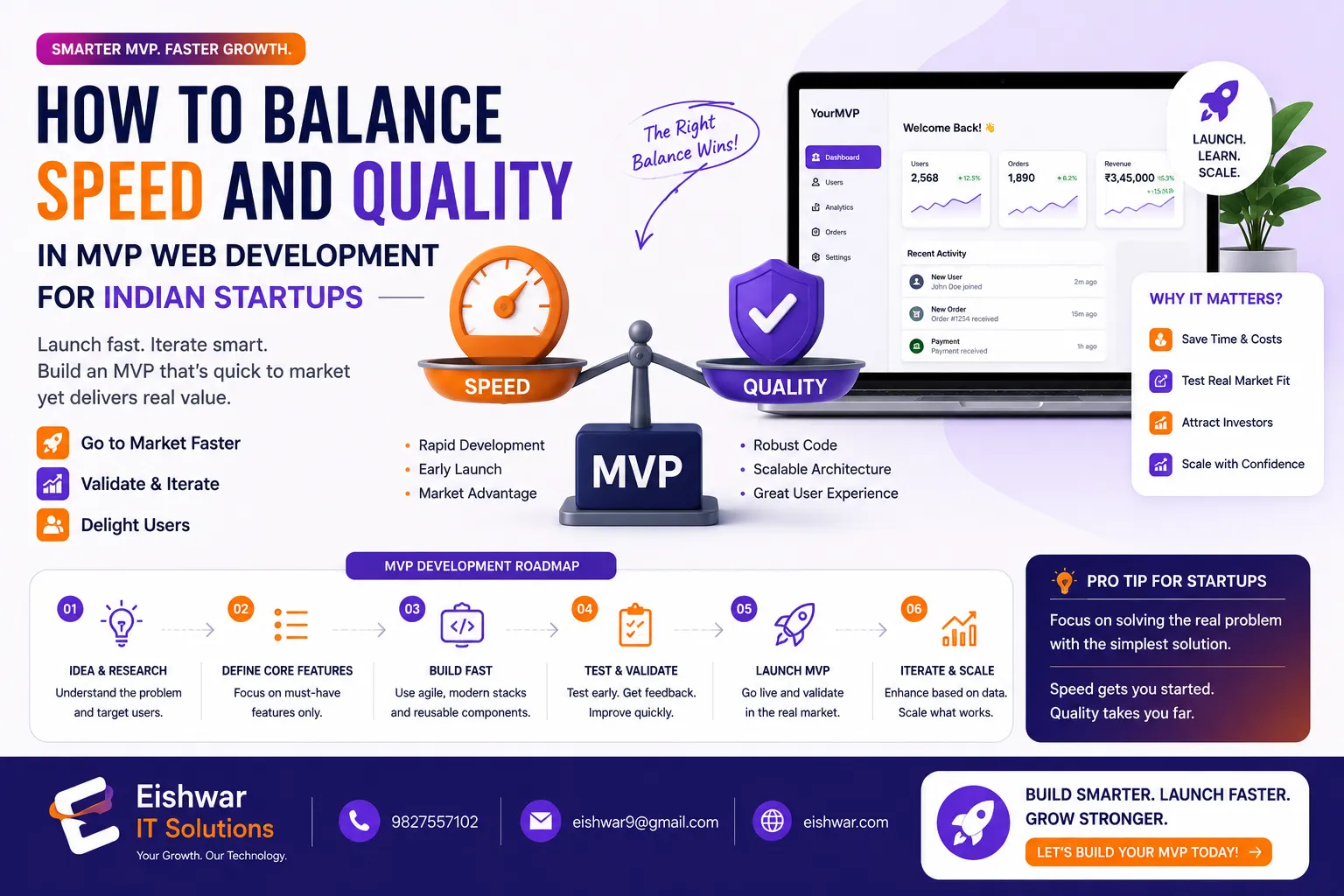
How to Balance Speed and Quality in MVP Web Development for Indian Startups
Introduction
Indian startups operate in a high-pressure environment where speed to market can make or break a business. Yet, rushing an MVP often leads to technical debt, poor user experience, and lost credibility. The real challenge isn't choosing between speed and quality—it's finding the right balance that allows you to launch quickly without building a product that collapses under its own weight.
This guide walks you through practical strategies to achieve that balance, backed by real-world examples and actionable tips tailored for the Indian startup ecosystem. Whether you're bootstrapping in a co-working space in Bangalore or pitching to investors in Mumbai, these insights will help you navigate the delicate trade-off between rapid deployment and reliable performance.
Main Section 1: Why Speed Matters in MVP Development
Speed is critical because it allows you to test your core hypothesis before competitors lock in the market. In India, where startup density is high—over 100,000 registered startups as of 2025—the first mover advantage can be decisive. A fast MVP helps you:
- Validate demand with real users early, reducing wasted investment
- Attract initial funding or angel investors who want to see traction
- Learn from actual usage data rather than assumptions or surveys
- Build momentum and brand recognition in a crowded space
- Iterate quickly based on feedback before competitors catch up
For example, a food delivery startup in Bangalore launched a basic MVP with just five restaurants and a simple ordering form. Within three weeks, they had enough data to refine their offering and secure seed funding. Speed gave them the edge. Another case: a fintech startup in Delhi used a no-code tool to build a loan eligibility checker in two weeks, gathering 500 sign-ups and proving demand before writing a single line of custom code.
However, speed isn't just about being first. It's about learning fast. A slow MVP delays your feedback loop, meaning you might spend months building features nobody wants. In India's dynamic market, where user preferences shift rapidly, speed is your competitive advantage.
Main Section 2: Why Quality Cannot Be Ignored
Quality isn't about building a perfect product; it's about ensuring the core experience works reliably. A buggy, slow, or confusing MVP can damage your brand before it even starts. Key quality elements for an MVP include:
- Core functionality that works without crashes or data loss
- Basic security (especially for payment or user data) to avoid breaches
- Intuitive navigation for first-time users who may have low digital literacy
- Fast load times on mobile devices (critical for India, where 70% of web traffic is mobile)
- Responsive design that works on low-end smartphones and slow networks
Consider a fintech startup that launched an MVP with a broken transaction flow. Users lost trust immediately, and the startup spent months recovering. Quality isn't a luxury—it's a necessity for credibility. Another example: a healthtech startup in Pune skipped basic load testing, and their app crashed during peak hours, leading to negative reviews that took six months to overcome.
Quality also extends to user experience. A cluttered interface or confusing navigation can drive users away, even if the underlying functionality is solid. In India, where word-of-mouth is a powerful acquisition channel, a poor first impression can ripple through your target audience.
Main Section 3: Practical Strategies to Balance Speed and Quality
Here are proven tactics to achieve both, with detailed examples and implementation tips:
1. Prioritize ruthlessly with the MoSCoW method
Classify features as Must-have, Should-have, Could-have, and Won't-have. Only build the must-haves for launch. Everything else can wait. For instance, an e-commerce MVP must have product listing, cart, and checkout. Features like product recommendations or wishlists are should-haves. User reviews or loyalty points are could-haves. A blog or advanced analytics are won't-haves.
Tip: Create a feature matrix and validate each item with at least five potential users. If a feature isn't essential to solving the core problem, drop it.
2. Use no-code or low-code platforms for non-core features
Tools like Bubble, Webflow, or Adalo can speed up development of landing pages, forms, and basic workflows while you focus custom code on your unique value proposition. For example, a logistics startup used Webflow for their marketing site and Bubble for a booking prototype, saving four weeks of development time.
Tip: Evaluate no-code platforms based on scalability. If your MVP grows, ensure you can migrate custom code without rebuilding from scratch.
3. Implement automated testing early
Even a simple test suite for critical paths can catch regressions without slowing down development. Use tools like Selenium or Cypress for frontend testing, and Jest or Mocha for backend. A travel booking startup automated their search and booking flow tests, reducing manual QA time by 70% and catching bugs before launch.
Tip: Start with smoke tests for the core user journey. Expand test coverage as you add features.
4. Build with a scalable architecture from day one
Choose a tech stack that allows incremental upgrades. For example, use React for frontend and Node.js for backend—both are widely supported in India and allow modular growth. Avoid monolithic architectures that require rewrites. A SaaS startup in Hyderabad used microservices from the start, enabling them to scale individual components without downtime.
Tip: Use cloud services like AWS or Azure that offer pay-as-you-grow pricing. This avoids upfront infrastructure costs while ensuring scalability.
5. Launch with a 'good enough' UI
Use pre-built component libraries like Material-UI or Bootstrap. A clean, simple design is better than a custom design that takes weeks. An edtech startup used Tailwind CSS with pre-built templates, launching their MVP in three weeks with a professional look that attracted 1,000 users in the first month.
Tip: Focus on usability over aesthetics. Use consistent fonts, colors, and spacing. Avoid custom animations that slow down load times.
6. Run a private beta with a small group of trusted users
This lets you catch major issues before public launch without delaying the timeline significantly. Invite 20-50 users from your target audience, offer incentives like early access or discounts, and collect feedback through structured surveys or interviews. A social commerce startup in Mumbai ran a two-week beta with 30 users, identifying three critical bugs and five usability improvements that they fixed before the public launch.
Tip: Use tools like UserTesting or Hotjar to record user sessions. This provides insights into where users struggle.
Expert Tips
We spoke with Ravi Sharma, founder of a successful SaaS startup in Pune. His advice: "Don't confuse speed with haste. Speed means making decisions quickly and sticking to them. Haste means skipping steps. Always test your riskiest assumption first. For us, that was whether users would pay for our product. We built a landing page with a pricing table and ran ads to gauge interest before writing any code."
Another expert, Priya Iyer from a Mumbai-based incubator, recommends: "Use a lean canvas instead of a business plan. It forces you to focus on the problem-solution fit, not feature lists. I've seen startups waste months building features that don't address the core pain point. A lean canvas keeps you grounded."
Additionally, Ankit Patel, CTO of a Delhi-based healthtech startup, suggests: "Invest in a CI/CD pipeline early. Even a basic setup with GitHub Actions or GitLab CI can automate deployments and testing, saving hours each week. It's a small upfront cost that pays off in speed and quality."
Common Mistakes
- Over-engineering the MVP: Building features that aren't validated yet wastes time and resources. For example, adding AI-powered recommendations to a simple booking app before confirming users want to book.
- Ignoring mobile optimization: Most Indian users access the web via mobile. A desktop-only MVP will miss the mark. Ensure your MVP is responsive and works on 3G networks.
- Skipping user feedback loops: Launching without a plan to collect feedback means you won't know what to improve. Set up in-app surveys, feedback forms, or analytics from day one.
- Choosing the wrong tech stack: Picking trendy but unfamiliar technologies slows development and hiring. Stick to widely used stacks like MERN (MongoDB, Express, React, Node.js) or LAMP (Linux, Apache, MySQL, PHP) for faster iteration.
- Neglecting security basics: Even an MVP should have HTTPS, input validation, and basic authentication. A data breach can kill your startup before it starts.
Future Trends
By 2026, AI-powered development tools will make it easier to generate code and tests automatically, further narrowing the speed-quality gap. Tools like GitHub Copilot and Tabnine are already helping developers write code faster with fewer errors. Edge computing will reduce latency for Indian users in tier-2 and tier-3 cities, enabling real-time features like live tracking or video streaming in MVPs.
Also, no-code platforms will become more sophisticated, allowing startups to build functional MVPs in days instead of weeks. Platforms like FlutterFlow and Draftbit are already enabling complex mobile MVPs without code. Watch for the rise of 'micro-MVPs'—ultra-minimal versions that test a single hypothesis with just one feature. This approach is gaining traction among lean Indian startups, especially in the SaaS and marketplace verticals.
Another trend is the use of serverless architectures, which allow startups to scale automatically without managing servers. AWS Lambda and Google Cloud Functions are becoming popular for MVPs because they reduce operational overhead and cost.
FAQs
What is the ideal timeline for building an MVP?
For most Indian startups, 4 to 8 weeks is a realistic target. Simple MVPs can be done in 2-3 weeks using no-code tools. Complex ones may take 10-12 weeks, but anything longer risks market irrelevance. The key is to set a hard deadline and stick to it, even if it means cutting features.
How do I ensure quality without slowing down?
Automate testing for critical paths, use pre-built components, and run a private beta with a small group. Focus on the core user journey and ignore edge cases until after launch. Also, use monitoring tools like Sentry or LogRocket to catch errors in real-time without manual testing.
Should I use a no-code platform for my MVP?
Yes, if your core functionality can be built with existing templates and integrations. No-code is great for MVPs in e-commerce, booking, or content platforms. For complex logic or unique algorithms, custom development is better. Evaluate the platform's scalability and export options before committing.
What features should I include in an MVP?
Only the features that directly solve the core problem for your target user. Use the MoSCoW method to prioritize. For example, a ride-sharing MVP needs booking, payment, and driver tracking—not loyalty rewards or advanced analytics. List your top three user pain points and build only the features that address them.
How do I measure MVP success?
Define one key metric (e.g., sign-ups, completed transactions, or user retention) before launch. Also track qualitative feedback through surveys or interviews. Success means you've validated your hypothesis and learned what to improve. For example, if your hypothesis is that users want a faster checkout, measure checkout completion rate.
What tech stack is best for an MVP in India?
The MERN stack (MongoDB, Express, React, Node.js) is popular due to its flexibility and large developer community in India. For simpler projects, consider using Next.js with Vercel for hosting. Avoid niche frameworks that are hard to hire for. Stick to technologies with strong local talent pools.
How do I handle feedback after MVP launch?
Set up a feedback system using tools like Typeform or Google Forms. Categorize feedback into bugs, feature requests, and usability issues. Prioritize based on impact on core functionality. Respond to users within 48 hours to show you value their input. Use a public roadmap to communicate what you're working on.
Conclusion
Balancing speed and quality in MVP development is not a compromise—it's a strategic choice. Indian startups that master this balance can launch faster, learn quicker, and build products that users actually want. Focus on the core, test early, and iterate relentlessly. Remember, an MVP is not a finished product; it's a learning tool. The goal is to maximize learning per unit of time and money. By applying the strategies outlined here, you can avoid common pitfalls and set your startup on a path to sustainable growth.
CTA
Ready to launch your MVP with the right balance? Contact EishwarITSolution today for a free consultation. Our team specializes in building fast, quality MVPs for Indian startups. Let's turn your idea into reality—without the trade-offs. Whether you need a no-code prototype or a custom-built web application, we'll help you find the optimal balance for your unique context.