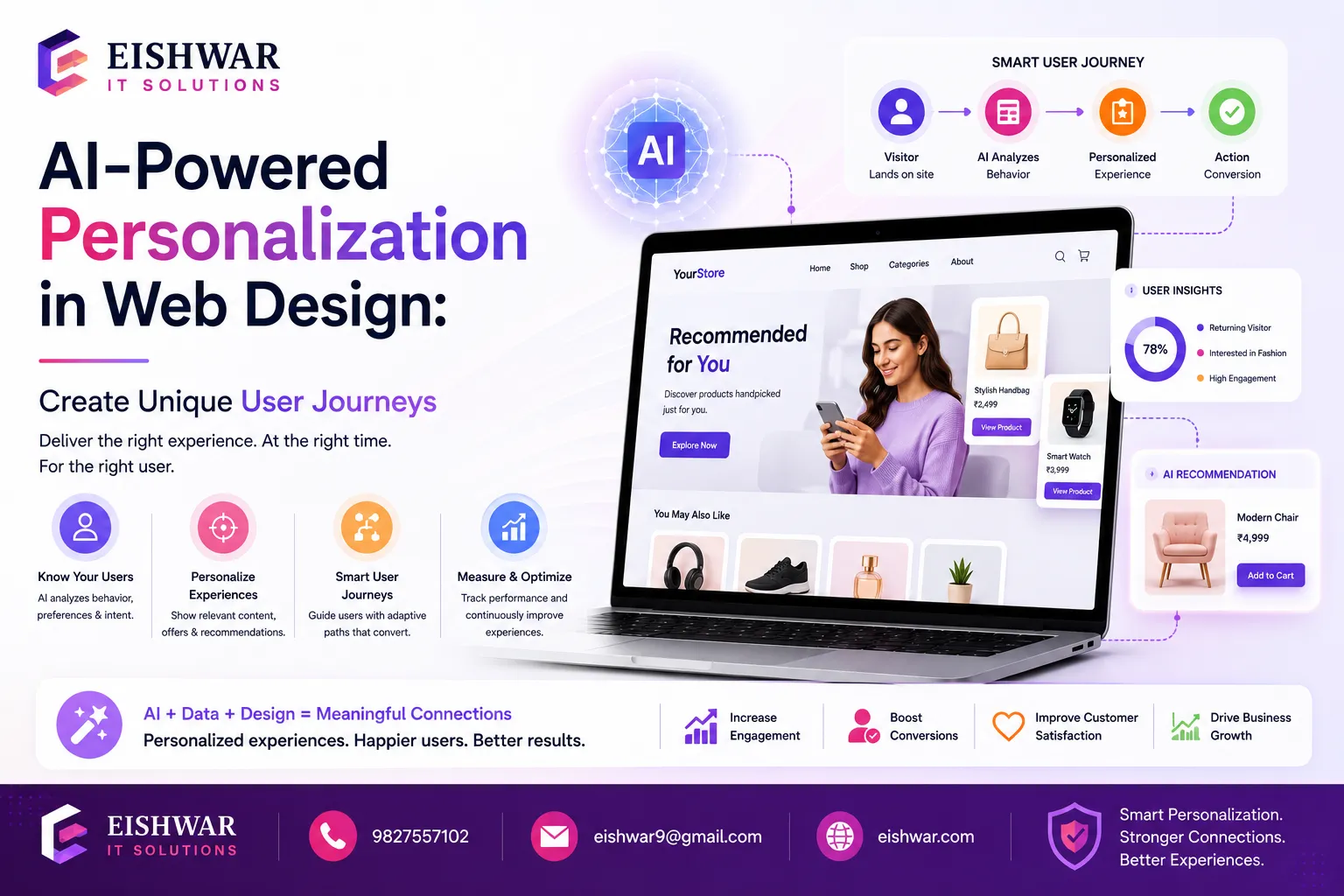
AI-Powered Personalization in Web Design: Create Unique User Journeys
Introduction
In 2026, the web is smarter than ever. Gone are the days when a one-size-fits-all website could win hearts and wallets. Today, users expect a site that knows them—their preferences, their location, even their mood. This is where AI-powered personalization steps in. For business owners, marketers, and professionals in India, leveraging AI in web design isn't just a trend; it's a necessity to stay competitive. At EishwarITSolution, we've seen firsthand how personalized user journeys can transform a casual visitor into a loyal customer. In this guide, we'll explore how to implement AI-driven personalization effectively, with actionable tips and real-world examples tailored for the Indian market. Whether you run a small e-commerce store in Jaipur or a SaaS startup in Bangalore, these strategies can help you connect deeply with your audience and drive measurable growth.
Main Section 1: What is AI-Powered Personalization in Web Design?
AI-powered personalization uses artificial intelligence to tailor the website experience for each visitor. It goes beyond simple greetings like 'Welcome back, Ravi!' It analyzes user behavior, demographics, browsing history, and even real-time actions to deliver content, product recommendations, and layouts that resonate. For instance, an e-commerce site might show winter wear to a user in Delhi and summer clothes to someone in Chennai. This level of customization improves user satisfaction and boosts conversion rates. According to a 2025 study by McKinsey, personalization can increase revenue by 10-15% and enhance marketing spend efficiency by 10-30%.
Key components of AI personalization include:
- User Behavior Analysis: Tracking clicks, time on page, and navigation paths to understand intent.
- Predictive Analytics: Forecasting what a user might want next based on patterns, like suggesting a laptop bag after a laptop purchase.
- Dynamic Content Blocks: Changing images, text, and offers based on user data—for example, showing a Diwali sale banner to users in India but a Christmas promotion to those in the US.
- Recommendation Engines: Suggesting products or articles similar to past interactions, using collaborative filtering or content-based filtering.
For Indian businesses, this means understanding regional festivals, language preferences, and cultural nuances. For example, a travel website could personalize offers for Diwali getaways or monsoon retreats based on the user's location and past searches. A food delivery app might recommend biryani on a rainy day in Hyderabad or vada pav during Mumbai's monsoon. The key is to make the experience feel intuitive and helpful, not intrusive.
Main Section 2: How to Implement AI Personalization in Your Website
Implementing AI personalization doesn't require a massive budget. Start with these practical steps:
Step 1: Collect Clean Data
AI thrives on data. Use tools like Google Analytics, heatmaps, and CRM data to gather insights. Ensure you comply with India's data privacy laws (like the Digital Personal Data Protection Act, 2023). Ask for consent and be transparent about data usage. For example, add a clear cookie consent banner and explain how data improves their experience. Clean data means removing duplicates, correcting errors, and standardizing formats—garbage in, garbage out.
Step 2: Choose the Right AI Platform
Several platforms offer AI personalization without heavy coding. Examples include:
- Adobe Target: Great for A/B testing and personalization, ideal for enterprises.
- Optimizely: User-friendly for marketers, with visual editors for non-technical teams.
- Dynamic Yield: Strong for e-commerce recommendations, with AI-driven product sorting.
- Google Optimize: Free and integrates with Google Analytics, perfect for small businesses.
For WordPress users, plugins like 'If-So' or 'PersonalizeWP' offer simple rule-based personalization without coding. Start with a free trial to test which platform fits your needs.
Step 3: Define Personalization Rules
Start simple. Segment users by location, device type, or referral source. Then create rules: 'If user is from Mumbai and visits during monsoon, show rain gear.' Or 'If user arrives from a Facebook ad about fitness, show workout gear.' Test and refine. For example, a local bakery could show different offers based on time of day: breakfast deals in the morning, cake orders in the evening.
Step 4: Personalize Key Elements
Focus on high-impact areas:
- Hero Banner: Show relevant imagery and offers—like a festival sale banner for returning users.
- Product Recommendations: Use collaborative filtering to show 'Customers who bought this also bought...'
- Content Suggestions: Tailor blog posts or case studies based on user industry or past reads.
- Call-to-Action (CTA): Personalize button text (e.g., 'Get Free Quote' for new visitors vs. 'View Your Dashboard' for returning users).
Step 5: Test and Optimize
Run A/B tests to compare personalized vs. non-personalized versions. Monitor metrics like bounce rate, time on site, and conversion rate. Iterate based on data. For instance, if personalized CTAs increase clicks by 20%, expand that approach to other pages. Use tools like Hotjar for heatmaps to see how users interact with personalized elements.
At EishwarITSolution, we helped a local e-commerce client increase sales by 25% using simple location-based personalization. They showed region-specific products and local language options, which reduced bounce rate by 18%. Another client, a travel agency, used predictive analytics to suggest destinations based on past bookings, boosting repeat bookings by 30%.
Main Section 3: Real-World Examples for Indian Audiences
Let's look at three examples of AI personalization done right in India:
Example 1: Flipkart's 'For You' Page
Flipkart uses AI to create a personalized homepage for each user. It shows products based on browsing history, past purchases, and even search trends. During festive seasons, it highlights regional deals—like Durga Puja offers for West Bengal users. This approach has significantly increased user engagement and repeat purchases. For small businesses, you can mimic this by using a recommendation plugin that tracks user behavior on your site.
Example 2: MakeMyTrip's Dynamic Offers
MakeMyTrip personalizes travel packages based on user's location and past trips. If a user from Bangalore frequently books to Goa, the site might show similar beach destinations or off-season discounts. They also use real-time data like weather to suggest activities. This relevance drives higher click-through rates. A local travel agency could do this by segmenting email lists and showing tailored offers on their site.
Example 3: Zomato's Restaurant Recommendations
Zomato uses AI to suggest restaurants based on time of day, past orders, and cuisine preferences. It also personalizes the search results based on user ratings and reviews. For instance, if you often order pizza, the app highlights pizza places at the top. This keeps users coming back for more. A small restaurant could use a simple loyalty app to track orders and suggest favorites.
These examples show that personalization isn't just for big players. Small businesses can implement similar strategies using affordable tools and data from their own customer interactions. The key is to start with what you have—even basic segmentation can yield results.
Expert Tips
- Start Small: Don't try to personalize everything at once. Focus on one or two elements, like the hero banner or product recommendations. For example, a local bookstore could start by showing bestsellers based on genre preference.
- Respect Privacy: Always get user consent. Use anonymized data where possible. Transparency builds trust. Add a clear privacy policy and allow users to opt out.
- Use AI for Content Creation: Tools like ChatGPT can help generate personalized email copy or product descriptions based on user segments. For instance, create different versions of a welcome email for first-time buyers vs. returning customers.
- Monitor Performance: Set up dashboards to track personalization impact. Adjust rules based on real-time data. Use Google Data Studio or Tableau for visualization.
- Combine with Human Touch: AI can automate, but human designers ensure the experience feels natural and empathetic. For example, use AI to suggest products but have a human review the final layout for emotional appeal.
Common Mistakes
- Over-Personalization: Creeping users out by showing too much knowledge (e.g., 'I see you bought a ring, are you getting married?'). Keep it subtle. Focus on helpful suggestions, not personal details.
- Ignoring Mobile Users: In India, mobile-first is key. Ensure personalization works seamlessly on all devices. Test on different screen sizes and browsers.
- Neglecting Testing: Personalization without testing can lead to poor user experiences. Always A/B test. For example, test personalized CTAs against generic ones to see which performs better.
- Using Stale Data: Outdated data leads to irrelevant suggestions. Refresh data regularly—at least weekly for e-commerce, monthly for content sites.
- Forgetting Accessibility: Ensure personalized content is accessible to users with disabilities, like screen reader compatibility. Use alt text for images and ensure color contrast meets WCAG standards.
Future Trends
Looking ahead, AI personalization will become even more sophisticated. Expect:
- Hyper-Personalization: Using real-time data like weather, traffic, or even heart rate (via wearables) to tailor experiences. For example, a fitness app could suggest workouts based on your sleep patterns.
- Voice and Visual Search: Personalizing based on voice queries or images uploaded by users. A fashion site could show outfits similar to a photo you upload.
- AI-Generated Design: Tools that automatically adjust layout and color schemes based on user preferences. For instance, a news site might change font size for older users.
- Predictive Personalization: AI anticipating user needs before they even click, like pre-loading content or suggesting actions. A travel site could predict your next vacation based on past trips and show relevant deals.
- Ethical AI: Greater focus on fairness, transparency, and avoiding bias in personalization algorithms. For example, ensuring recommendations don't discriminate based on gender or location.
Indian businesses that adopt these trends early will gain a significant edge in customer loyalty and market share. Start experimenting now to stay ahead.
FAQs
1. What is AI-powered personalization in web design?
AI-powered personalization uses artificial intelligence to tailor website content, recommendations, and user experience based on individual visitor data. It analyzes behavior, location, and preferences to create unique user journeys. For example, it can show different products to users based on their browsing history or suggest articles based on past reads.
2. Is AI personalization expensive for small businesses?
Not necessarily. Many affordable tools like Google Optimize, HubSpot, or even WordPress plugins offer basic personalization. Start with free trials and scale as you see ROI. The key is to begin with simple data collection and segmentation. For example, a small bakery could use a free plugin to show different offers based on time of day.
3. How can I ensure data privacy while personalizing?
Always obtain explicit consent before collecting data. Use anonymized data where possible, comply with India's data protection laws, and provide clear privacy policies. Avoid storing sensitive information without encryption. For instance, use cookies only after user acceptance and allow them to opt out easily.
4. What metrics should I track to measure personalization success?
Track bounce rate, time on site, conversion rate, click-through rate on personalized elements, and repeat visit frequency. Compare these against non-personalized versions to gauge impact. For example, if personalized product recommendations increase conversion by 15%, that's a clear win.
5. Can AI personalization work for B2B websites?
Absolutely. B2B sites can personalize content based on industry, company size, or job role. For example, show case studies relevant to the user's sector or offer whitepapers based on their interests. This builds trust and accelerates lead nurturing. A software company could show different demo videos for startups vs. enterprises.
6. How often should I update personalization rules?
Review and update rules monthly or after major campaigns. Monitor user feedback and analytics to identify outdated or ineffective rules. Stay agile—personalization is an ongoing process. For example, if a seasonal promotion ends, remove related rules immediately to avoid confusion.
7. What are the best tools for AI personalization on a budget?
For budget-friendly options, consider Google Optimize (free), HubSpot's free CRM with basic personalization, or WordPress plugins like 'If-So' (starting at $49/year). These tools allow you to test personalization without a big investment. Start with one tool and expand as you see results.
Conclusion
AI-powered personalization is no longer a futuristic concept—it's a practical tool that can dramatically improve your website's performance. By understanding your users and delivering tailored experiences, you build stronger connections and drive measurable results. Remember, the goal is to make each visitor feel valued, not tracked. Start small, test often, and always prioritize user trust. At EishwarITSolution, we're here to help you navigate this exciting journey. Ready to transform your website into a personalized powerhouse? The future of web design is personal, and it starts with you.
CTA
Ready to implement AI-powered personalization on your website? Contact EishwarITSolution today for a free consultation. Our experts will help you design unique user journeys that captivate your audience and boost conversions. Let's build a smarter web, together. Don't wait—your users are already expecting a personalized experience.