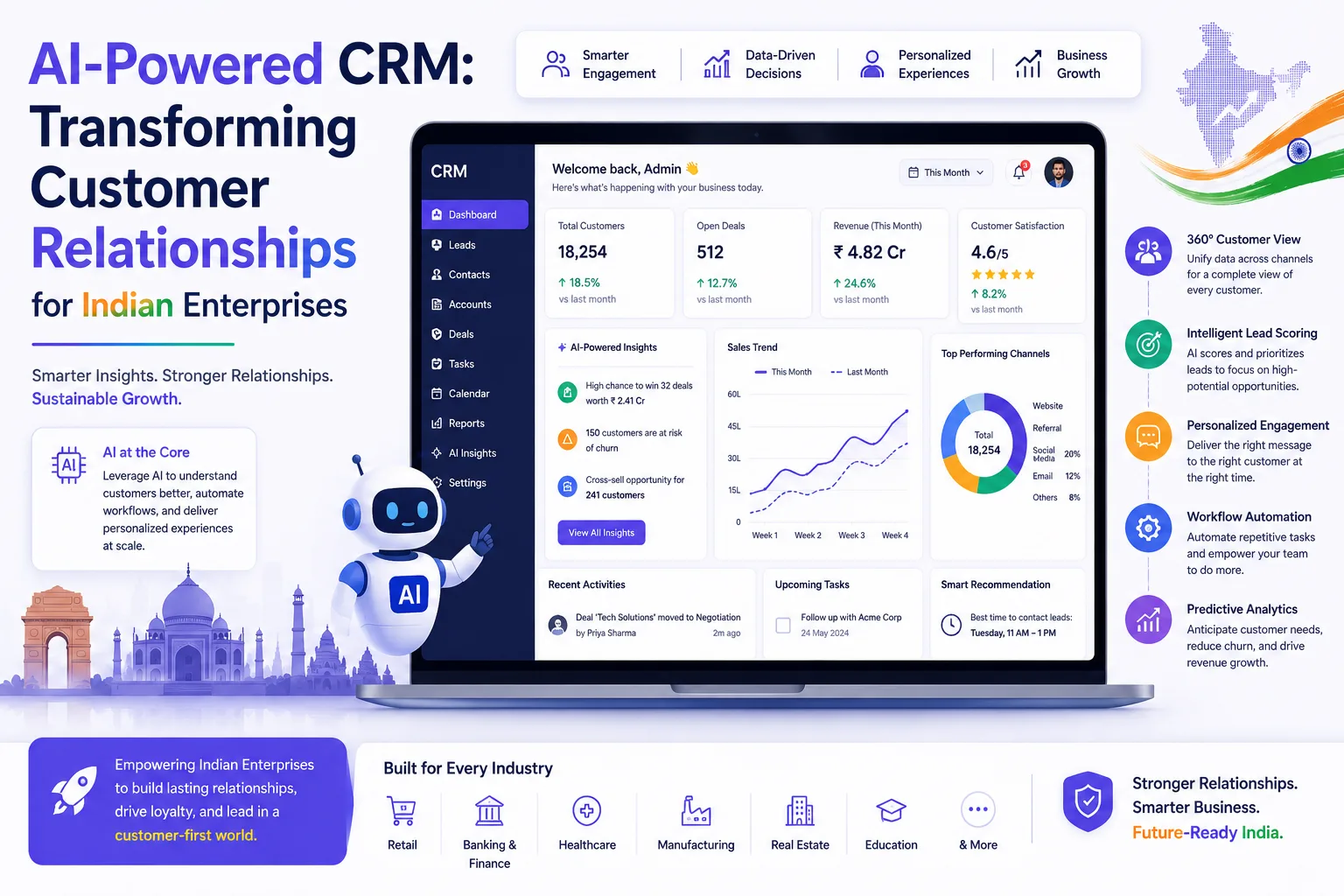
AI-Powered CRM: Transforming Customer Relationships for Indian Enterprises
Introduction
In today's hyper-competitive market, building strong customer relationships is the cornerstone of business success. Indian enterprises, from startups to conglomerates, are increasingly turning to AI-powered CRM systems to gain a competitive edge. Unlike traditional CRMs that merely store contact information, AI-driven CRMs leverage machine learning and natural language processing to predict customer behavior, automate workflows, and deliver personalized experiences at scale. This article explores how AI-powered CRM is revolutionizing customer relationships for Indian businesses and offers actionable insights for implementation.
Consider the scale of the Indian market: over 600 million internet users, a rapidly growing e-commerce sector, and a diverse linguistic landscape spanning 22 official languages. Traditional CRMs struggle to manage such complexity, but AI-powered systems thrive on it. For instance, a mid-sized textile exporter in Surat can use AI CRM to analyze export data, predict demand spikes, and automate communication with international buyers in English and Hindi. The result is not just efficiency but a deeper understanding of customer needs that drives loyalty and revenue.
Main Section 1: What is AI-Powered CRM and Why It Matters for Indian Businesses
AI-powered CRM integrates artificial intelligence into customer relationship management software. It uses algorithms to analyze customer data, identify patterns, and automate responses. For Indian enterprises, this means handling vast amounts of data from diverse sources—social media, email, phone calls, and in-store interactions—efficiently. The Indian market is unique due to its linguistic diversity, price sensitivity, and rapid digital adoption. AI CRM can segment customers based on behavior, predict churn, and suggest next-best actions, making it indispensable for businesses aiming to scale personalization.
For example, a retail chain in Mumbai can use AI CRM to send personalized offers to customers who frequently buy during monsoon sales. Similarly, a B2B company in Bangalore can automate follow-ups based on lead scoring. The result: higher conversion rates and improved customer loyalty.
But why is this particularly crucial for Indian businesses? The answer lies in the 'Jugaad' mindset—Indian consumers are savvy and expect value. AI CRM helps deliver that value by identifying micro-moments: when a customer is most likely to buy, what channel they prefer, and what price point resonates. A practical tip: start by integrating your CRM with UPI payment data to understand spending habits. For example, a fintech startup in Pune used AI CRM to analyze transaction patterns and offer personalized loan options, increasing approval rates by 25%.
Main Section 2: Key Benefits of AI CRM for Indian Enterprises
Hyper-Personalization
AI CRM analyzes past purchases, browsing history, and social media activity to tailor recommendations. Indian customers expect brands to understand their preferences, especially in sectors like e-commerce and banking. For instance, HDFC Bank uses AI to offer personalized loan offers based on spending patterns. A smaller example: a boutique clothing store in Jaipur can use AI CRM to send saree recommendations to customers based on their previous purchases of festive wear, increasing repeat sales by 30%.
Predictive Analytics
Predictive models help businesses forecast sales, identify high-value leads, and detect churn risks. A Delhi-based SaaS company can use AI CRM to flag accounts with declining engagement and trigger retention campaigns. For instance, if a customer hasn't logged in for 30 days, the CRM can automatically send a discount offer or a personalized tutorial. This proactive approach reduces churn by up to 40%, as seen in a case study of a Bangalore-based edtech firm.
Automated Workflows
From lead assignment to follow-up emails, AI automates repetitive tasks, freeing up sales teams to focus on closing deals. This is crucial for Indian SMEs with limited manpower. For example, a small manufacturing unit in Coimbatore can set up automated workflows: when a lead fills a contact form, the CRM assigns it to the nearest sales rep, sends a welcome email, and schedules a follow-up call—all without manual intervention. This saves 10 hours per week per salesperson.
Enhanced Customer Support
AI chatbots integrated with CRM provide instant responses in multiple Indian languages, improving customer satisfaction. For example, a travel agency in Kerala can offer 24/7 support in Malayalam and English. A practical tip: use sentiment analysis to prioritize urgent queries. If a chatbot detects frustration in a customer's message, it can escalate to a human agent. This approach reduced response time by 60% for a Mumbai-based telecom provider.
Main Section 3: How to Implement AI CRM Successfully in Your Business
Implementing AI CRM requires a strategic approach. Start by defining clear objectives—whether it's increasing sales, improving retention, or streamlining operations. Choose a platform that integrates with your existing tools (e.g., ERP, marketing automation). Train your team to interpret AI insights, not just rely on them blindly. Pilot the system with a small segment before full rollout. Finally, continuously monitor performance and refine algorithms based on feedback.
For Indian businesses, consider data privacy regulations under the Digital Personal Data Protection Act. Ensure your CRM provider complies with local laws. Also, invest in data quality—clean, structured data yields better AI predictions. A practical example: a logistics company in Chennai cleaned its customer database by removing duplicates and standardizing addresses, resulting in a 20% improvement in delivery time predictions.
Another tip: involve your sales team early. They often have insights that algorithms miss. For instance, a sales rep might know that a particular client prefers calls over emails—feed that into the CRM. Also, set realistic milestones. Don't expect full automation overnight; start with one feature, like lead scoring, and expand gradually.
Expert Tips
- Start small: Focus on one department (e.g., sales) before expanding. A pilot in a single branch can demonstrate ROI and build buy-in.
- Integrate with WhatsApp: Many Indian customers prefer WhatsApp for communication. Use AI CRM to manage WhatsApp conversations, automate responses, and track sentiment. For example, a restaurant chain in Delhi used WhatsApp integration to send personalized offers, increasing order frequency by 15%.
- Use sentiment analysis: Monitor customer sentiment from social media and calls to proactively address issues. A hotel in Goa used sentiment analysis to detect negative reviews early and offer discounts, improving ratings by 0.5 stars.
- Train your team: Provide regular training on how to use AI insights effectively. Role-play scenarios where AI suggests a next action, and the team discusses whether to follow it.
- Measure ROI: Track metrics like lead conversion rate, customer lifetime value, and response time. Use A/B testing to compare AI-driven campaigns with traditional ones.
Common Mistakes
- Over-reliance on automation: AI can suggest, but human judgment is still crucial, especially for complex negotiations. For example, an AI might recommend a discount, but a sales rep might know the client values quality over price.
- Ignoring data quality: Garbage in, garbage out. Ensure data is clean and updated. A common issue is duplicate records—use deduplication tools regularly.
- Lack of personalization: Generic AI responses can frustrate customers. Customize workflows for different segments. For instance, don't send the same email to a first-time visitor and a loyal customer.
- Neglecting privacy: Failing to comply with data protection laws can lead to fines and loss of trust. Always get explicit consent for data usage.
- Not aligning with business goals: AI CRM should serve your specific objectives, not just be a technology upgrade. Define KPIs before implementation.
Future Trends
The future of AI CRM in India is promising. Expect deeper integration with voice assistants like Alexa and Google Assistant, enabling hands-free CRM updates. AI will also enable real-time sentiment analysis during calls, helping sales reps adjust their pitch. Moreover, blockchain may be used to enhance data security and transparency. As 5G becomes widespread, AI CRM will process data faster, enabling instant personalization. Indian enterprises that adopt these trends early will lead their industries.
Another trend is the rise of 'conversational CRM'—where AI interacts with customers via voice, chat, and video. For example, a real estate firm in Mumbai could use an AI assistant to schedule property visits, answer queries in Hindi and Marathi, and send follow-ups automatically. Additionally, edge computing will allow AI CRM to process data locally, reducing latency for real-time applications like in-store personalization.
FAQs
What is AI-powered CRM?
AI-powered CRM uses artificial intelligence to analyze customer data, automate tasks, and provide predictive insights, helping businesses improve customer relationships. It goes beyond traditional CRMs by learning from interactions and adapting in real-time.
How does AI CRM benefit Indian small businesses?
It automates lead management, personalizes communication, and offers affordable scalability, helping small businesses compete with larger players. For example, a small bakery in Pune can use AI CRM to send birthday offers to regular customers, increasing repeat visits.
What are the best AI CRM platforms for Indian companies?
Popular options include Salesforce Einstein, Zoho CRM with AI, HubSpot CRM, and Freshsales. Choose based on your budget and needs. For cost-conscious SMEs, Zoho offers a robust free tier with basic AI features.
Is AI CRM expensive?
Costs vary. Many platforms offer tiered pricing, with basic AI features available in mid-range plans. The ROI often justifies the investment—businesses typically see a 20-30% increase in sales efficiency within the first year.
How can AI CRM improve customer retention?
By predicting churn, identifying at-risk customers, and automating personalized retention offers, AI CRM helps keep customers engaged. For instance, a subscription-based service can offer a discount to a customer who hasn't renewed in 60 days.
What data does AI CRM need to work effectively?
It needs historical customer data, interaction logs, purchase history, and demographic information. Clean, structured data yields the best results. Start by auditing your existing data and removing duplicates.
Can AI CRM handle multiple Indian languages?
Yes, many AI CRMs now support natural language processing for Hindi, Tamil, Bengali, and other major Indian languages. This enables businesses to communicate with customers in their preferred language, improving engagement.
How long does it take to implement AI CRM?
Implementation can take 4-12 weeks, depending on the complexity of your data and customization needs. A phased approach—starting with core features—can speed up the process and reduce disruption.
Conclusion
AI-powered CRM is no longer a luxury but a necessity for Indian enterprises aiming to thrive in a digital-first world. By leveraging AI, businesses can deliver personalized experiences, predict customer needs, and streamline operations. The key is to implement strategically, avoid common pitfalls, and stay abreast of emerging trends. Start your AI CRM journey today to transform customer relationships and drive growth.
CTA
Ready to revolutionize your customer relationships? Contact EishwarITSolution for a free consultation on implementing AI-powered CRM tailored to your business needs. Our experts will help you choose the right platform, integrate it with your existing systems, and train your team for maximum ROI.