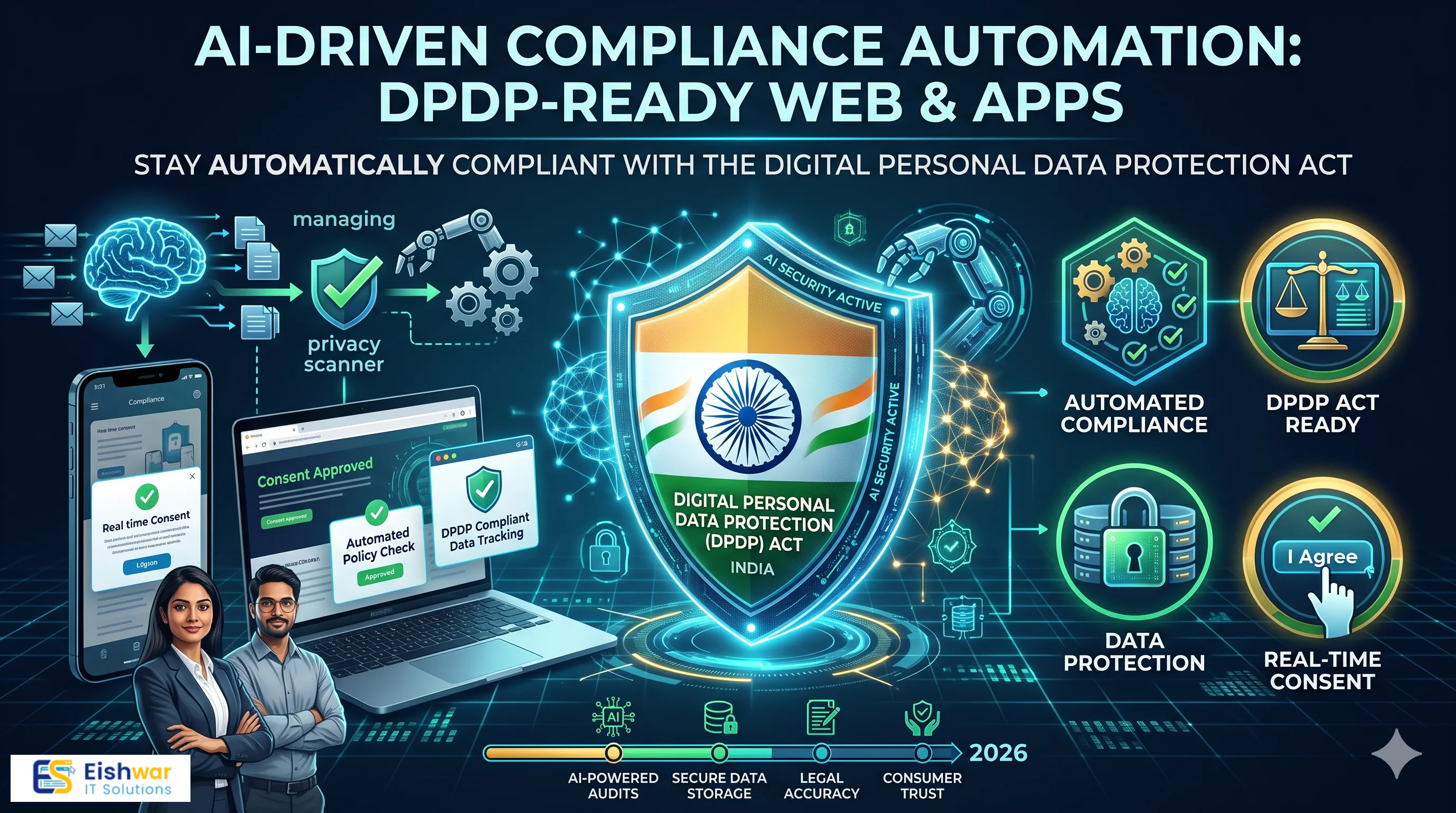
AI-Driven Compliance Automation: DPDP-Ready Web & Apps
India's Digital Personal Data Protection Act is no longer a distant compliance project. It is a design requirement for every website, mobile app, CRM, and customer portal that handles personal data. For business owners, marketers, and technology leaders, the question is simple: how do you stay compliant without slowing down product delivery? The answer increasingly lies in AI-driven compliance automation.
Introduction
If your business collects names, phone numbers, email addresses, payment details, health information, or even browsing behavior, you are responsible for protecting that data. The DPDP Act introduces clear obligations around consent, purpose limitation, data minimisation, breach reporting, and the rights of data principals.
Manual compliance does not scale. Spreadsheets, PDF policies, and periodic legal reviews cannot keep up with continuous deployments, third-party integrations, and real-time data flows. That is why forward-looking Indian businesses are embedding AI into their web and app development lifecycle to automate privacy checks, consent management, data mapping, and audit reporting.
In this guide, you will learn how AI-driven compliance automation works, where it fits in your development process, and how to implement it practically in 2026. You will also see common mistakes to avoid, future trends to watch, and answers to frequently asked questions.
Main Section 1: Why DPDP Compliance Is Now a Web & App Development Priority
The DPDP Act in plain English
The DPDP Act gives individuals more control over their personal data. Businesses must explain why they need data, collect only what is necessary, obtain valid consent, allow people to access or erase their data, and report certain breaches. Non-compliance can lead to significant penalties and reputational damage.
For digital teams, this translates into technical requirements. A sign-up form needs consent capture. A mobile app needs an easy way to withdraw consent. A backend database needs clear retention rules. A marketing automation tool needs to respect user preferences. AI-driven compliance automation helps convert these legal requirements into repeatable engineering tasks.
The cost of manual compliance
Manual processes create hidden costs. Legal teams spend hours reviewing data flows. Developers make assumptions about consent. Marketers export lists without checking lawful basis. Customer support struggles to handle data access or deletion requests. By the time an audit happens, evidence is scattered across tools.
These gaps increase risk. They also slow down releases because teams wait for manual approvals. In a competitive Indian market, that delay can mean losing customers to faster competitors.
Why AI-powered automation makes sense
AI can scan code, forms, APIs, and databases to identify personal data. It can classify data by sensitivity and purpose. It can generate privacy notices in plain language. It can route data subject requests to the right team. It can monitor for unusual access patterns that may indicate a breach.
Most importantly, AI-driven compliance automation works continuously. It does not wait for a quarterly review. It becomes part of your CI/CD pipeline, your CMS, your CRM, and your analytics stack.
India-specific pressure points
Indian businesses often operate across multiple languages, regions, and payment systems. They may use third-party logistics, cloud providers, and marketing agencies. Each partner adds a data-sharing relationship. AI automation helps map these relationships and keep records current.
India's growing digital economy also means higher expectations from customers. People want transparency. They want control. A DPDP-ready website or app can become a trust signal, not just a legal obligation.
Main Section 2: How AI-Driven Compliance Automation Works Across the Product Lifecycle
1. Automated data discovery and mapping
You cannot protect what you cannot see. AI tools can crawl your web pages, mobile app screens, API endpoints, and database schemas to discover personal data fields. They can tag data as identity data, contact data, financial data, health data, or behavioral data.
For example, an e-commerce checkout page may contain name, address, phone, email, and payment tokens. AI can map where each field is stored, which third-party service receives it, and how long it is retained. This creates a living data map instead of a static spreadsheet.
2. Consent and preference automation
Consent is not a one-time checkbox. Users may change their mind. AI can power dynamic consent banners that adapt to context. It can record consent version, timestamp, purpose, and withdrawal status. It can sync preferences across web, app, email, and SMS channels.
For Indian businesses, consent automation is especially useful for marketing campaigns. Instead of manually cleaning lists, your system can automatically exclude users who have withdrawn consent.
3. Dynamic privacy notices and policies
Privacy policies are often written once and forgotten. But your data practices change when you add a new payment gateway, analytics tool, or AI chatbot. AI can draft and update privacy notices based on actual data flows. It can also produce short, plain-language summaries for users.
This does not replace legal review. It gives your legal team a faster starting point and keeps documents closer to reality.
4. Data subject request automation
Under the DPDP Act, individuals can request access, correction, or erasure of their data. AI can identify the request, verify identity through approved workflows, locate relevant records, and generate a response. It can also track deadlines and escalate complex cases.
For a SaaS company, this could mean automating account deletion requests across production databases, backups, and analytics tools. For a healthcare app, it could mean routing requests to a privacy officer while redacting sensitive information.
5. Security, breach detection, and response
AI-driven compliance automation supports security teams by monitoring access logs, detecting anomalies, and prioritizing alerts. If a breach occurs, AI can help assess the scope, identify affected users, and prepare notification drafts.
This speed matters because breach reporting timelines are tight. The faster you understand what happened, the faster you can respond and reduce harm.
6. Continuous audit and reporting
Auditors want evidence. AI can maintain logs of consent events, data access, policy versions, training completion, and incident responses. It can generate dashboards for management and regulators. This turns compliance from a scramble into a routine.
For Indian startups and SMEs, this level of automation was once only available to large enterprises. Cloud-based AI tools have changed that. You can now subscribe to compliance automation platforms or build lightweight automations using APIs.
Main Section 3: Implementation Blueprint for Indian Businesses
Step 1: Run a DPDP readiness assessment
Start by identifying what personal data you collect, where it lives, who can access it, and why you need it. Involve legal, development, marketing, and customer support. Use AI discovery tools to speed up the inventory, but validate the results with humans.
Create a simple risk register. Mark high-risk data such as financial information, health records, and children's data. Prioritise those areas for automation.
Step 2: Embed privacy by design into development workflows
Add privacy checks to your product requirements. Before a new feature is built, ask: What data does it need? How will consent be captured? How will users exercise their rights? How will data be deleted?
Integrate AI compliance tools into your CI/CD pipeline. For example, a pre-deployment scan can flag hardcoded personal data, missing consent parameters, or insecure API endpoints.
Step 3: Choose the right AI compliance stack
You do not need one giant platform. You can combine specialist tools. Look for consent management platforms, data mapping tools, AI governance solutions, and security monitoring services. Check for India data residency options and DPDP alignment.
Evaluate vendors on integration capability, transparency, and support. Ask how their AI models are trained and whether your data is used for model improvement.
Step 4: Integrate with your CMS, CRM, and automation tools
Your website CMS should respect consent states before loading analytics or advertising scripts. Your CRM should flag records with expired consent. Your marketing automation should suppress users who have opted out.
AI can orchestrate these rules across systems. This is where automation and AI in web and app development delivers real business value: fewer manual checks, fewer mistakes, and faster campaign execution.
Step 5: Train teams and create ownership
Technology alone is not enough. Train marketers on consent best practices. Train developers on privacy by design. Train support teams on data subject requests. Assign a data protection officer or privacy lead, even if part-time.
Create simple playbooks. What should happen when a user asks for deletion? Who approves a new data vendor? How do you report a suspected breach? AI can support these processes, but people remain accountable.
Step 6: Monitor, measure, and improve
Track metrics such as consent capture rate, request response time, data mapping coverage, and audit findings. Review them monthly. Use AI insights to identify bottlenecks and automate repetitive tasks.
Remember that compliance is a moving target. DPDP rules will evolve. Your automation should be flexible enough to adapt.
Expert Tips
- Start with high-risk data. Do not try to automate everything at once. Focus on financial, health, and children's data first.
- Keep humans in the loop. AI can draft notices and classify data, but legal and privacy experts should approve final decisions.
- Make consent clear, not clever. Use plain language. Avoid dark patterns. Give users genuine choice.
- Document everything automatically. Logs are your best defence during an audit. Automate log collection and retention.
- Test with real user journeys. Walk through sign-up, checkout, support requests, and account deletion. Fix gaps before launch.
- Review third-party vendors. Your compliance depends on partners. Check their data practices and contracts.
- Use AI to reduce friction. The goal is not more pop-ups. The goal is smoother, more transparent experiences.
Common Mistakes
- Treating compliance as a one-time project. DPDP readiness is ongoing. New features and vendors change your data map.
- Copy-pasting privacy policies. Generic policies may not match your actual data practices. AI can help customise them, but review is essential.
- Ignoring mobile app permissions. Many teams focus on websites and forget app-level data collection.
- Confusing consent with notice. Informing users is not the same as getting valid consent. Both matter.
- Forgetting backups and analytics. Deletion requests must cover backups, data warehouses, and third-party tools where technically feasible.
- Over-automating without governance. AI decisions need oversight. Without it, you may create new compliance risks.
- Waiting for a breach to act. Proactive automation is cheaper than reactive crisis management.
Future Trends
Several trends will shape AI-driven compliance automation in India over the next few years.
- Agentic AI for privacy operations. AI agents will handle routine data requests, vendor assessments, and audit evidence collection.
- Privacy-enhancing technologies. Techniques like differential privacy, federated learning, and synthetic data will reduce reliance on raw personal data.
- Automated DPDP audits. Regulators and auditors may expect machine-readable compliance reports.
- Cross-border data flow controls. As rules mature, businesses will need automated checks for international data transfers.
- AI governance integration. Compliance teams will manage both data privacy and AI model risks in one framework.
- Voice and conversational consent. As voice interfaces grow, consent capture will move beyond checkboxes.
- Real-time consent in adtech. Digital advertising will rely on automated signals to respect user preferences instantly.
FAQs
What is AI-driven compliance automation?
It is the use of artificial intelligence to automate privacy and regulatory tasks such as data discovery, consent management, policy updates, data subject requests, and audit reporting. It helps businesses stay compliant continuously instead of relying on manual reviews.
Is DPDP compliance mandatory for small businesses in India?
The DPDP Act applies to organisations that process digital personal data, with some exemptions. Even small businesses should assess whether they are covered. Good privacy practices also build customer trust and reduce risk.
Can AI replace a lawyer or data protection officer?
No. AI can speed up drafting, classification, and monitoring, but legal judgment, accountability, and context still require human experts. Use AI as an assistant, not a replacement.
How much does AI compliance automation cost?
Costs vary widely. Small businesses can start with affordable consent management and data mapping tools. Larger enterprises may invest in integrated platforms. Compare total cost against potential penalties, lost trust, and manual effort.
How long does it take to become DPDP-ready?
A basic readiness program can take a few weeks. Full automation across web, app, CRM, and analytics may take several months. Start with a risk assessment and phase your implementation.
Will compliance automation hurt user experience?
Not if it is designed well. The goal is transparent, frictionless consent and preference management. AI can personalise privacy notices and reduce unnecessary interruptions.
What should I do first?
Map your data. Identify where personal data is collected, stored, and shared. Then prioritise high-risk areas and implement consent automation. A trusted technology partner can help you build a practical roadmap.
Conclusion
The DPDP Act is a turning point for Indian businesses. It rewards organisations that treat privacy as a product feature, not an afterthought. AI-driven compliance automation gives you the speed and consistency to meet these expectations without slowing down innovation.
By automating data discovery, consent, requests, security monitoring, and audits, you reduce risk and free your team to focus on growth. The businesses that act early will build stronger trust with customers, partners, and regulators.
CTA
Ready to make your website and apps DPDP-ready? EishwarITSolution helps Indian businesses design, develop, and automate compliant digital experiences. Contact us for a DPDP readiness assessment and a practical AI compliance roadmap.