
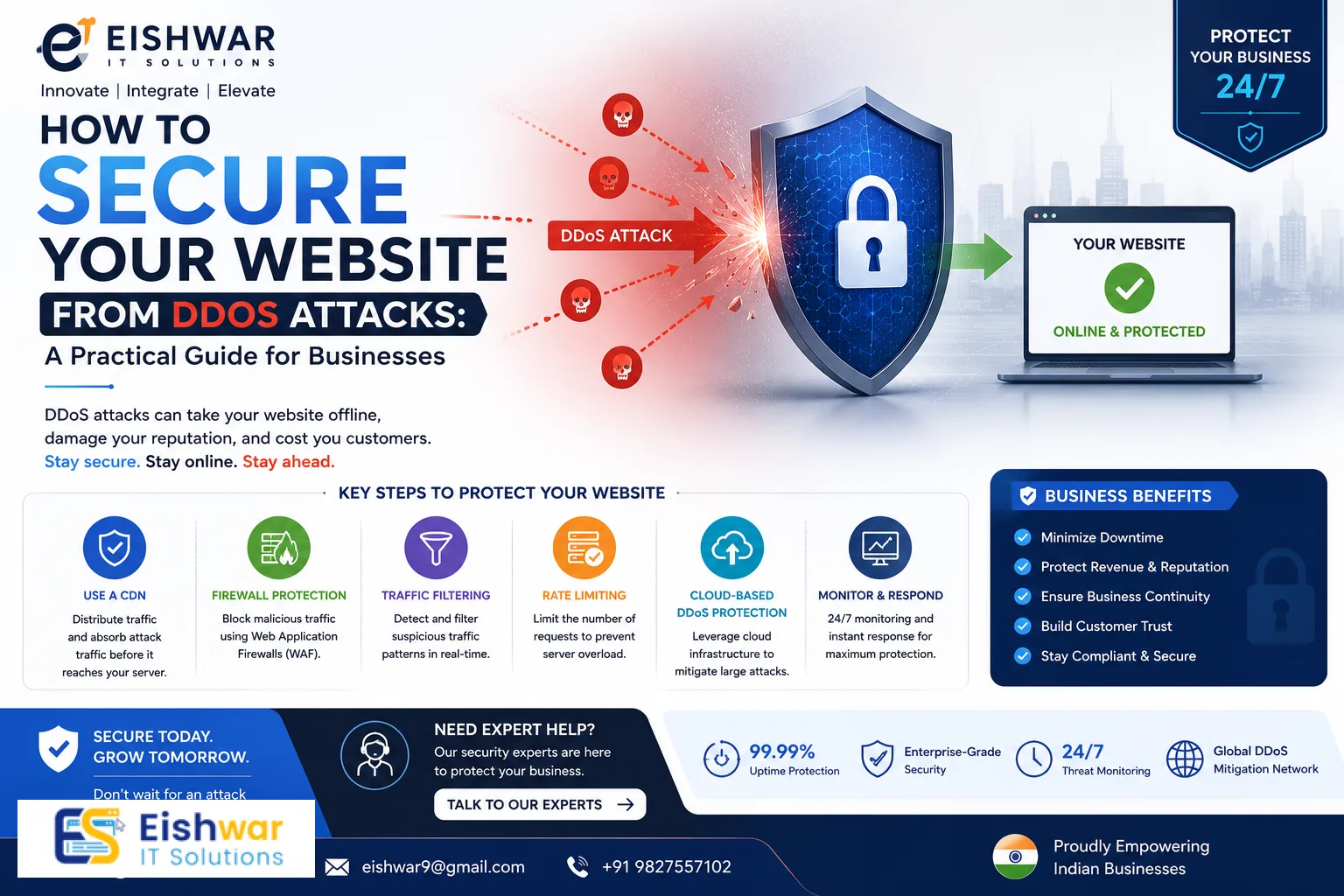
How to Secure Your Website from DDoS Attacks: A Practical Guide for In
Published on: 06 Jul 2026
How to Secure Your Website from DDoS Attacks: A Practical Guide for Indian Businesses
Introduction
Imagine waking up to find your website completely inaccessible. Customers can't place orders, leads can't reach you, and your business grinds to a halt. This is the reality of a Distributed Denial-of-Service (DDoS) attack—a cyber threat that floods your site with traffic until it crashes. For Indian businesses, where digital presence is no longer optional, DDoS attacks are becoming alarmingly common. In 2025 alone, India witnessed a 150% rise in such attacks, targeting everything from e-commerce stores to local service providers. The good news? You don't need a massive IT budget to defend yourself. This guide will walk you through practical, affordable steps to secure your website from DDoS attacks, tailored for business owners, marketers, and professionals in India.
Learn more about our Website services
Understanding DDoS Attacks: What Indian Businesses Face
A DDoS attack is like a traffic jam created deliberately on your website's highway. Attackers use multiple compromised systems (often part of a botnet) to send overwhelming requests to your server, making it unable to respond to legitimate visitors. In India, common triggers include competitor sabotage, hacktivism, or even ransom demands. For example, a small e-commerce site in Mumbai might be targeted during a festive sale, losing thousands in revenue. The attack can last hours or days, and without preparation, recovery is costly. Understanding the types—volumetric (flooding bandwidth), protocol (targeting server resources), or application layer (mimicking real users)—helps you choose the right defense.
Why Indian Businesses Are Vulnerable
Many Indian businesses operate on shared hosting or low-cost servers, which lack robust DDoS protection. Additionally, reliance on outdated infrastructure, lack of monitoring, and limited cybersecurity awareness make them easy targets. A 2024 survey found that 60% of Indian SMEs had no DDoS mitigation plan. The cultural factor of 'it won't happen to me' often delays action. But the cost of downtime—lost sales, damaged reputation, and recovery expenses—far outweighs the investment in prevention.
Main Section 1: Proactive Measures to Prevent DDoS Attacks
Choose a Hosting Provider with Built-in DDoS Protection
Your hosting provider is your first line of defense. Look for providers that offer automatic DDoS mitigation, such as Cloudflare, AWS Shield, or Indian providers like Netmagic and CtrlS. They can absorb and filter malicious traffic before it reaches your site. For example, a Chennai-based logistics company switched to a provider with 24/7 DDoS monitoring and saw a 90% reduction in attack-related downtime.
Implement a Web Application Firewall (WAF)
A WAF acts as a gatekeeper, inspecting incoming traffic and blocking suspicious patterns. Cloud-based WAFs (e.g., Cloudflare WAF, Sucuri) are cost-effective and easy to set up. They can filter out bot traffic, SQL injections, and DDoS attempts. For instance, a Delhi-based startup used a WAF to stop a Layer 7 DDoS attack that was mimicking human clicks, saving their server from overload.
Rate Limiting and Traffic Throttling
Set limits on how many requests a single IP address can make within a specific time. Most CDNs and servers allow rate limiting. This prevents a single botnet from overwhelming your resources. For example, an online tutoring platform in Bengaluru implemented rate limiting on their login page, stopping a credential-stuffing attack that could have led to a DDoS.
👉 Don't wait for the perfect moment; turn your vision into reality today.
Free ConsultationUse a Content Delivery Network (CDN)
CDNs distribute your website across multiple servers globally, reducing the load on your origin server. During a DDoS attack, the CDN absorbs traffic spikes, ensuring your site remains accessible. Popular options include Cloudflare, Akamai, and Fastly. A Jaipur-based travel agency using a CDN survived a 100 Gbps attack without any downtime.
Main Section 2: Reactive Strategies During an Attack
Have an Incident Response Plan Ready
Prepare a step-by-step plan that includes identifying the attack (using monitoring tools like Google Analytics or server logs), contacting your hosting provider, and switching to a DDoS mitigation service. Assign roles—who contacts the provider, who communicates with customers, who handles PR. A Kolkata-based retailer had a plan in place and restored their site within 30 minutes of an attack, minimizing revenue loss.
Enable DDoS Protection Services Instantly
If you use a CDN or WAF, activate their DDoS protection mode immediately. For example, Cloudflare's 'Under Attack' mode uses JavaScript challenges to filter traffic. This can be toggled on within seconds. Many providers also offer emergency DDoS mitigation for a small fee—keep that contact handy.
Scale Up Your Server Resources Temporarily
If you have cloud hosting, you can auto-scale to handle traffic spikes. AWS, Google Cloud, and Azure allow dynamic resource allocation. However, this is a temporary fix—scaling alone won't stop a large attack, but it buys time. A Pune-based SaaS company auto-scaled during a DDoS and maintained partial functionality, retaining customer trust.
Isolate and Block Malicious Traffic
Use your firewall or server tools to block IP ranges or countries that are sending attack traffic. Be careful not to block legitimate users. Tools like fail2ban can automate this. For instance, a Mumbai-based financial advisory firm blocked traffic from a specific region that was launching a DDoS, stopping the attack within minutes.
Main Section 3: Long-Term Maintenance for DDoS Resilience
Regular Security Audits and Updates
Keep your CMS, plugins, and server software updated. Outdated software can have vulnerabilities that attackers exploit to launch DDoS attacks. Schedule monthly audits using tools like Nessus or OWASP ZAP. An Ahmedabad-based real estate portal prevented a DDoS by patching a known vulnerability in their WordPress plugin.
Monitor Traffic Patterns Continuously
Use monitoring tools like New Relic, Datadog, or even free tools like Google Analytics to spot anomalies—sudden traffic spikes, unusual geographic sources, or repeated failed requests. Set up alerts so you're notified instantly. A Hyderabad-based e-commerce store detected a slow DDoS attack early and mitigated it before customers noticed.
Educate Your Team and Customers
Train your staff to recognize phishing attempts that could compromise credentials used in DDoS attacks. Also, inform customers about what to do if the site is slow—reassure them it's temporary. A Bangalore-based startup created a simple one-pager for their support team, reducing panic during an actual attack.
Backup Your Data and Have a Failover Plan
Regular backups ensure you can restore your site quickly if the attack corrupts data. Use offsite backups (cloud storage) and test restoration monthly. Also, consider a failover site—a static version of your site hosted elsewhere that can be activated during an attack. A Delhi-based news portal used a failover site to keep publishing during a prolonged DDoS.
👉 Free Website Audit
Get Free AuditExpert Tips
- Use a combination of on-premise and cloud-based DDoS protection: This hybrid approach ensures redundancy. For example, use a hardware firewall on your server and a cloud WAF for additional filtering.
- Conduct regular stress tests: Simulate DDoS attacks using tools like LOIC (Low Orbit Ion Cannon) or hire ethical hackers to test your defenses. A Bengaluru-based fintech company runs quarterly stress tests and discovered a weakness in their CDN configuration.
- Keep an emergency communication channel: Have a WhatsApp group or Slack channel with your hosting provider, IT team, and key stakeholders for real-time updates during an attack.
- Consider cyber insurance: Some Indian insurers now offer policies covering DDoS-related losses, including revenue loss and recovery costs. It's a safety net for unexpected events.
Common Mistakes
- Relying solely on a firewall: A firewall alone cannot handle large volumetric DDoS attacks. You need CDN and rate limiting as well.
- Ignoring application-layer attacks: Many businesses focus on network-level DDoS but forget about Layer 7 attacks that mimic human behavior. Use a WAF with behavioral analysis.
- Not testing your backup plan: Backups are useless if you can't restore them quickly. Test your restoration process at least once a quarter.
- Delaying response time: Every minute of downtime costs money. Have automated alerts and a clear escalation path to reduce response time.
- Neglecting mobile and API endpoints: DDoS attacks can target mobile apps or APIs. Secure those too with rate limiting and authentication.
Future Trends
DDoS attacks are evolving. In 2026, we expect to see more AI-powered attacks that adapt to defenses in real-time. Conversely, AI-based mitigation tools are becoming smarter at distinguishing between legitimate and malicious traffic. The rise of 5G will increase bandwidth, making volumetric attacks more powerful. Indian businesses should invest in machine learning-based WAFs and consider edge computing to distribute traffic further. Additionally, government regulations may require businesses to report DDoS incidents, emphasizing the need for robust logging and compliance.
FAQs
What is a DDoS attack and how does it affect my website?
Can a small business in India afford DDoS protection?
What should I do first when I suspect a DDoS attack?
How often should I update my DDoS protection measures?
Are there any legal requirements in India for DDoS protection?
Can a DDoS attack be completely prevented?
Conclusion
DDoS attacks are a serious threat, but with the right preparation, your Indian business can stay protected. Start with a secure hosting provider, implement a WAF, and use a CDN. Have a response plan ready, educate your team, and keep your systems updated. The investment in DDoS protection is an investment in your business's continuity and reputation. Don't wait for an attack to take action—secure your website today.
👉 Free Homepage Demo
Book DemoCTA
Ready to fortify your website against DDoS attacks? At EishwarITSolution, we offer comprehensive website security audits and DDoS mitigation services tailored for Indian businesses. Contact us today for a free consultation and keep your site running smoothly.