Low-Code/No-Code Platforms for Indian Businesses: Build Apps Faster in
Published on: 15 Jun 2026
Low-Code/No-Code Platforms for Indian Businesses: Build Apps Faster in 2026
Introduction
Imagine wanting a custom inventory management system for your business—but you don’t have a dedicated developer. In 2026, that’s no longer a barrier. Low-code and no-code platforms have democratized web development, allowing Indian business owners, marketers, and professionals to create powerful applications with minimal or no coding. This shift is not just a convenience; it’s a strategic advantage in a market where speed and agility define success. In this comprehensive guide, we’ll explore why these platforms are a game-changer for Indian SMBs, how to choose the right one, and practical steps to build your first app. We’ll also dive into real-world examples, expert tips, and future trends that will shape the landscape.
Learn more about our Website services
What Are Low-Code and No-Code Platforms?
Low-code platforms provide a visual development environment with drag-and-drop components and pre-built templates, requiring minimal coding for customization. Think of them as a bridge between traditional development and complete abstraction—you can still add custom scripts when needed. No-code platforms go a step further—they require zero coding knowledge, enabling anyone to build apps using intuitive interfaces. Both types accelerate development, reduce costs, and empower non-technical teams. For example, a marketing manager can create a lead tracking app without waiting for IT, while a logistics coordinator can build a delivery dashboard in hours. The key difference lies in flexibility: low-code offers more control for complex logic, while no-code prioritizes ease of use.
Why Indian Businesses Are Embracing Low-Code/No-Code in 2026
India’s digital transformation is accelerating. With over 800 million internet users and a booming startup ecosystem, businesses need to move fast. Traditional web development can take months and cost lakhs—often beyond the budget of small and medium businesses. Low-code/no-code platforms cut development time by up to 80% and costs by 50% or more. They also address the shortage of skilled developers—a common pain point for Indian SMBs. Consider a retail chain in Mumbai: they used Zoho Creator to build a custom inventory app in two weeks, saving ₹2 lakhs compared to hiring a freelancer. Similarly, a healthcare clinic in Bangalore used AppSheet to digitize patient records from spreadsheets, reducing paperwork by 90%. These platforms also enable rapid prototyping, allowing businesses to test ideas before full investment. In 2026, with increasing internet penetration and mobile-first users, the ability to iterate quickly is invaluable.
Top Low-Code/No-Code Platforms for Indian Businesses
Here are some platforms gaining traction in India, each with unique strengths:
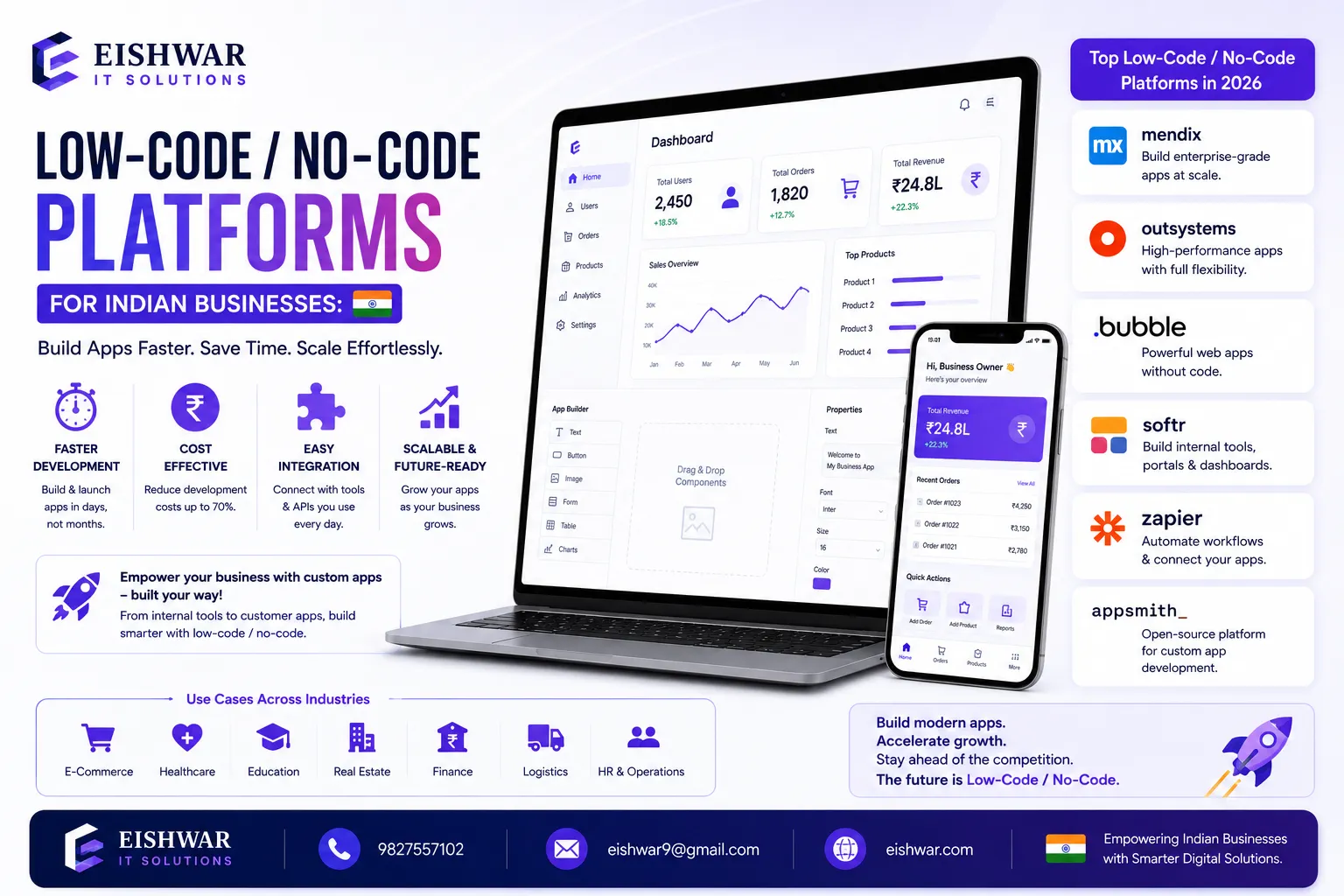
- Bubble: A powerful no-code platform for building web apps. Ideal for marketplaces, SaaS, and internal tools. It offers a visual editor, database management, and workflow automation. Example: A small e-commerce brand in Delhi used Bubble to create a multi-vendor marketplace in three weeks.
- OutSystems: An enterprise-grade low-code platform with robust security and scalability. Best for large organizations needing compliance (e.g., DPDP Act). It supports complex integrations and high-traffic apps.
- AppSheet (Google): Excellent for creating mobile and web apps from spreadsheets—great for data-driven businesses. A logistics company in Pune used it to build a real-time tracking app from Google Sheets.
- Zoho Creator: A low-code platform tailored for Indian businesses, offering deep integration with Zoho’s suite (CRM, Books, etc.). It supports local payment gateways like Razorpay and PayU.
- Adalo: User-friendly no-code platform for building mobile and web apps with a visual builder. Perfect for startups testing MVPs. A food delivery service in Hyderabad created a customer ordering app in a weekend.
- FlutterFlow: A low-code platform for native mobile apps (iOS/Android). It allows custom code in Flutter, making it scalable for growth.
When choosing, consider factors like pricing (many offer free tiers), integration capabilities, and learning curve. For Indian businesses, Zoho Creator and AppSheet are particularly popular due to local support.
👉 Don't wait for the perfect moment; turn your vision into reality today.
Free ConsultationPractical Use Cases for Indian Businesses
Let’s see how different industries can leverage these platforms with specific examples:
- Retail: Build a customer loyalty app with purchase tracking and rewards. A clothing store in Jaipur used Adalo to create a points-based system, increasing repeat purchases by 30%.
- Healthcare: Create a patient appointment booking system with reminders. A dental clinic in Chennai used Bubble to integrate with Google Calendar and SMS notifications, reducing no-shows by 40%.
- Education: Develop a student management portal for attendance and grades. A coaching center in Pune used Zoho Creator to automate report cards, saving 10 hours per week.
- Logistics: Build a real-time shipment tracking dashboard for delivery partners. A courier company in Mumbai used AppSheet to connect with GPS APIs, improving delivery accuracy.
- Hospitality: Create a booking system for restaurants or hotels. A small hotel in Goa used Bubble to manage reservations and online payments via Razorpay.
These examples show that no-code isn’t just for simple apps—it can handle real business processes.
Step-by-Step Guide to Building Your First App with Bubble (No-Code)
Let’s walk through creating a simple project management app, a common need for teams:
- Sign up: Create a free account on Bubble.io. The free plan includes 200MB of data storage, enough for testing.
- Choose a template: Select the “Task Manager” template from the marketplace. This gives you a pre-built structure with tasks, projects, and user roles.
- Customize the design: Drag and drop elements to match your brand colors. Use the design tab to adjust fonts, buttons, and layout. For example, change the primary color to your company’s blue.
- Add data fields: Define fields like task name, assignee, due date, and status. Bubble’s database is like a spreadsheet—you can add new fields easily.
- Set up workflows: Configure actions such as “Create task” when a button is clicked, or “Mark complete” to update status. Use conditionals to send email notifications when a task is overdue.
- Test and deploy: Use Bubble’s built-in testing tools to simulate user actions. Then publish with a custom domain (e.g., app.yourbusiness.com). Bubble handles hosting and SSL.
Tip: Start with a simple MVP—just task creation and listing. Add features like comments or file uploads later based on user feedback.
👉 Free Website Audit
Get Free AuditExpert Tips for Success with Low-Code/No-Code
- Start small: Build a simple MVP before scaling. A Mumbai startup launched a basic booking app in a week, then added payment integration after validating demand.
- Invest in training: Platforms offer tutorials—spend a day learning. For example, Bubble’s academy has free courses that cover workflows and databases.
- Plan for scalability: Choose platforms that allow custom code when needed. OutSystems and FlutterFlow let you add JavaScript or Dart for advanced features.
- Integrate with existing tools: Use APIs to connect with your CRM (e.g., Zoho) or payment gateway (e.g., Razorpay). Most platforms have pre-built connectors.
- Focus on user experience: Even with no-code, test your app with real users. A/B test layouts to improve engagement. For instance, a retail app saw 20% more sign-ups after simplifying the registration form.
- Monitor performance: Use built-in analytics to track app usage and errors. Platforms like Bubble offer logs to debug issues.
Common Mistakes to Avoid
- Overcomplicating: Don’t try to build everything at once—iterate. A common error is adding too many features that confuse users. Focus on core functionality first.
- Ignoring security: Ensure the platform complies with Indian data protection laws (e.g., DPDP Act 2023). Use encryption and role-based access. For example, limit sensitive data to admin users.
- Neglecting mobile optimization: Most users in India access via mobile—test on small screens. Platforms like Adalo automatically optimize for mobile, but always preview on actual devices.
- Choosing a platform with limited integrations: Check if it works with tools you already use, like Google Workspace or QuickBooks. A logistics company regretted choosing a platform that didn’t support their accounting software.
- Underestimating maintenance: Apps need updates as business rules change. Plan for ongoing tweaks—most platforms make this easy with version control.
Future Trends in Low-Code/No-Code for 2026 and Beyond
The low-code/no-code market in India is expected to grow at 30%+ CAGR. Key trends include:
- AI-assisted development: Platforms will offer AI that writes logic and suggests components. For example, Bubble’s AI can generate workflows based on natural language prompts.
- Hyperautomation: Combining low-code with RPA and AI for end-to-end automation. A retail chain could automate inventory ordering based on sales data.
- Citizen development: More non-IT employees will build apps, driving innovation. Companies will create internal “app stores” for sharing solutions.
- Industry-specific solutions: Pre-built modules for healthcare, finance, and education. Zoho Creator already offers templates for GST compliance and HR management.
- Edge computing integration: Apps will process data locally for faster responses, crucial for IoT applications in logistics.
FAQs
- Q: Can low-code/no-code platforms handle complex business logic?
A: Yes, modern platforms support complex workflows, conditional logic, and API integrations. For highly specialized needs, you can add custom code. For instance, Bubble allows JavaScript plugins. - Q: Are these platforms secure for business data?
A: Reputable platforms like OutSystems and Bubble offer enterprise-grade security, including encryption and access controls. Always check compliance certifications like ISO 27001. For Indian data, ensure DPDP Act compliance. - Q: How much does it cost to build an app with no-code?
A: Costs vary. Basic plans start free or at $25/month. For a full-featured app, expect $100–$500/month, still cheaper than hiring a developer. For example, a Bubble app with 1,000 users costs around $150/month. - Q: Can I connect my no-code app to payment gateways like Razorpay?
A: Absolutely. Most platforms offer plugins or API connectors for popular Indian payment gateways. Zoho Creator has direct integration with Razorpay and PayU. - Q: Will I be locked into a specific platform?
A: Some platforms allow you to export your code (e.g., Bubble exports to React). Others are proprietary. Evaluate lock-in risks before committing. For long-term projects, choose platforms with export options. - Q: Is it possible to build a mobile app with no-code?
A: Yes, platforms like Adalo and Bubble generate responsive web apps that work on mobile. For native apps, consider FlutterFlow (low-code) which compiles to iOS and Android code. - Q: How long does it take to learn a no-code platform?
A: Most users can build a basic app in a weekend. Advanced features take 2-4 weeks of practice. Platforms like Bubble offer interactive tutorials that accelerate learning. - Q: Can I integrate with existing databases like MySQL?
A: Yes, through API connectors. For example, OutSystems supports direct database connections, while Bubble can use REST APIs to sync data.
Conclusion
Low-code/no-code platforms are not just a trend—they are a strategic tool for Indian businesses to innovate faster. By 2026, they will be mainstream, enabling non-technical teams to create solutions that drive growth. The key is to start small, choose the right platform, and focus on solving real business problems. Whether you’re a retailer, a clinic, or a logistics company, there’s a no-code path waiting for you. The democratization of app development means that the next great business tool could be built by you, not a developer. Embrace the shift, and watch your business transform.
👉 Free Homepage Demo
Book DemoCTA
Ready to build your first app without coding? Contact EishwarITSolution for expert guidance on selecting and implementing the perfect low-code/no-code platform for your Indian business. Our team specializes in helping SMBs leverage tools like Bubble, Zoho Creator, and AppSheet to reduce costs and accelerate growth. Let’s turn your idea into reality—fast.