
Edge Computing for Indian Businesses: Boost Web Performance in 2026
Published on: 14 Jun 2026
Edge Computing for Indian Businesses: Boost Web Performance in 2026
Introduction
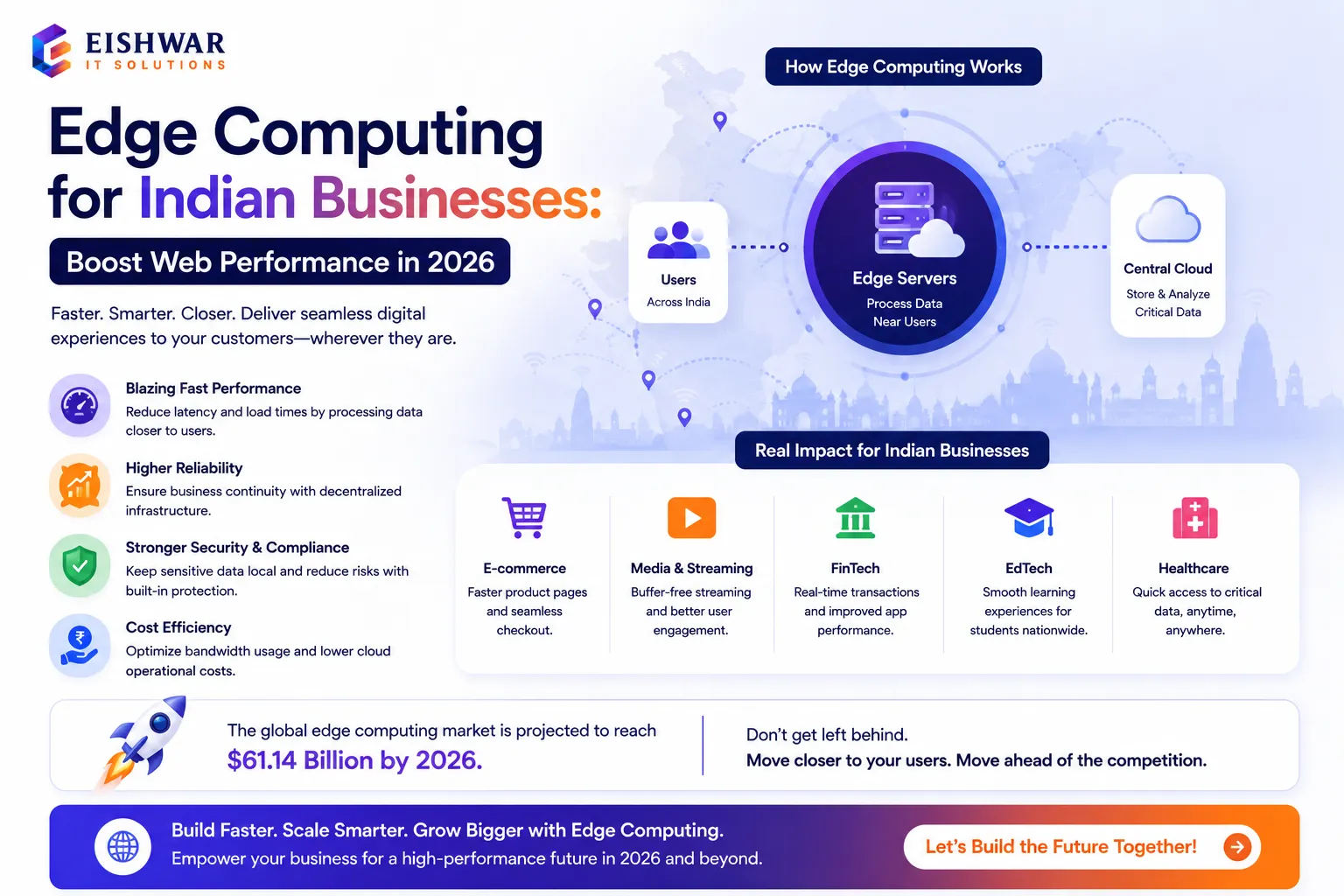
In the fast-paced digital landscape of 2026, every millisecond counts. For Indian businesses, especially those targeting a diverse and geographically dispersed audience, website speed can make or break customer engagement. Edge computing has emerged as a game-changer, moving data processing closer to the user rather than relying on a centralized server. This shift dramatically reduces latency, enhances security, and improves overall web performance. In this comprehensive guide, we will explore how edge computing can benefit Indian businesses, provide actionable tips, and highlight future trends to keep you ahead of the curve.
Learn more about our Website services
Main Section 1: What is Edge Computing and Why It Matters for Indian Businesses
Edge computing is a distributed computing paradigm that brings computation and data storage closer to the sources of data. Instead of sending all requests to a central server (often located in Mumbai or Delhi), edge nodes located across India process data locally. For an Indian business with customers in tier-2 cities like Patna or Coimbatore, this means faster load times and reduced network congestion. In a country where internet infrastructure varies widely, edge computing ensures consistent performance regardless of location.
Key Benefits:
- Reduced Latency: By processing data at the edge, response times drop from hundreds of milliseconds to single digits. For example, a user in Lucknow accessing a Delhi-based server might experience 150ms latency; with an edge node in Kanpur, that drops to under 20ms.
- Improved User Experience: Faster pages lead to higher conversion rates and lower bounce rates. A 100ms improvement can boost e-commerce conversions by 7% (based on industry studies).
- Cost Efficiency: Less bandwidth usage and lower server load reduce operational costs. Edge caching can cut origin server traffic by up to 60%.
- Enhanced Security: Data is processed locally, minimizing exposure during transit. Edge-based Web Application Firewalls (WAF) can block threats before they reach your server.
For example, an e-commerce site based in Bengaluru using edge computing can serve product pages to a user in Guwahati in under 100ms, compared to 300ms+ with a traditional setup. This speed advantage can directly impact sales, especially during high-traffic events like Diwali sales. Consider a scenario where a customer in a rural area with 3G connectivity tries to load a page—edge computing can compress and optimize content on the fly, ensuring a usable experience.
Main Section 2: Practical Implementation for Indian Businesses
Implementing edge computing doesn't require a complete overhaul of your existing infrastructure. Here are practical steps Indian businesses can take:
- Choose an Edge Provider: Options like Cloudflare Workers, AWS Lambda@Edge, or Fastly are popular. For India-specific coverage, consider providers with points of presence (PoPs) in multiple Indian cities. Cloudflare, for instance, has PoPs in Mumbai, Delhi, Chennai, and Bangalore, while AWS has edge locations in Mumbai and Singapore.
- Optimize Static Assets: Use edge caching for images, CSS, and JavaScript files. This reduces load on your origin server. For example, cache product images with long expiry headers and serve them from the edge.
- Dynamic Content at the Edge: Implement serverless functions at edge locations to handle personalization, A/B testing, or API responses. For instance, you can use an edge function to redirect users based on their location—show different festival offers to users in North vs. South India.
- Monitor Performance: Use tools like Google PageSpeed Insights or WebPageTest with Indian server locations to measure improvements. Set up Real User Monitoring (RUM) to track actual user experiences across regions.
- Start Small: Begin with a single page or function, measure the impact, and then scale. A common starting point is moving your global footer or header to an edge function.
Actionable Tip: For a typical Indian business website, start by moving your global footer or header to an edge function. This small change can reduce Time to First Byte (TTFB) by 30%. For example, if your TTFB is currently 500ms, an edge function can bring it down to 350ms, improving Core Web Vitals scores.
👉 Don't wait for the perfect moment; turn your vision into reality today.
Free ConsultationMain Section 3: Edge Computing vs CDN – Clearing the Confusion
Many Indian businesses confuse edge computing with Content Delivery Networks (CDNs). While both aim to improve performance, they are different. A CDN caches static content at edge locations, but edge computing allows you to run code at those locations. For example, a CDN can serve a cached product image, but edge computing can generate a personalized recommendation widget on the fly without hitting the origin server. For Indian businesses needing real-time personalization (e.g., festival offers based on location), edge computing is superior.
When to Use CDN vs Edge:
- CDN: Best for static content like videos, images, and downloadable files. For example, serving a product catalog PDF from a CDN is efficient and low-cost.
- Edge Computing: Ideal for dynamic content, API aggregation, authentication checks, and real-time data processing. For instance, an edge function can validate a user's session token before allowing access to a payment page.
Many modern setups combine both: use CDN for caching and edge computing for logic. This hybrid approach is becoming the gold standard for high-performance websites in India. For example, a news website can cache article pages via CDN but use edge computing to personalize the homepage based on user reading history.
Expert Tips
- Prioritize Mobile Users: With over 70% of Indian internet traffic coming from mobile devices, ensure your edge strategy is optimized for mobile networks. Use edge functions to resize images for mobile screens and reduce data usage.
- Leverage Local ISPs: Partner with edge providers that have direct peering with Indian ISPs like Airtel, Jio, and BSNL to reduce hops. This can cut latency by an additional 10-20ms.
- Use Real User Monitoring (RUM): Collect actual user performance data from different Indian regions to fine-tune your edge configuration. Tools like SpeedCurve or Datadog RUM can help identify bottlenecks.
- Security First: Use edge-based Web Application Firewalls (WAF) to block threats before they reach your origin server. For example, Cloudflare's WAF can block SQL injection attempts at the edge, protecting your database.
- Test During Peak Hours: Indian internet usage spikes during evenings and weekends. Test your edge setup under load to ensure it handles traffic surges, such as during flash sales or cricket match live streams.
Common Mistakes
- Ignoring Cache Invalidation: Failing to properly clear cached content can serve outdated information. Implement proper cache tagging and use purge APIs to invalidate specific content when it changes.
- Over-Engineering: Moving every function to the edge can increase complexity and cost. Start with high-impact, low-complexity tasks like redirects or header modifications.
- Not Considering Data Sovereignty: Ensure edge nodes comply with Indian data localization laws. Some providers may route data outside India, which could violate the DPDP Act 2023. Verify that your provider stores data within India.
- Neglecting Monitoring: Without proper monitoring, you won't know if your edge setup is actually improving performance. Use tools like Datadog or New Relic to track metrics like TTFB, error rates, and cache hit ratios.
- Forgetting Fallbacks: If an edge node fails, your site should gracefully fall back to the origin server. Plan for redundancy by configuring multiple edge nodes or using a failover mechanism.
Future Trends
By 2026, edge computing will become mainstream for Indian businesses. Here are key trends to watch:
👉 Free Website Audit
Get Free Audit- AI at the Edge: Running lightweight AI models on edge nodes for real-time personalization and fraud detection. For example, an e-commerce site can use an edge-based AI model to recommend products based on user behavior without sending data to a central server.
- 5G Integration: With 5G rollout in India, edge computing will enable ultra-low latency applications like AR/VR shopping experiences. A user trying on virtual clothes via AR can get real-time feedback with sub-10ms latency.
- Edge-Native Applications: More startups will build applications specifically designed for edge deployment, bypassing traditional servers entirely. For instance, a real-time chat app could run entirely on edge nodes for instant message delivery.
- Green Edge: Energy-efficient edge nodes will become a selling point for eco-conscious businesses. Providers like Cloudflare are already investing in renewable energy for their edge data centers.
- Federated Edge: Multiple edge providers collaborating to create a seamless, global edge network. This could allow Indian businesses to serve users in remote areas by leveraging a mesh of edge nodes from different providers.
FAQs
1. What is the cost of implementing edge computing for a small Indian business?
2. Can edge computing help with SEO?
3. Is edge computing secure for handling sensitive customer data?
4. Do I need to rewrite my entire website to use edge computing?
5. What are the best edge computing providers for Indian businesses?
6. How does edge computing handle dynamic content like user-specific dashboards?
7. What are the challenges of implementing edge computing in rural India?
Conclusion
Edge computing is no longer a futuristic concept—it's a practical solution for Indian businesses looking to improve web performance, user experience, and competitiveness. By reducing latency, enhancing security, and enabling real-time personalization, edge computing addresses the unique challenges of serving a diverse Indian audience. Start small, measure results, and scale as you see the benefits. The future of web development is at the edge, and now is the time to embrace it.
👉 Free Homepage Demo
Book DemoReady to Supercharge Your Website's Performance?
At EishwarITSolution, we specialize in implementing cutting-edge technologies like edge computing for Indian businesses. Whether you're a startup or an established enterprise, our team can help you optimize your web performance and stay ahead in 2026. Contact us today for a free consultation and performance audit.
CTA
Ready to Supercharge Your Website's Performance? At EishwarITSolution, we specialize in implementing cutting-edge technologies like edge computing for Indian businesses. Whether you're a startup or an established enterprise, our team can help you optimize your web performance and stay ahead in 2026. Contact us today for a free consultation and performance audit.