
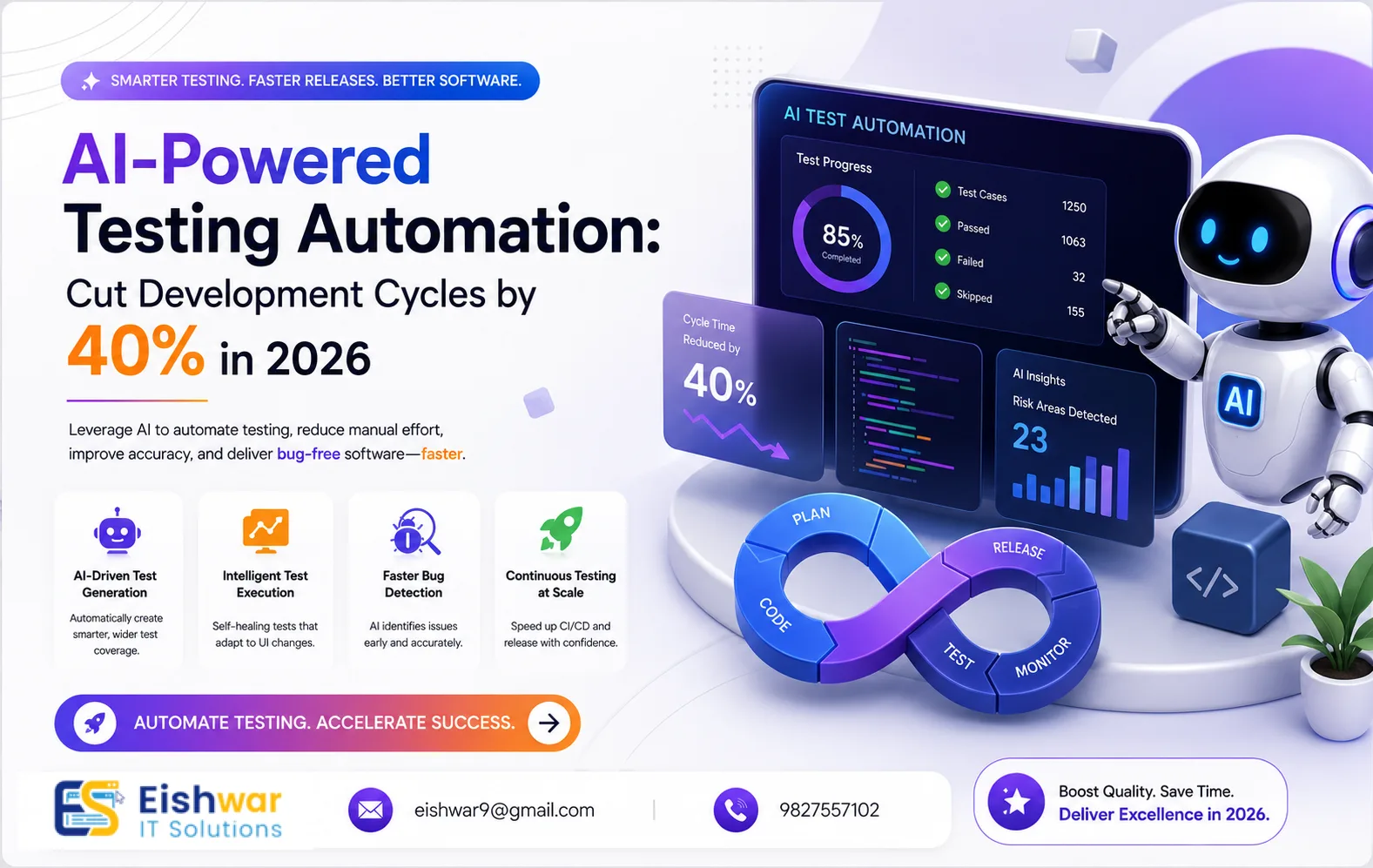
AI-Powered Testing Automation: Cut Development Cycles by 40% in 2026
Published on: 11 Jun 2026
AI-Powered Testing Automation: Slash Development Cycles by 40% for Indian Enterprises
Introduction
In the fast-paced world of web and app development, time is money. For Indian enterprises, especially those serving global clients, every day saved in the development cycle means faster revenue, better customer satisfaction, and a competitive edge. Yet, traditional manual testing remains a bottleneck—slow, error-prone, and resource-heavy. Consider a typical scenario: a mid-sized e-commerce company in Mumbai releases a new feature. Manual testers spend days running regression tests, only to miss a critical bug that surfaces during peak traffic. This not only delays the release but also erodes customer trust. Enter AI-powered testing automation. By 2026, forward-thinking companies are leveraging machine learning and intelligent automation to reduce testing time by up to 40%, while improving accuracy and coverage. In this blog, we explore how AI testing automation works, its benefits for Indian businesses, and actionable steps to implement it today. Whether you're a startup in Bangalore or a large enterprise in Pune, the insights here will help you streamline your QA processes and deliver faster, higher-quality software.
Learn more about our Website services
Main Section 1: What is AI-Powered Testing Automation?
AI-powered testing automation uses machine learning algorithms and natural language processing to automatically generate, execute, and analyze test cases. Unlike traditional automation, which requires manual scripting for each test, AI tools learn from application behavior, past defects, and user interactions to create smarter tests. For instance, tools like Testim, Functionize, and Applitools use AI to detect UI changes, self-heal broken locators, and prioritize high-risk areas. This drastically reduces the effort needed to maintain test suites, especially in agile environments where code changes frequently.
For Indian enterprises, this means your QA team can focus on complex scenarios instead of repetitive regression testing. A Bangalore-based fintech startup we worked with slashed their regression testing from 3 days to 6 hours after adopting AI-driven testing. The key is that AI doesn't just automate—it learns and adapts, making your testing process more resilient. For example, when a UI element like a button's ID changes, traditional automation scripts break and require manual updates. AI tools, however, can automatically detect the change and adjust the test, saving hours of maintenance. Moreover, AI can analyze historical defect data to identify which parts of the application are most prone to failure, allowing teams to focus their efforts where it matters most. This proactive approach not only speeds up testing but also improves overall product quality.
Main Section 2: How Indian Enterprises Are Using AI Testing Automation
Indian businesses across sectors—e-commerce, edtech, healthcare, and banking—are adopting AI testing automation to accelerate releases. For example, a leading Indian e-commerce platform used AI to simulate thousands of user journeys during Diwali sales, catching performance bottlenecks before they impacted customers. They integrated AI testing into their CI/CD pipeline, allowing them to run automated tests on every code commit. This reduced their release cycle from bi-weekly to daily, giving them a significant competitive advantage during the festive season. Another edtech firm automated cross-browser testing across 50+ device configurations, reducing their QA cycle from 2 weeks to 3 days. By using AI to generate test scripts for different browsers and screen sizes, they eliminated the need for manual configuration and testing, freeing up their QA team to focus on more strategic tasks like user experience testing.
👉 Don't wait for the perfect moment; turn your vision into reality today.
Free ConsultationThe approach typically involves three steps: 1) Intelligent test generation using AI to analyze user flows and create test scripts automatically. For instance, AI can record user interactions on a live application and convert them into reusable test cases. 2) Self-healing automation where tests automatically update when UI elements change. This is particularly valuable in agile environments where UI changes are frequent. 3) Predictive analytics that highlight which parts of the application are most likely to fail. By analyzing code changes, defect history, and test results, AI can predict where bugs are likely to occur, allowing teams to prioritize testing efforts. By integrating these into CI/CD pipelines, Indian companies achieve continuous testing without manual intervention. A practical tip: start by automating your most critical user journeys, such as login, checkout, or payment flows. These are high-risk areas where failures can have significant business impact.
Main Section 3: Practical Steps to Implement AI Testing Automation
Ready to start? Here’s a practical roadmap for your business. First, audit your current testing process—identify repetitive, time-consuming tests that can be automated. For example, regression tests, smoke tests, and data validation tests are ideal candidates. Second, choose the right AI testing tool that fits your tech stack (e.g., Selenium-based or codeless platforms). For instance, if your team is comfortable with coding, tools like Testim offer a hybrid approach. If you prefer a codeless solution, consider Functionize or Mabl. Third, start small with a pilot project—pick a high-impact module like user authentication or payment processing, and measure time savings. For example, a Pune-based SaaS company we assisted started by automating their login and payment flows. Within a month, they reduced testing time by 35% and caught 20% more defects. Fourth, train your team on AI concepts and tool usage. Invest in workshops or online courses to ensure your QA engineers understand how to interpret AI outputs and maintain test suites. Finally, scale gradually by integrating AI testing into your CI/CD pipeline. Use tools like Jenkins or GitLab CI to trigger automated tests on every code commit. Remember, AI testing is not a magic bullet—it works best when combined with human expertise for exploratory testing. For new features or complex scenarios, manual testing is still essential to catch edge cases that AI might miss.
Expert Tips
- Start with regression tests—they are repetitive and ideal for AI automation. Automating these can free up 30-40% of your QA team's time.
- Use AI for visual testing to detect pixel-perfect UI differences across devices. Tools like Applitools can compare screenshots and highlight even minor discrepancies, ensuring a consistent user experience.
- Leverage AI-powered test data generation to create realistic, anonymous data sets. This is especially useful for testing scenarios like user registration or payment processing, where real data is sensitive.
- Monitor test results with AI analytics to identify flaky tests and optimize coverage. AI can analyze test run history to pinpoint tests that fail intermittently, allowing you to fix them before they cause false alarms.
- Combine AI with manual testing for new features that require human intuition. For example, usability testing and accessibility testing are best done manually, while AI handles the repetitive checks.
Common Mistakes
- Over-automating everything—AI is not cost-effective for one-time tests. Focus on tests that are run frequently, such as regression and smoke tests.
- Ignoring test maintenance—AI self-healing reduces but doesn't eliminate upkeep. Regularly review and update your test suites to ensure they remain relevant.
- Skipping training—teams need to understand AI outputs to trust them. Invest in training to build confidence and competence.
- Not integrating with CI/CD—manual handoffs kill the speed benefit. Automate test execution as part of your build pipeline to achieve continuous testing.
- Expecting 100% accuracy—AI tests still need human oversight for edge cases. Use AI to augment, not replace, human judgment.
Future Trends
By 2027, AI testing will evolve into autonomous quality engineering, where AI not only tests but also suggests code fixes. We'll see more AI-driven chaos engineering that simulates real-world failures, such as network outages or server crashes, to test system resilience. Additionally, self-healing applications will automatically correct minor bugs, reducing the need for manual intervention. Indian enterprises that adopt AI testing now will be well-positioned to lead in the era of continuous delivery. For example, a forward-thinking Indian bank could use AI to automatically roll back a faulty deployment, minimizing downtime and customer impact. The key is to stay ahead of the curve by experimenting with these technologies today.
👉 Free Website Audit
Get Free AuditFAQs
1. What is AI-powered testing automation?
It uses machine learning to automatically generate, execute, and maintain test cases, reducing manual effort and improving accuracy. AI tools can learn from application behavior and adapt to changes, making testing more efficient.
2. How much time can AI testing save for Indian businesses?
Typically 30-40% reduction in testing cycles, with some companies reporting up to 60% savings after full implementation. The exact savings depend on the complexity of the application and the maturity of the AI implementation.
3. Which AI testing tools are best for Indian enterprises?
Popular options include Testim, Functionize, Applitools, and Mabl. Choose based on your tech stack and budget. For example, Testim is great for teams comfortable with coding, while Mabl offers a codeless experience.
4. Do I need a large QA team to implement AI testing?
No, many codeless AI tools are designed for small teams. Start with a pilot project and scale as you see results. Even a team of 2-3 QA engineers can successfully implement AI testing.
5. Can AI testing replace manual testers?
No, AI complements manual testing. Human testers are still needed for exploratory testing, usability testing, and complex scenarios that require creativity and intuition. AI handles repetitive, data-intensive tasks, freeing up testers for higher-value work.
6. How do I measure the ROI of AI testing automation?
Track metrics like test execution time, defect detection rate, and release frequency. For example, if your testing cycle drops from 2 weeks to 3 days, that's a clear ROI. Also, consider the cost savings from reduced manual effort and fewer production bugs.
👉 Free Homepage Demo
Book Demo7. What are the common challenges in adopting AI testing?
Challenges include tool selection, team training, and integration with existing workflows. Start with a pilot to identify and address these issues early. Also, ensure executive buy-in to secure necessary resources.
Conclusion
AI-powered testing automation is no longer a luxury—it's a necessity for Indian enterprises aiming to stay competitive in 2026. By cutting development cycles by up to 40%, you can launch faster, reduce costs, and improve quality. The key is to start small, choose the right tools, and integrate AI into your existing workflows. At EishwarITSolution, we help businesses like yours implement AI testing strategies that deliver real ROI. Ready to accelerate your development? Take the first step today and see the difference AI can make.
CTA
Ready to slash your development cycles? Contact EishwarITSolution today for a free consultation on AI-powered testing automation tailored to your business. Let's build faster, smarter, and better together. Our experts will work with you to identify the best approach for your unique needs, ensuring a smooth transition to AI-driven testing.