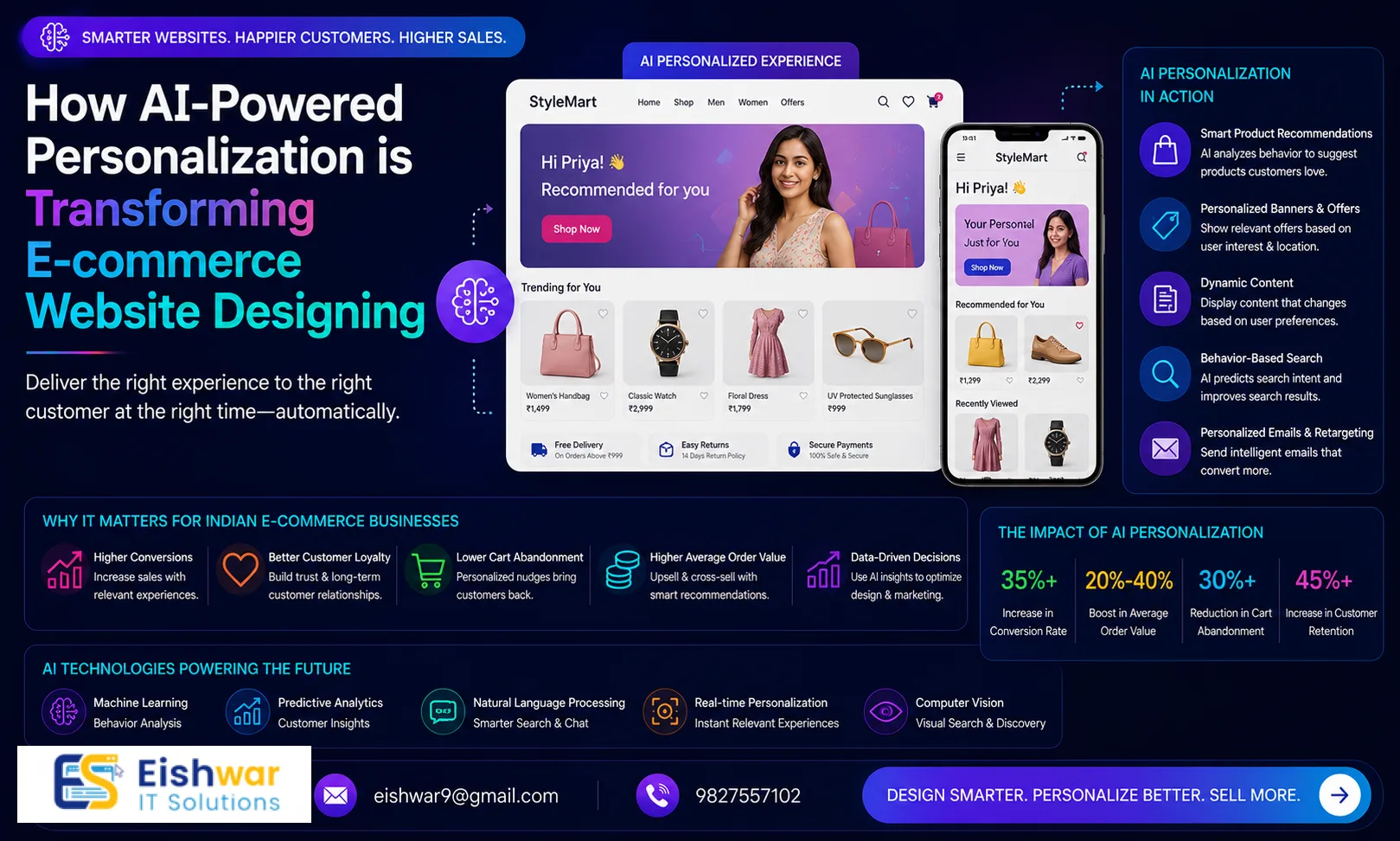
How AI-Powered Personalization is Transforming E-commerce Website Desi
Published on: 12 Jun 2026
How AI-Powered Personalization is Transforming E-commerce Website Design in India
Introduction
Imagine visiting an online store that knows your size, style, and budget before you even type a word. That’s not science fiction—it’s AI-powered personalization. For Indian e-commerce businesses, this technology is no longer optional. With over 800 million internet users and a booming online shopping culture, delivering a generic website experience is like shouting into a crowded market. AI helps you whisper directly to each visitor, making them feel understood and valued.
Learn more about our Website services
At EishwarITSolution, we’ve seen firsthand how AI transforms e-commerce website design. From dynamic product recommendations to predictive search, AI turns static pages into living, breathing sales assistants. In this guide, we’ll explore how you can harness AI to design an e-commerce website that not only looks great but sells smarter.
Main Section 1: The Rise of AI in Indian E-commerce
India’s e-commerce market is projected to reach $200 billion by 2027. With giants like Flipkart and Amazon leading the charge, small and medium businesses must innovate to compete. AI personalization levels the playing field. It uses data—browsing history, purchase patterns, location, even weather—to tailor every user’s journey.
For example, a Delhi-based fashion store can show winter coats to users in Srinagar while displaying summer kurtas to those in Chennai—all in real time. This isn’t just clever; it’s profitable. Personalized experiences can increase conversion rates by up to 30% and average order value by 20%. A practical tip: start by segmenting your audience based on geographic data and browsing behavior using tools like Google Analytics 4. This low-effort approach can yield immediate results without a full AI overhaul.
AI also powers chatbots that handle customer queries 24/7, reducing bounce rates and improving satisfaction. Indian consumers, especially in tier-2 and tier-3 cities, appreciate instant support in their local language. AI-driven multilingual chatbots are bridging that gap beautifully. For instance, a chatbot that switches between Hindi, Tamil, and English can boost engagement by up to 40% in regions where English isn’t the first language.
Main Section 2: Key AI Personalization Features for Your E-commerce Website
To design an AI-powered e-commerce site, focus on these features:
Dynamic Product Recommendations
Instead of a static 'You May Also Like' section, use AI algorithms that analyze real-time behavior. If a user is browsing running shoes, show them matching socks, water bottles, and fitness trackers. Tools like Nosto and Dynamic Yield integrate seamlessly with platforms like Shopify and Magento. A pro tip: use collaborative filtering to recommend products based on what similar users purchased, not just the current user’s history. This can uncover hidden interests and boost cross-sell rates by 15-25%.
Personalized Search and Navigation
AI-powered search understands synonyms, misspellings, and intent. For example, searching 'red saree for wedding' should show festive red sarees, not casual wear. Implement search solutions like Algolia or Elasticsearch to boost discoverability. Add features like autocomplete and faceted filters (e.g., by price, brand, or occasion) to refine results. A real-world example: an Indian jewelry store using AI search saw a 20% increase in add-to-cart rates because users found what they needed faster.
👉 Don't wait for the perfect moment; turn your vision into reality today.
Free ConsultationSmart Pricing and Offers
AI can adjust discounts based on user loyalty, cart value, and browsing history. A first-time visitor might see a 10% welcome discount, while a loyal customer gets early access to a sale. This builds loyalty without leaving money on the table. Use tools like Prisync or Omnia to automate dynamic pricing. However, be cautious: over-discounting can erode margins. Test different thresholds to find the sweet spot.
Behavioral Email and Retargeting
Combine AI with email marketing. If a user abandons a cart, send a personalized reminder with the exact items and a time-limited discount. Tools like Klaviyo and Mailchimp now offer AI-driven segmentation. For example, segment users by browsing frequency—send a “we miss you” email to lapsed customers and a “new arrivals” alert to frequent browsers. This approach can recover 10-15% of abandoned carts.
Main Section 3: How to Implement AI in Your E-commerce Website Design
Ready to get started? Follow these steps:
- Audit Your Current Data: AI thrives on data. Collect user behavior via analytics tools like Google Analytics 4 or Hotjar. Ensure you comply with India’s Data Protection Bill. Start by tracking key metrics: page views, time on site, click paths, and conversion funnels. Clean your data regularly to remove duplicates and errors.
- Choose the Right AI Platform: For small businesses, start with affordable solutions like Wix’s AI tools or Shopify’s AI apps. For larger stores, consider enterprise-grade platforms like Salesforce Einstein or Adobe Sensei. Evaluate based on scalability, integration ease, and cost. A tip: request a demo or trial before committing.
- Redesign with Personalization in Mind: Your website layout should support dynamic content. Use modular design—blocks that change based on user data. For example, a hero banner that shows different products to different users. Implement a content management system (CMS) that allows easy swapping of modules. Tools like Contentful or WordPress with AI plugins can help.
- Test and Optimize: Run A/B tests on personalized vs. generic pages. Measure metrics like click-through rate, time on site, and conversion rate. Iterate based on results. Use tools like Optimizely or VWO for testing. A practical example: test whether showing personalized recommendations on the homepage increases engagement by 10% or more.
- Train Your Team: AI tools are only as good as the people using them. Invest in training for your designers and marketers to interpret AI insights. Conduct workshops on data interpretation and ethical AI use. Encourage cross-team collaboration between data scientists and UX designers.
At EishwarITSolution, we recommend starting small—maybe with product recommendations—and scaling as you see ROI. A phased approach reduces risk and allows you to learn from early wins.
Expert Tips
- Start with First-Party Data: With third-party cookies fading, collect data directly through sign-ups, surveys, and on-site behavior. Use progressive profiling—ask for one piece of information at a time (e.g., email first, then preferences later) to avoid overwhelming users.
- Balance Personalization and Privacy: Be transparent about data use. Offer opt-in options and clear privacy policies. Indian users are becoming privacy-conscious. Display a cookie consent banner that explains how data is used. A good example is the “Manage Preferences” option used by major Indian e-commerce sites.
- Use AI for Content Personalization: Show different blog posts, FAQs, or videos based on user interests. For example, a tech gadget store can show reviews to a researcher and unboxing videos to a casual browser. Implement a recommendation engine for content using tools like Outbrain or Taboola.
- Leverage Social Proof with AI: Display personalized testimonials—show reviews from users with similar demographics or purchase history. For instance, a user from Mumbai might see reviews from other Mumbai buyers. This builds trust and relevance.
- Don’t Forget Mobile: Over 70% of Indian e-commerce traffic comes from mobile. Ensure your AI features work flawlessly on small screens. Optimize for touch interactions, reduce page load times, and use responsive design. Test on various devices and network speeds.
Common Mistakes
- Over-Personalization: Showing too many recommendations can overwhelm users. Keep it simple—3 to 5 suggestions per section. Use A/B testing to find the optimal number.
- Ignoring Data Quality: Garbage in, garbage out. Clean your data regularly to avoid irrelevant recommendations. Set up automated data validation rules.
- Neglecting Load Speed: AI features can slow down your site. Optimize images, use CDN, and consider server-side rendering. Aim for a load time under 3 seconds, as per Google’s Core Web Vitals.
- Forgetting the Human Touch: AI should assist, not replace, human interaction. Keep live chat options for complex queries. Train customer support teams to handle escalations from AI chatbots.
- Copying Competitors Blindly: What works for Amazon may not work for you. Test and tailor AI strategies to your audience. Conduct user research to understand unique preferences.
Future Trends
AI in e-commerce is evolving fast. Look out for:
👉 Free Website Audit
Get Free Audit- Voice Commerce: With smart speakers gaining popularity in India, AI-powered voice search will become essential. Optimize your product data for natural language queries, like “find me a blue kurta under ₹1500.”
- Visual AI: Users can upload a photo of a product and find similar items in your store. Pinterest Lens is a great example. Implement visual search using APIs from Google Vision or Amazon Rekognition.
- Hyper-Personalization: AI will predict future purchases based on life events—like suggesting baby products to a user browsing maternity wear. Use predictive analytics tools like IBM Watson to anticipate needs.
- AR Integration: Augmented reality powered by AI lets users try products virtually—think furniture placement or makeup trials. Platforms like Shopify AR and IKEA Place offer ready-to-use solutions.
- AI-Generated Content: From product descriptions to social media posts, AI will handle routine content creation, freeing up your team for strategy. Tools like Jasper or Copy.ai can generate SEO-friendly descriptions in minutes.
FAQs
What is AI-powered personalization in e-commerce website design?
How does AI personalization improve conversion rates?
Is AI personalization expensive for small Indian businesses?
What data does AI need to personalize effectively?
Can AI personalization work for niche e-commerce stores?
How do I ensure my AI personalization is privacy-compliant in India?
Conclusion
AI-powered personalization is not a luxury—it’s a necessity for Indian e-commerce businesses that want to thrive. By designing a website that adapts to each user, you create a shopping experience that feels personal, intuitive, and trustworthy. The results? Higher conversions, better customer loyalty, and a brand that stands out in a crowded market. The key is to start small, focus on data quality, and continuously optimize based on user feedback.
👉 Free Homepage Demo
Book DemoAt EishwarITSolution, we specialize in building AI-driven e-commerce websites that deliver real results. Whether you’re starting from scratch or upgrading an existing store, our team can help you integrate smart personalization seamlessly. From strategy to implementation, we guide you every step of the way.
CTA
Ready to transform your e-commerce website with AI? Contact EishwarITSolution today for a free consultation. Let’s build a store that knows your customers better than they know themselves. Don’t wait—your competitors are already personalizing. Take the first step toward smarter e-commerce design now.